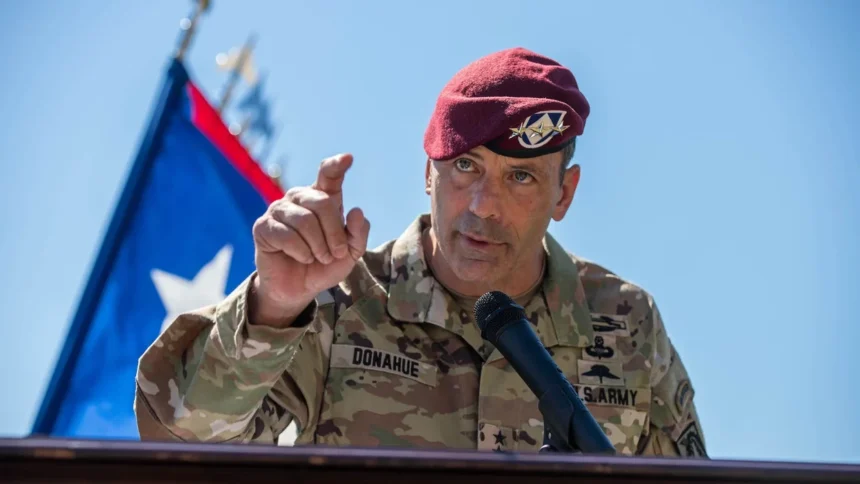
The United States will stand shoulder-to-shoulder with its European allies in defending the Baltic states, the commander of US Army Europe and Africa declared on Tuesday, as NATO establishes a critical second command headquarters in the region to bolster its eastern flank.
Speaking at a ceremony in the Estonian city of Valga, US General Chris Donahue underscored Washington’s concrete commitment to the region’s security.
“You are ready to do more and back up words with actions, and the United States will be right there by your side,” Donahue said. “This is how deterrence is built: Not with words from a podium, but with boots in the mud.“
General Donahue, who is scheduled to step down from his post this Thursday, currently serves as both the commander of NATO’s allied land forces in Europe and the head of the US Army Europe and Africa.
Restructuring NATO’s Command Focus
Historically, NATO troops stationed across the Baltic nations—Lithuania, Latvia, and Estonia—alongside northern Poland, operated under a single multinational headquarters based in the northwestern Polish city of Szczecin.
The strategic creation of a second command zone fundamentally changes this layout:
- More Dedicated Troops: It allows the alliance to allocate a significantly higher concentration of forces specifically to the Baltic states.
- New Command Structure: Moving forward, two multinational divisions operating in Estonia and Latvia will fall under the direct command of the German-Netherlands Corps, based in Muenster, Germany.
Rising Strategic Pressures
The military restructuring comes amid stark warnings from NATO intelligence. The alliance has cautioned that Russia could be capable of launching a large-scale assault on allied territory as early as 2029 if its current pace of militarization continues. The Kremlin has consistently denied having any such plans.
The urgency for Europe to ramp up its own defense capabilities has intensified following repeated criticisms from US President Donald Trump, who has continuously accused European allies of failing to pull their own military weight.