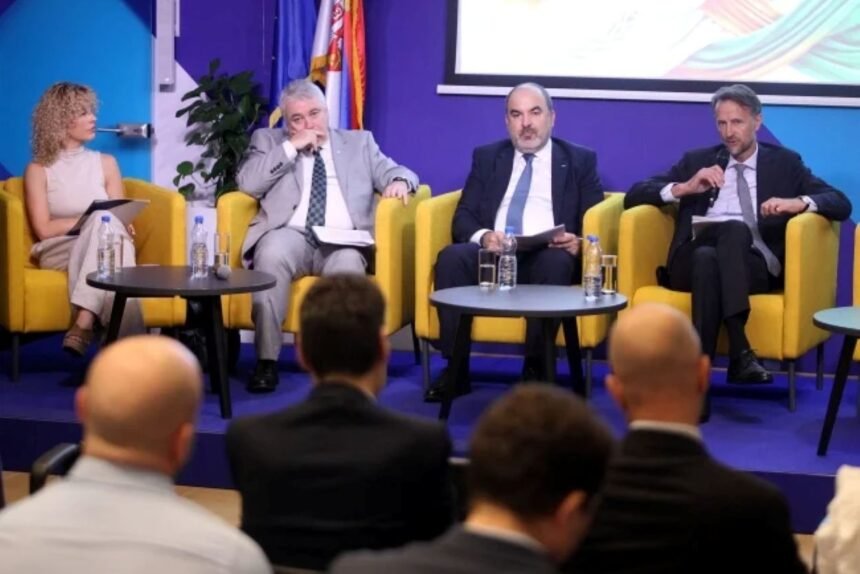
The European Union enlargement process yields substantial benefits for both candidate countries and existing member states, and a strong momentum is currently sweeping Europe to integrate new nations, including Serbia. This was the core assessment shared today in Belgrade by Irish Ambassador Kevin Colgan and Cypriot Ambassador Andreas Fotiou.
The diplomats spoke ahead of the panel discussion “From Cyprus to Ireland: How to Capitalize on the Tivat Summit Results?” The event, organized by the European Policy Centre (CEP) and the EU Delegation to Serbia, marked the conclusion of the Cypriot presidency and the transition to the Irish presidency of the Council of the EU.
Ireland’s Upcoming Presidency: Competitiveness, Values, and Security
Irish Ambassador Kevin Colgan announced that Ireland’s presidency of the Council of the EU will officially begin tomorrow, July 1, 2026, and run through the end of the year. He outlined that Dublin has structured its priorities into three main pillars:
- Competitiveness: Fostering a more competitive business environment across Europe to drive innovation and support ordinary citizens.
- Values: Upholding a project fundamentally rooted in democracy, human rights, equality, and the rule of law.
- Security: Addressing the destabilizing effects of Russia’s invasion of Ukraine and strengthening European resilience against modern security threats.
Ambassador Colgan emphasized that enlargement will be a key priority, drawing on Ireland’s own historical success within the bloc.
“Ireland strongly supports enlargement. As a nation, we gained an immense amount from EU membership. We transformed from one of the poorest countries in Europe into one of the most developed and successful,” Colgan noted.
Cyprus Reflects on a Turbulent but Productive Term
Reflecting on his country’s tenure, Cypriot Ambassador Andreas Fotiou noted that Cyprus steered the EU Council during a highly turbulent geopolitical period, dominated by the war in Ukraine and regional conflicts.
Despite these hurdles, Fotiou highlighted concrete progress in accession negotiations with several candidate countries, including Ukraine, Moldova, Montenegro, Albania, and Serbia. He also pointed to regional milestones, such as reaching a consensus to initiate negotiations on the “Roam like at home” program for the Western Balkans.
“Cyprus is a very close friend of Serbia and fully supports its EU accession process,” Fotiou concluded.
Geopolitical Imperatives and the Western Balkans
The Head of the EU Delegation to Serbia, Andreas von Bekkerat, pointed out that the recent Tivat Summit and a surge in diplomatic non-papers underscore a clear shift in EU priorities.
“Because of geopolitical realities like the war in Ukraine, the EU must expand to become stronger and more competitive on the global stage,” von Bekkerat stated. He contrasted the current climate with the stagnation of a decade ago, noting that the mutual commitment to real reform and enlargement is now genuine.
“Serbia has all the potential to catch up with Albania and Montenegro as the wealthiest economy in the region, provided that political will and momentum align,” von Bekkerat added. He emphasized that the ultimate success of enlargement depends on clearly communicating its mutual benefits to both Serbian citizens and EU member-state electorates.
Technical Conditions vs. Democratic Fundamentals
While acknowledging the momentum, Srđan Majstorović, Chairman of the CEP Governing Board, offered a more critical perspective on Belgrade’s recent progress. He remarked that while the outgoing Cypriot presidency did an excellent job pushing enlargement policy forward, “Serbia was a loser in this race” by failing to make any formal, technical steps forward during the past six months.
While there is growing speculation that an internal EU consensus may soon be reached to open Cluster 3 (Competitiveness and Inclusive Growth) for Serbia, Majstorović stressed that technical compliance is only part of the equation.
“Nobody disputes that the Serbian Government has met the technical conditions to open Cluster 3,” Majstorović concluded. “However, making true progress in European integration requires far more—it demands prerequisites concerning democratic institutions, a free public sphere, media freedom, and the adequate application of the rule of law.”