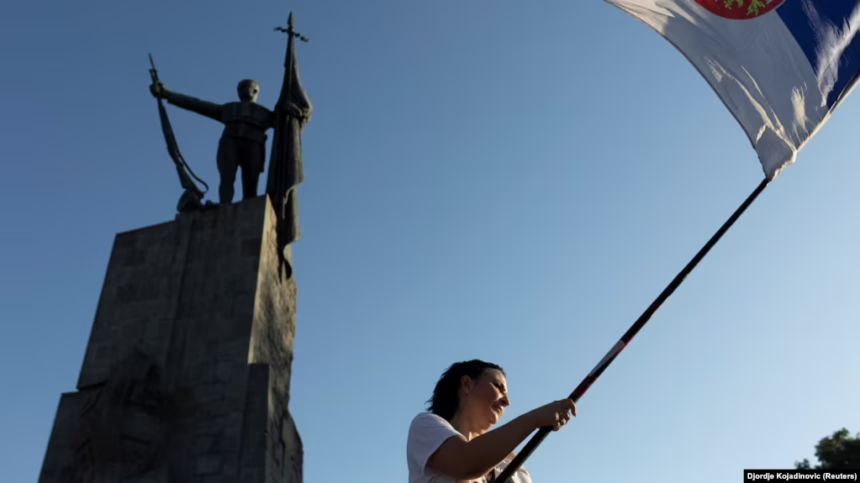
A striking political transformation unfolded in the streets of Kraljevo during the annual Vidovdan commemorations. What began nearly two years ago as a fierce civil rights movement demanding accountability for state corruption—symbolized by the phrase “your hands are bloody” following the tragic Novi Sad railway canopy collapse—has taken a sharp ideological turn.
At an anti-government rally organized by the umbrella student protest movement “Students in Opposition” (Studenti u blokadi), local grievances were completely overshadowed by booming nationalist epic poetry played on traditional gusle instruments and radical messages declaring “no surrender of Kosovo.”
From Anti-Corruption to Rigid Nationalism: The Vidovdan Shift
Kraljevo, a central Serbian city located roughly 100 kilometers from the border, historically served as a primary sanctuary for thousands of Serb refugees fleeing the 1999 war. At this latest rally, speakers from Kosovo took the stage to fiercely condemn Prime Minister Albin Kurti’s administration in Prishtina for integrating parallel Serbian institutions into the Kosovar system—labeling the process the “systemic erasure of Serbs.”
Simultaneously, speakers turned their fury onto official Belgrade, demanding that President Aleksandar Vučić launch harsh reciprocal, state-level sanctions against ethnic Albanians inside Serbia.
The political tone was amplified by independent Member of Parliament Jelena Pavlović, a Belgrade attorney formerly aligned with the ultra-right, pro-Russian, conspiracy-driven parliamentary movement “We, the Power of the People” led by Branimir Nestorović. Pavlović delivered a scathing rebuke of Belgrade’s current foreign policy to the gathered crowd:
MP Jelena Pavlović: “This nation will never forgive you for the Brussels Agreement, the Washington Agreement, the Franco-German plan, and the Ohrid Agreement—which represent the shameful surrender of Kosovo, the very foundation of the national, cultural, and spiritual identity of the Serbian people.”
Strategic Counter-Defense or Authentic Conviction?
The student movement’s hard-right shift has triggered a intense debate among its progressive civil society supporters. Initially, the movement gained international respect by staging grueling marathons and cycling treks to Strasbourg and Brussels to brief European institutions on democratic deficits and media capture in Serbia.
However, the recent release of a formal student “Memorandum” explicitly defining Kosovo as an inseparable part of Serbia has complicated their international standing. Kurt Bassuener, a senior international analyst at the Democratization Policy Council (DPC) in Berlin, argues that while genuine nationalist sentiments exist among the youth, the shift is primarily a defensive tactical maneuver:
Kurt Bassuener: “Kosovo is not what drove people into the streets in November 2024. Although nationalist symbolism has become increasingly visible in protests, it was rarely in the foreground. The government and pro-regime tabloids consistently portray these students as foreign mercenaries, traitors, and even ‘Ustaše.’ The students feel a tactical need to continuously prove their ‘patriotic’ credibility to the general public.”
Bassuener compared this maneuver to the strategy used in 2000, when the Democratic Opposition of Serbia (DOS) selected the conservative nationalist Vojislav Koštunica to lead the ticket to unseat Slobodan Milošević without being labeled Western puppets.
The Consequences: Trapped in the Past
Despite the tactical intentions, international observers warn that weaponizing the Kosovo narrative is highly counterproductive for the opposition’s long-term goals.
- Entrenching EU Support for Vučić: By shouting down Western-mediated normalization deals like the Ohrid Agreement, the opposition inadvertently reinforces a growing consensus within Brussels. Bassuener revealed that an EU member state official recently confided that “there is no sustainable alternative” to Aleksandar Vučić in Serbian politics. Terrified of regional instability, risk-averse EU governments will continue supporting the current regime if the only viable alternative is an even more radical, backward-looking nationalist front.
- Eroding Regional Solidarity: Embracing hardline nationalism actively breaks cross-regional alliances within Serbia. The student movement had previously built deep ties and mutual solidarity with minority youth in multi-ethnic municipalities like Novi Pazar. Forcing an absolute stance on Kosovo effectively alienates these vital demographics.
While normal progress toward EU integration demands that Serbia uphold the rule of law, liberate its media, and sanction Russia, the scenes from Kraljevo indicate that the anti-Vučić opposition remains fundamentally trapped in historical loops—undermining their own struggle for a democratic future.