“I told myself: ‘I have postponed confronting the truth for far too long, including what I saw 26 years ago.’ I decided to go to the Jashari complex. I arrived there. I could not find the strength to get out of the car, I had no strength, and I burst into tears because I saw those scenes.”
This is how Ilire Zajmi recalls her attempt to confront the trauma of war reporting, while tears continue to run down her face as she pauses for a moment to regain herself and continue her testimony.
During the war in Kosovo, journalists were among the first witnesses to violence, displacement, and the human consequences of the conflict. While documenting events in the field and informing the public, many were repeatedly exposed to traumatic situations that left lasting consequences even after the war ended.
However, the impact of this experience on journalists’ mental health has remained a largely underexplored topic, often silenced by social stigma and the lack of public discussion on psychological trauma.
In 1999, Ilire Zajmi was 28 years old and worked as a journalist for both local and international media in Kosovo.
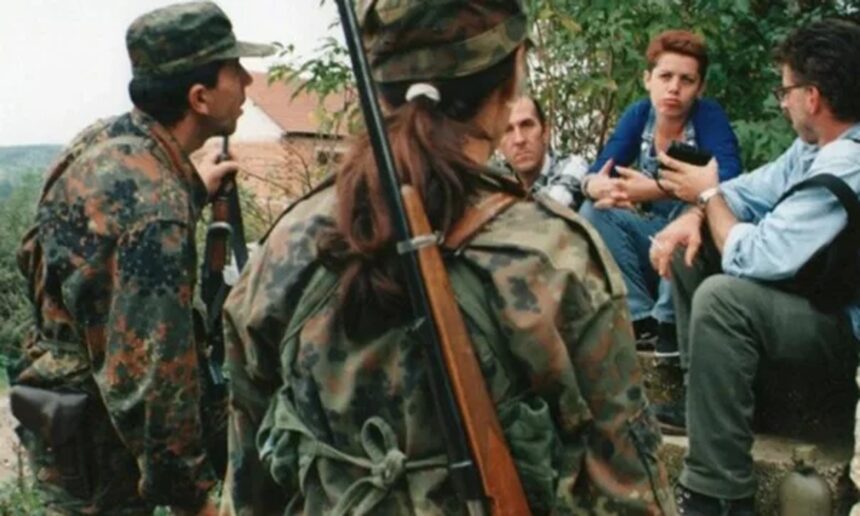
A young journalist, unprepared for what awaited her in the field, Ilire Zajmi, together with other colleagues, began traveling to different parts of Kosovo to document and report on massacres, killings, expulsions, and the burning of villages by Serbian security forces.
She first went into the field during the fighting in Drenica in 1998.
“In some villages of Drenica, we had heard there was fighting. I remember for the first time I started trembling. I felt something and said to myself: ‘Oh God, am I okay, why did I come here?’ That was my first traumatic experience when I heard the gunfire and the fighting,” Zajmi said.
The experiences she lived through during the war in Kosovo in 1998–1999, Zajmi says, still remain vivid today and continue to affect her.
“Among the biggest consequences I still have today is when we went to Prekaz. Even today I suffer from it. We went there and saw the entire Serbian apparatus pulling the victims of the Jashari family out of a large pit where they had been thrown,” Zajmi explained, describing the moment she witnessed the bodies of the Jashari family within a perimeter of about 100 meters.
As she recalls, it took her days to process and overcome what she had seen.
“Whenever I tried to sleep, those scenes kept replaying in my mind,” Zajmi remembers, noting that at the time she was accompanied by a colleague from the magazine “Kosovarja” and an Italian journalist from “La Repubblica.”
In addition to what she witnessed regarding the Jashari family, Zajmi also recalls the Rogova massacre in Has.
“The police entered at 6 a.m., took people from their bedrooms, killed and mutilated them, and dressed them in KLA uniforms, placing weapons beside them—so they staged the entire scene,” Zajmi said.
She emphasizes that the memories from 27 years ago remain vivid and that they return to her mind from time to time.
All these memories, traumas, and feelings from her wartime reporting, Zajmi says she has discussed with colleagues, but she has never received professional psychological treatment.
Musa Kurhasku, who at the time was a journalist reporting for Radio Television of Albania, also covered massacres and killings in the Dukagjin region during the war, including cases involving his own relatives.
During the war in 1999, Kurhasku did not personally report on his brother’s killing by Serbian forces.
“I assigned a colleague of mine, a friend; I did not report it myself—not because I couldn’t cope, but because it felt unbelievable, I couldn’t even believe it myself, because we had a very close bond,” Kurhasku recalls.
He also remembers the years before NATO’s bombing campaign, saying there were many situations that still remain in his mind today.
“Until the day the war ended and even after the war, we kept reporting, because many things continued to happen and we witnessed them even after the war. I happened to be at the Loxha massacre, and to be honest, for two or three months I could not get the smell of death, of corpses, out of my mind,” he says.
Although 27 years have passed since the end of the war in Kosovo, Kurhasku says those experiences still follow him.
“You carry those experiences even when you meet the families of victims of the killed. Every time I go to massacre commemorations, I relive them again, I remember what we saw and reported during the war,” he explains.
Ridvan Slivova is a photojournalist who documented, through photography, the violence and repressive system of the Serbian regime in Kosovo. He began photography at a young age, initially focusing on artistic images.
In 1990, he produced his first professional journalistic photographs when the deputies of the time declared Kosovo a Republic.
He recalls constantly witnessing painful scenes, but the first photograph of a victim remains one of the most difficult.
“When the army arrived at that time and brought the news, I immediately went out. That was the first photograph of a corpse I took. My photo was published in several newspapers, including in Slovenia, and when it was published 80 days later, they sent me the newspaper, and only then did I understand that what I was doing was historical documentation,” Slivova explains.
After that, he reported from villages in Drenica: Prekaz, Polac, Klinë, and Qirez.
“We often had extremely dangerous situations where I myself did not know whether I would be able to go into the field the next day,” he says.
The column of Gollak remains in his memory.
“It was a column of victims from Gollak in Prishtina. I have visited 90 percent of the places I photographed. Memories come back immediately, but now it feels different—I only feel the sense of freedom. When I see the camera I now carry openly, I remember that during the war we had to hide it so as not to be discovered by Serbian police,” Slivova adds.
He says that immediately after the war he sought psychological help from a friend.
“I had collected around 200 photographs of massacres and persecutions. Through long conversations, I tried to process the trauma together with him (a psychologist friend),” he says.
Gresa Miftari is a clinical psychologist. She links the experiences of journalists who report from conflict and war zones to post-traumatic stress disorder (PTSD), anxiety, depression, and secondary trauma.
Miftari also explains why, after the war, there was little focus on mental health treatment, including for journalists.
“After the war, as a society, we focused more on economic and institutional reconstruction, while mental health was not a topic widely discussed publicly. We also did not have well-established services for treatment or awareness. The first trauma therapy professionals appeared only in the late 2000s, years after people, including journalists, had already been living with silent pain,” she explains.
According to her, support for mental health treatment, both in the past and today, has largely come from non-governmental organizations and individual initiatives.
“This is also related to the limited resources we had as a transitioning state, as well as the lack of knowledge and appropriate approaches,” Miftari emphasizes.