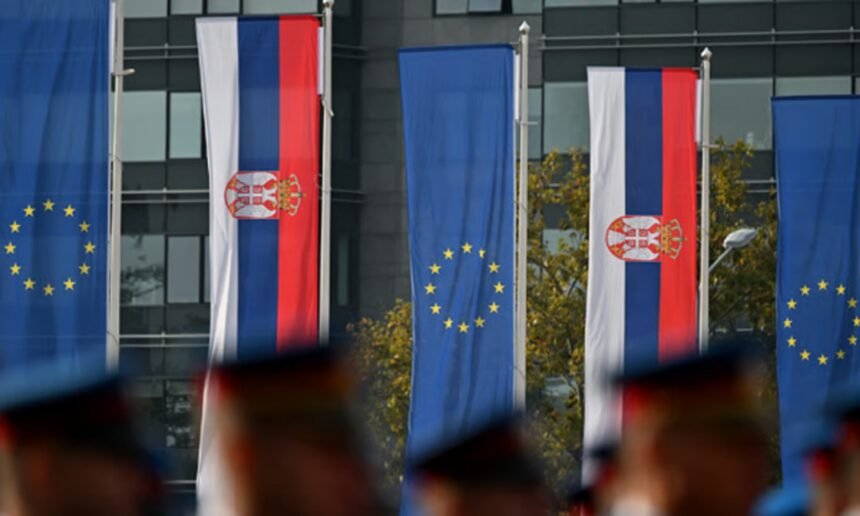
Serbia has suffered a major setback in its efforts to join the European Union after EU ambassadors meeting in Brussels on Wednesday failed to reach unanimity on advancing the country’s accession process.
Eight of the EU’s 27 member states opposed the opening of Cluster 3, which focuses on competitiveness and inclusive growth, during the meeting of EU ambassadors, according to diplomats who spoke to Euronews.
The countries opposing the opening of Cluster 3 are: the Netherlands, Sweden, Finland, Belgium, Estonia, Lithuania, Bulgaria, and Croatia.
Three other countries Denmark, Luxembourg, and Latvia did not fully oppose the move but remain unconvinced. France remains among the strongest supporters of Serbia’s EU membership path.
French President Emmanuel Macron has previously stated that the European Union needs a strong and democratic Serbia as a partner.
Countries supporting Serbia argue that further isolation of the Western Balkan state could have negative consequences and that its reform efforts should be rewarded.
“Double standards” accusations
Serbia officially applied for EU membership in 2009 and received candidate status in 2012. So far, 22 negotiating chapters have been opened, while two have been temporarily closed.
The opening or closing of any negotiation chapter requires unanimous approval from all 27 EU member states. Clusters represent groups of negotiation chapters covering different areas of EU legislation and policies.
Former Serbian Prime Minister Ana Brnabić rejected claims that Serbia is aligned with Russia, telling Euronews that Serbia has supported Ukraine since the beginning of Russia’s full-scale invasion, while accusing the EU of applying “double standards” in the accession process.
A European Commission spokesperson told Euronews that a document explaining why the Commission believes Serbia’s recent steps justify opening Cluster 3 had been shared with member states.
According to the document, Serbia has implemented a significant portion of commitments aimed at addressing concerns raised by EU countries, including the withdrawal of controversial judicial reforms, as well as progress in media freedom, electoral reform, and cooperation with the EU on foreign and security policy.
Although Serbia has not aligned itself with EU sanctions against Russia over the war in Ukraine, the Commission noted that Belgrade has cooperated in preventing sanctions evasion, provided support to Ukraine, and increased political contacts with Kyiv.
However, the document acknowledges that Serbia’s work remains incomplete, stating that “further work is needed” in judicial and prosecutorial reforms.
Concerns over rule of law and Russia ties
The Wednesday meeting was held to determine whether EU member states shared the Commission’s positive assessment.
An EU diplomat told Euronews, under condition of anonymity, that the opposition from eight countries was mainly linked to concerns over Serbia’s rule of law record and its failure to align with EU sanctions against Russia.
Another diplomat said some member states agreed with the Commission’s assessment, believing Serbia had either fulfilled or was close to fulfilling the criteria for opening Cluster 3.
Several senior EU officials have publicly supported opening the cluster, especially after Serbian President Aleksandar Vučić withdrew controversial judicial law amendments in June following recommendations from the Venice Commission.
European Commissioner for Enlargement Marta Kos has been among the strongest supporters of the move.
“In light of several recent positive developments, the Commission has renewed its recommendation to the Council to open Cluster 3 in Serbia’s accession negotiations,” Kos said.
European Parliament calls for reforms
On Wednesday, the European Parliament overwhelmingly approved its 2025 enlargement report on Serbia, with 468 votes in favour, 116 against, and 79 abstentions.
The report recommends electoral reforms, strengthening judicial independence, and fighting corruption. It also states that Cluster 3 is technically ready to be opened.
Croatian MEP Tonino Picula, the rapporteur for the report, said after the vote that Serbia’s situation has deteriorated in recent years.
According to him, reforms have stalled and their pace has slowed.
“While the European Union is experiencing new enlargement momentum, with Montenegro and Albania advancing in accession negotiations, EU-related reforms in Serbia have stalled in key areas, especially regarding the rule of law and democratic standards,” Picula said.
Asked why the European Parliament’s position differs from the Commission’s recommendation, Picula expressed surprise.
“Our report is based on the Commission’s own assessments and findings. Therefore, it is unclear to us where the Commission sees this progress,” he said.
Following the publication of the report, Serbian President Aleksandar Vučić defended Serbia’s readiness to implement reforms.
“We must take into account all remarks and all requirements of the European Union,” Vučić said, adding that “Serbia is fully committed to its European path and will continue to pursue it seriously and responsibly.”