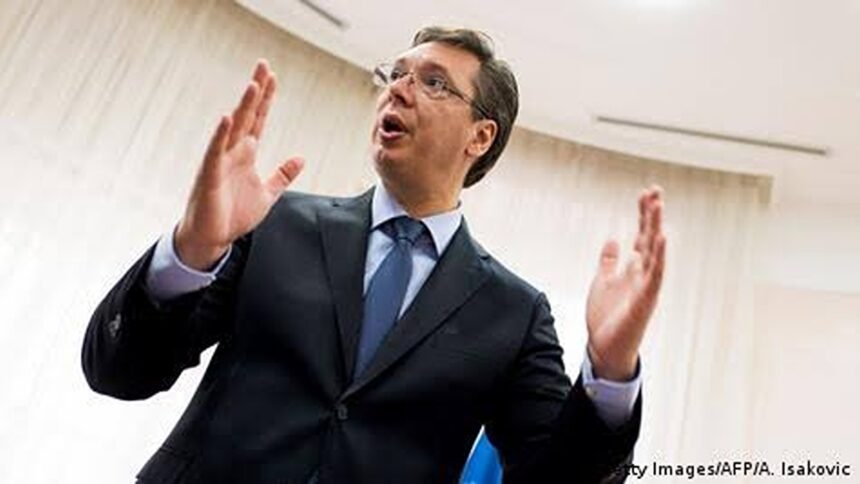
Serbian President Aleksandar Vučić has once again placed Kosovo at the center of his political messaging as Serbia moves toward anticipated early parliamentary elections, reviving one of the country’s most politically charged nationalist themes.
Speaking at a rally in Užice under the slogan “United Serbia,” Vučić returned to the Kosovo issue toward the end of a speech lasting more than 24 minutes.
“If they haven’t heard me from abroad, Kosovo is Serbia. It was, is and will be,” Vučić said, directing his message both at domestic supporters and what appeared to be an international audience.
His remarks came amid growing political pressure on his ruling camp and increasing attention to Serbia’s student-led political movement, which has emerged as a significant challenge to Vučić’s political dominance.
The timing of the Kosovo rhetoric has drawn particular attention. With parliamentary elections expected in October, Vučić has intensified his public appearances and political messaging, while Kosovo has once again featured prominently in his nationalist appeals.
The Serbian president has suggested that early parliamentary elections could be held on either October 18 or October 25.
Students ahead of Vučić in BIRODI model
The latest electoral analysis published by the Bureau for Social Research (BIRODI) indicates that the political landscape could be considerably more difficult for Vučić than in previous elections.
According to BIRODI’s central scenario, a student-backed electoral list could receive 48.5 percent of the vote, compared with 38.6 percent for the SNS–Aleksandar Vučić list. The Socialist Party of Serbia (SPS), led by Ivica Dačić, is estimated at 3.9 percent.
The model estimates approximately 2.003 million votes for the student list and around 1.593 million for Vučić’s list. Even if SNS and SPS were combined, their estimated 42.5 percent would remain below the student list’s projected result.
BIRODI projects a possible range of 45.9–51.1 percent for the student list and 36.3–40.9 percent for the SNS–Vučić list.
However, BIRODI has stressed that this is not a conventional opinion poll or a definitive election forecast. It is an analytical model based on previous election results, available public-opinion research and demographic changes, with turnout and other variables incorporated into its calculations.
Kosovo remains a central political message
Against this backdrop, Vučić’s renewed emphasis on Kosovo can be viewed as part of a broader nationalist political narrative that has long played a central role in Serbian politics.
His statement in Užice was accompanied by a message aimed at unspecified actors “from abroad,” reinforcing the familiar framing of Kosovo as both a national question and a point of confrontation with international actors.
The speech also included economic and social promises, suggesting that Vučić’s campaign messaging is combining domestic policy issues with nationalist themes as the prospect of early elections draws closer.
For Vučić, Kosovo remains one of the most powerful political symbols available to his government. But the latest BIRODI model suggests that nationalist messaging alone may not be enough to prevent a growing electoral challenge from the student movement.
If the model’s central scenario were reflected at the ballot box, the result would represent a significant shift in Serbia’s political landscape — placing a student-backed movement ahead of the political force associated with Vučić.
For now, however, the figures remain a scenario rather than an election result. The decisive test will come when Serbian voters actually go to the polls.