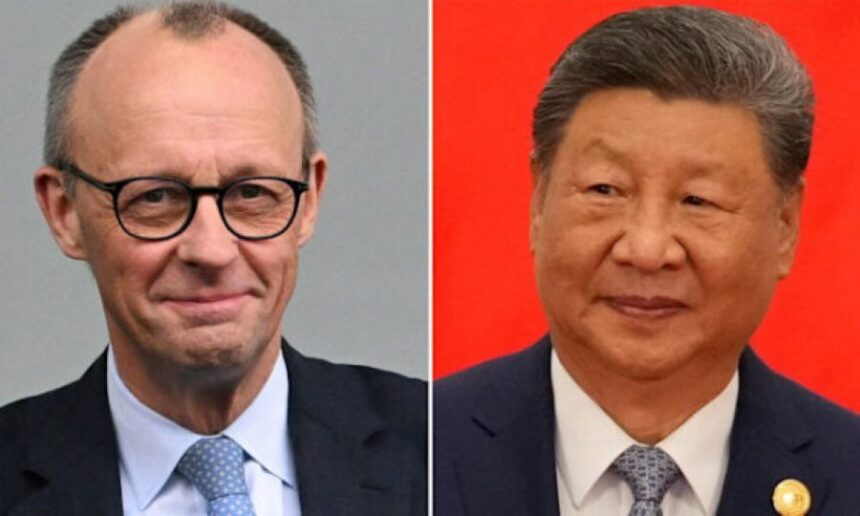
Chancellor Friedrich Merz has embarked on his first visit to China during his term, navigating the delicate balance of partner and competitor in economic relations. The trip comes amid growing concerns over Germany’s reliance on Chinese supply chains and increasing trade frictions.
China remains Germany’s second-largest trading partner after the United States, though a significant trade deficit persists. According to the German Economic Institute (IW), in 2025 imports from China exceeded exports by approximately €90 billion, marking a one-third increase compared to the previous year. Meanwhile, German exports to China fell by nearly 10%, dropping China to the sixth-largest export market for German goods.
Supply Chain Pressures and Competition
Jürgen Matthes of IW described the situation as a “shock,” noting that slowing exports to China are hampering Germany’s export sector, while the rising influx of Chinese imports increases competitive pressure on domestic industries.
The German Chamber of Industry and Commerce (DIHK) highlighted in its latest survey that Chinese suppliers have become serious competitors across key German industrial sectors. Germany primarily imports electronics, batteries, machinery, textiles, and chemicals from China, while vehicles, machinery, and chemical products remain its main exports.
Strategic Importance of China
For German companies, China is crucial, especially amid global economic uncertainty. Since the COVID-19 pandemic, automotive manufacturers have localized R&D in China to remain competitive and tailor products for local consumers. In 2025, German companies invested roughly €7 billion in China, a marked increase from previous years, according to IW data based on Deutsche Bundesbank figures.
Rising Challenges
German firms continue to face market access difficulties, opaque regulations, and state-favored competition, along with export restrictions on key raw materials. Long delays, processing times, and supply chain uncertainties particularly affect small and medium enterprises (SMEs).
Dependency on Critical Materials
The German automotive, defense, and renewable energy sectors are heavily reliant on Chinese suppliers, especially for battery production. China dominates over 90% of global rare earth processing, vital for smartphones, laptops, wind turbines, and electric motors. Since April 2025, China has restricted rare earth exports, leaving German companies with limited allocations and little ability to stockpile supplies, creating production risks across industries.
Calls for Risk Mitigation
Experts stress that Germany and Europe must reduce dependency on China to avoid higher future costs. The “risk removal” strategy, initiated in 2023 to diversify supply chains and mitigate dependence, has struggled to achieve its goals. Matthes noted that many companies remain overly reliant on critical imports, and detailed risk assessments are necessary to address these vulnerabilities.
Expectations for Merz’s Visit
The visit arrives at a critical moment. DIHK President Peter Adrian emphasized that beyond ensuring a level playing field in trade and investment, Germany must push for transparent and rule-based export controls, streamlined approval processes, and predictable supply chain regulations to safeguard its industrial base.