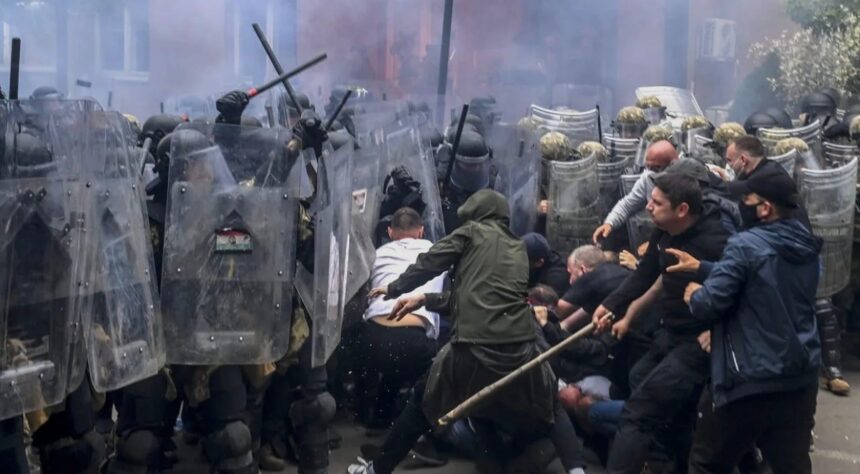
On that day, violent Serbian protesters clashed with KFOR troops after the Serbian community, in full coordination with the Serb List party and with direct political and operational support from Belgrade, boycotted the April local elections.
Three years after the terrorist attack against KFOR peacekeeping troops in Zveçan, the events of 29 May 2023 remain among the gravest episodes of destabilization in the Western Balkans since Kosova declared independence. What was initially presented by Belgrade as a “spontaneous protest by local Serbs” gradually took on an entirely different meaning. Facts, arrests, and subsequent developments revealed an organized, coordinated operation backed by criminal and political networks closely tied to the Serbian government, involving intelligence structures and receiving ideological support from segments of the Serbian Orthodox Church.
The attack on NATO soldiers was not a random outburst of anger in the streets of the north of Kosova. It represented a direct challenge to the Euro-Atlantic presence in Kosova and an organized attempt to create new tensions in the region at a time when Aleksandar Vučić’s Serbia continued to use the north of Kosova as an instrument of political and geopolitical pressure.
On that day, violent Serbian protesters clashed with KFOR troops after the Serbian community, in full coordination with the Serb List party and with direct political and operational support from Belgrade, boycotted the April local elections. As a result, Kosova’s institutions, acting in accordance with the constitutional and legal order, decided that the elected Albanian mayors of Zveçan, Leposaviq, Zubin Potok, and North Mitrovica should begin exercising their official duties. The scenes from that day were shocking, with organized crowds attacking NATO soldiers using explosive devices, stones, metal rods, Molotov cocktails, and firearms. KFOR confirmed that Italian and Hungarian soldiers had been subjected to “unprovoked attacks.”
The consequences of the assault were alarming. More than 30 KFOR members were injured, while one Hungarian soldier lost his leg due to wounds sustained during the clashes. For NATO, this represented one of the most serious security challenges in more than a decade, while for Kosova it constituted clear evidence that paramilitary and criminal structures linked to Belgrade had moved beyond political tensions and barricades into open terrorist actions against international forces.
At the center of these developments stands the name of Milan Radoičić, once the most powerful criminal and political figure in the north of Kosova and long regarded as Belgrade’s key operative for controlling parallel Serbian structures. Radoičić was not a marginal figure or an isolated local actor. He built and controlled networks that intertwined smuggling, political intimidation, and informal security structures in the north of Kosova. As the former vice-president of the Serbian List, Radoičić operated as a direct extension of Vučić’s policies in Kosova, supported logistically by the Serbian Intelligence Agency (BIA) and supported morally and ideologically by the Serbian Orthodox Church.
Later, following the terrorist attack in Banjskë in September 2023, he publicly admitted involvement in organizing the armed group responsible for killing the Kosova Police sergeant and national hero Afrim Bunjaku. This admission ultimately destroyed Belgrade’s narrative that violence in the north was the product of spontaneous dissatisfaction among local citizens. On the contrary, Radoičić confirmed the existence of an organized infrastructure operating with political and logistical support from Serbia.
The attacks in Zveçan and Banjskë cannot be viewed separately because they are part of the same political and operational project. Both rely on the same architecture of violence: criminal networks linked to the Serbian state, nationalist propaganda, coordination by Serbian intelligence services, and ideological mobilization through the Serbian Orthodox Church. This is no longer merely a local security issue in the north of Kosova; it is a broader destabilization strategy aimed at preserving Serbian influence and challenging the Western presence in the region. These two events represented direct escalations intended to create a situation similar to Crimea, where Serb-majority areas in Kosova could be forcibly detached. That strategy failed due to the swift and professional response of the Kosova Police, the Kosova Intelligence Agency, and the clear stance of Kosova’s state institutions.
The role of the Serbian Orthodox Church, supported by Moscow, in this process was deeply concerning, as segments of it transformed themselves into spokespersons for radical Serbian nationalism. The rhetoric used by senior church figures helped construct the narrative that the north of Kosova is “occupied territory,” while local institutions and NATO’s presence were portrayed as threats to local Serbs. It is precisely this language that creates a climate in which violence against KFOR can be justified as “national defense.”
During such crises in the north of Kosova, religious facilities and structures linked to the Serbian Orthodox Church were allegedly used as mobilization points and logistical support hubs for radical Serbian groups. This pattern was clearly visible during the Banjskë attack, when the armed Serbian group barricaded itself inside a monastery. Although the Church denied “direct involvement,” the presence of armed groups within spaces connected to religious institutions raised serious questions about the relationship between religious nationalism and Serbian paramilitary structures.
At the same time, Serbian intelligence services played a key role in creating crises in the north of Kosova. The BIA and related security structures spent years building a system of control over the Serbian community, not only through political influence exercised via the Serb List, but also through fear, economic blackmail, and ties to criminal groups. The protests of 2023 were not spontaneous; they displayed clear organization, logistical capacity, and operational coordination. The explosive devices, methods of crowd mobilization, and tactics used against KFOR demonstrated a level of preparation far beyond any form of civilian protest.
NATO itself described the crowd as “violent and dangerous,” while KFOR confirmed that its troops had been attacked by organized aggressive elements. This diplomatic language conceals a far harsher reality: soldiers of the North Atlantic Treaty faced structures operating according to the logic of paramilitary militias.
President Vučić continues to play a double game. To the West, he presents himself as a partner in stability and a leader of dialogue, while domestically, for the nationalist public in Serbia, he fuels narratives of victimhood and protects radical structures in the north of Kosova. This duality lies at the core of his political strategy. He has no genuine interest in full stability in the north because controlled tension serves as an instrument of pressure against the European Union and NATO.
After the attack of 29 May, Serbia took no serious steps against those responsible for organizing the violence. On the contrary, many figures involved continued to move freely within Serbia. Radoičić remained politically protected even after admitting his role in the Banjskë attack. This ongoing protection transforms Belgrade from a passive observer into an indirect sponsor of destabilization in the north of Kosova.
One of the most problematic aspects of the entire crisis remains the relatively weak international response to Serbia’s role. Although NATO soldiers were physically attacked by Serbian paramilitary groups, part of Western diplomacy continued to treat the situation primarily as an “interethnic escalation,” thereby avoiding direct acknowledgment of the terrorist structures and their political sponsors. This approach created the impression in Belgrade that the political cost of destabilizing the north of Kosova would remain limited. Europe continues to face a dilemma regarding how to manage Serbia. Fear that Belgrade may move even closer to Russia has led many European leaders to tolerate Vučić’s authoritarianism and the nationalist rhetoric of his regime. Yet developments in the north of Kosova demonstrated that this policy of accommodation has not produced moderation. On the contrary, Serbia has continued testing the limits of Western tolerance through controlled crises.
The events of 29 May must also be understood within the broader context of Russia’s hybrid warfare in the Balkans. Serbia remains Moscow’s closest ally in the region, and many of the mechanisms used in the north of Kosova reflect typical Russian destabilization models: the use of paramilitary actors, propaganda, disinformation, the Church, criminal networks, and official denial of state involvement. In this sense, the attack on KFOR was not only an attack against Kosova but also a direct challenge to NATO itself. The fact that crowds attacked Italian and Hungarian soldiers with explosive devices and improvised weapons clearly demonstrates that the objective was to project strength and to create the perception of NATO weakness on the ground. This propaganda dimension is central to Belgrade’s strategy. Every crisis in the north seeks to create the perception that Kosova is a dysfunctional state and that NATO cannot guarantee stability without compromise with Serbia.
However, subsequent developments also revealed another reality. Kosova’s institutions have significantly increased their capacity to confront these structures. Arrests and convictions of individuals involved in attacks against KFOR and the Kosova Police demonstrate a more coordinated approach by security and justice institutions. Kosova law enforcement authorities have consistently insisted that destabilization in the north is not an ethnic issue, but rather a problem involving criminal and terrorist networks supported by Belgrade.
This remains perhaps the key point that the international community still hesitates to acknowledge clearly. The problem in the north of Kosova is not the Kosova Serb community itself; rather, the problem lies in the criminal and political structures Serbia uses to control it and sabotage Kosova’s institutional integration. As long as these structures remain active and politically protected, the risk of future crises will continue.
In conclusion, three years after the attack against KFOR, the central question remains whether the West, particularly the EU, has learned the appropriate lessons from what happened in Zveçan. The attack of 29 May was neither a local incident nor a spontaneous protest. It was a clear warning that Serbian paramilitary nationalism, supported by criminal networks, state intelligence structures, and segments of the Serbian Orthodox Church, continues to represent one of the most serious threats to the stability of the Western Balkans.