Recent developments in the Middle East, particularly U.S. and Israeli strikes on Iranian targets, have revealed the complex and sometimes contradictory nature of Serbia’s foreign policy messaging. While Serbia officially positions itself as a Western partner committed to EU integration and dialogue with Washington, statements from senior officials illustrate a persistent tension between historical grievances, nationalist narratives, and pragmatic engagement.
Historical and Geopolitical Context
Serbia’s foreign policy has long been shaped by its experience with NATO intervention in 1999, which continues to resonate politically and culturally. President Aleksandar Vučić explicitly referenced the NATO bombing of Yugoslavia in framing the current Iran crisis, drawing a parallel that implicitly criticizes Western military actions and underscores Serbia’s narrative of Western disregard for international law.
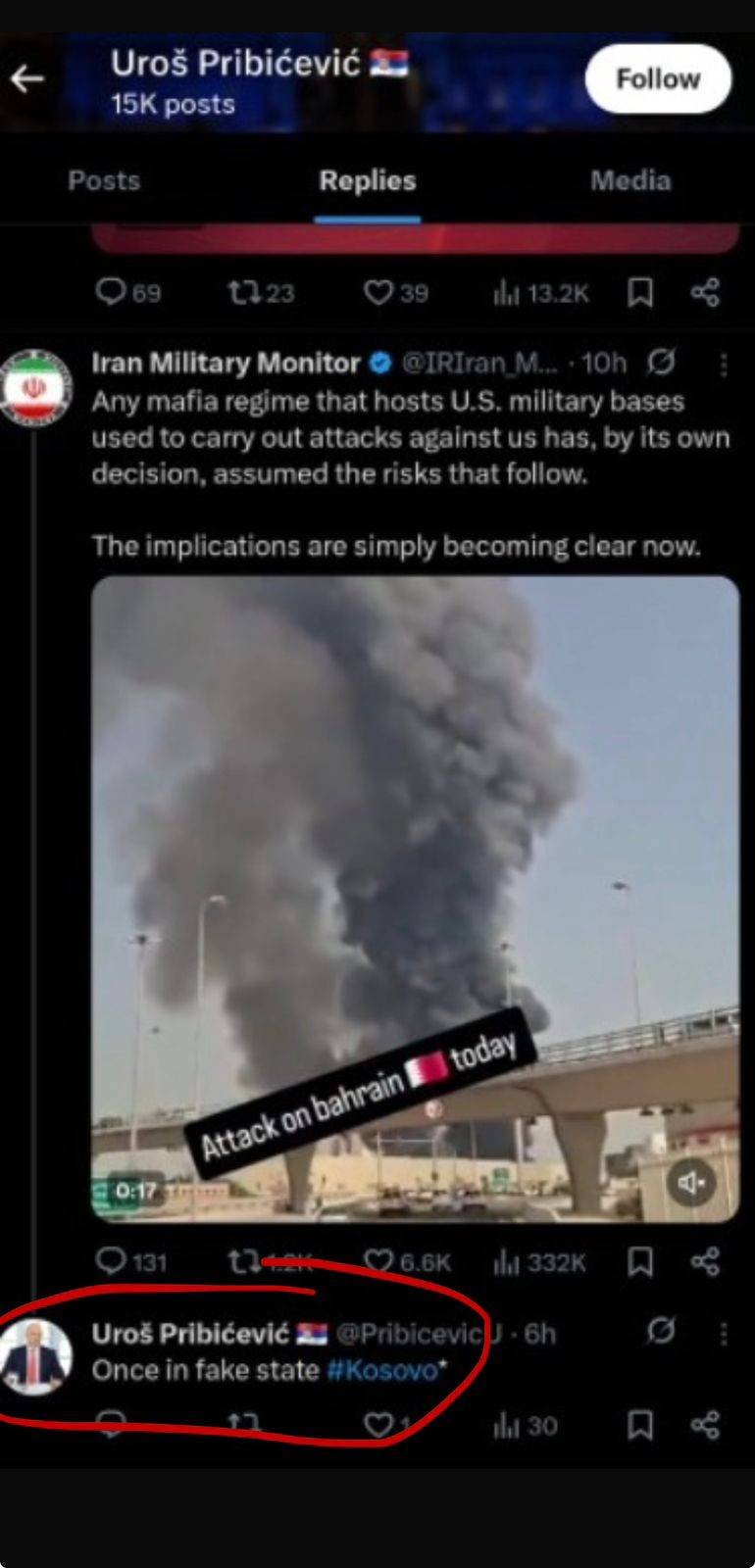
At the same time, lower-ranking officials such as Assistant Minister Uroš Pribićević introduced Kosovo into discussions about attacks on U.S. military installations, indirectly linking the region’s security architecture to global confrontations. The Camp Bondsteel U.S. base, central to NATO’s KFOR mission, was mentioned in this context, suggesting that Serbia’s domestic political discourse sometimes frames Western-led stability efforts as potential targets or sources of geopolitical tension.
Dual Messaging and Strategic Balancing
Serbia’s strategy reflects a long-standing dual-track approach:
- Engagement with the West: Serbia maintains strong economic, political, and diplomatic links with the EU, NATO structures, and Washington, benefiting from trade, investment, and participation in stabilization missions.
- Narrative Alignment with Anti-Western Sentiment: Simultaneously, political elites often voice grievances against Western interventions, express sympathy toward states like Iran or Russia, and continue to challenge the sovereignty of Kosovo.
This balancing act has allowed Serbia to navigate competing international pressures while preserving ties with Russia, China, and other non-Western actors, but recent crises show its limits and inherent risks. Global conflicts increasingly expose tensions between Serbia’s rhetoric and its formal diplomatic commitments, creating potential friction with Western partners.
Implications for the Western Balkans
For Western policymakers in Brussels and Washington, Serbia’s strategic ambiguity raises crucial questions:
- Is Serbia’s pro-Western orientation genuine, or primarily a pragmatic posture designed to coexist with a fundamentally divergent geopolitical worldview?
- How sustainable is Belgrade’s approach, especially regarding Kosovo’s stability, NATO’s credibility in the Balkans, and Serbia’s EU accession prospects?
- Could Serbia’s nationalist rhetoric and historical framing of Western interventions undermine regional security during moments of international tension?
The ongoing crises in Ukraine and the Middle East underscore that Serbia’s foreign policy contradictions are not merely rhetorical, but carry real-world implications for regional security, European integration, and transatlantic relations. The repeated invocation of historical grievances and Kosovo in global military narratives highlights the fragility of Serbia’s Western integration strategy and the challenges facing European and American diplomacy in aligning Belgrade with NATO and EU frameworks.
Conclusion
Serbia’s foreign policy today exemplifies the difficulties of balancing domestic political narratives with international commitments. While economic and diplomatic incentives encourage Western integration, nationalist rhetoric and selective historical analogies reveal an enduring skepticism toward Western security institutions. How Serbia reconciles these conflicting impulses may determine not only its European trajectory, but also the broader stability of the Western Balkans.