Shortly after the first bombs fell on Iran — igniting a conflict that within hours escalated into a regional crisis — Kosovo’s authorities moved quickly to stand alongside the United States, condemning the Iranian regime and reaffirming their support for the Western alliance.
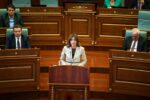
Kosovo’s President, Vjosa Osmani, said that thanks to the leadership of the United States and President Donald Trump, the time of freedom for the Iranian people is approaching.
In a post on X, she added that Kosovo will continue to support the actions taken by the United States and other allies to bring an end to the Iranian regime, while strongly condemning Iran’s attacks against its allies in the Middle East.
The United States and Israel launched joint strikes against Iran on February 28, with the aim of curbing the country’s nuclear program. In response, Iran and its supporters have been targeting facilities in countries allied with the United States — from Saudi Arabia to Cyprus — despite warnings from Trump against retaliation.
“Better not do it, because if they do, we will strike them with a force never seen before,” Trump wrote on the social network Truth Social.
A few hours after the attacks began, Kosovo’s Prime Minister, Albin Kurti, convened the National Security Council to discuss the situation, stating that Kosovo is closely monitoring possible implications for the country and the region.
His government did not respond to questions from Radio Free Europe regarding potential implications or concrete measures that might be taken. Likewise, neither the Presidency, the Ministry of Internal Affairs, the Kosovo Police, nor the U.S. Department of State provided any comment.
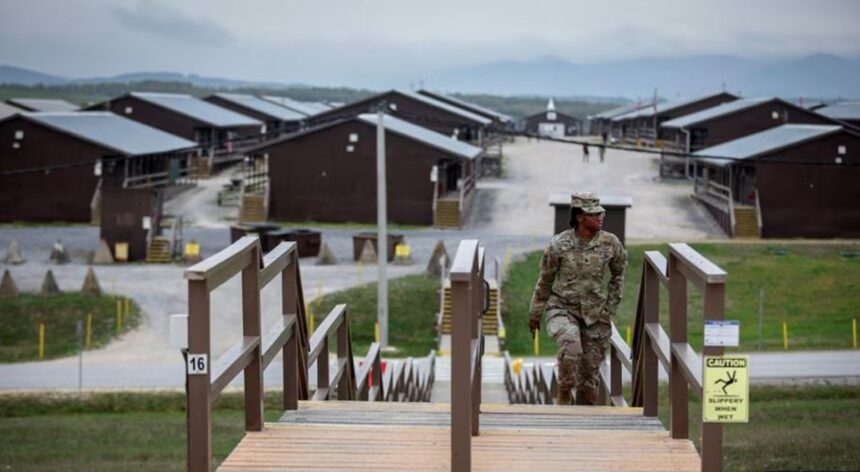
Kosovo hosts Camp Bondsteel — the largest United States military base in the Balkans — and around 600 American soldiers serving within the NATO peacekeeping mission, KFOR.
In a response to Radio Free Europe, a NATO official said that KFOR continues to fulfill its mandate to ensure a calm and secure environment for all citizens of Kosovo.
“The strength and posture of KFOR are reviewed and adjusted from time to time according to developments on the ground, so the mission remains effective in achieving its objective. At the moment, no significant changes are being considered,” the NATO official said.
Iran and its supporters have attacked several bases and missions of the United States and its allies in the Middle East. A British base in Cyprus was also targeted by drone attacks. Cypriot authorities said that, according to initial assessments, the drones were launched by Hezbollah from Lebanese territory.
The incident triggered an immediate European response: several countries sent fighter jets and frigates to Cyprus to strengthen the island’s air and naval defenses amid fears of further escalation of the conflict.
Regarding Kosovo, former senior NATO official Jamie Shea argues that although Camp Bondsteel is a major U.S. installation, it is unlikely to rank among Tehran’s priority targets. This is because Bondsteel is not an air base and is not used to support current U.S. operations against Iran.
“As far as I understand, Iran has a limited number of ballistic missiles. Since the United States and Israel are striking their launch platforms, Iran must use them wisely to achieve maximum effect,” Shea told Radio Free Europe’s program Expose.
According to the Office of the U.S. Director of National Intelligence, Iran possesses the largest ballistic missile arsenal in the Middle East. Its arsenal includes long-range missiles capable of reaching Israel, Kh-55 cruise missiles with a range of up to 3,000 kilometers, and Shahed drones believed to have struck the British base in Cyprus and capable of flying up to 2,500 kilometers.
This means that if launched from Iran, the Balkans remain outside the range of these weapons.
Former commander of the U.S. Army in Europe, Ben Hodges, warned that the U.S. naval base in Crete, Greece, could fall within the range of potential threats. He considers it a significant target in Europe due to its logistical role in the region.
Hodges did not mention specific missile or drone threats against Camp Bondsteel but emphasized that the base should always be treated as potentially at risk.
“I would always assume there is a threat, especially if terrorist organizations or individuals angered by attacks on Iran or the killing of the Ayatollah decide to act on their own. Therefore, security measures at Camp Bondsteel must always be maintained and this possibility taken into account,” Hodges said.
Shea stressed that for Europe — including Kosovo — the most likely threats from Iranian or Iran-inspired actions are terrorist attacks, cyberattacks, and so-called “lone wolf” attacks carried out by individuals acting independently but inspired by extremist ideologies or groups.
“Many Kosovars joined the Islamic State during the time of the caliphate; some of them may have returned to the country, and some may still remain radicalized. This means there could be certain ‘pockets’ of radicalization. And I’m not talking only about Kosovo, because a similar situation may appear in other European countries within Muslim communities,” Shea said.
He also warned that the conflict could lead to rising oil and gas prices, higher inflation, and a major global recession. The consequences would be particularly severe for Kosovo and the Western Balkans as a whole — a region he described as economically fragile and dependent on foreign investment.
General Hodges also raised concerns about the safety of European citizens, including Kosovars, who might become stranded in Gulf and Middle Eastern countries.
“If hundreds of thousands of Europeans are stuck in the United Arab Emirates, Qatar, or similar countries because airlines have stopped flights, I can understand why the French government might feel the need to send its forces to protect them,” he said.
The President of France, Emmanuel Macron, announced this week that his country will send the aircraft carrier Charles de Gaulle to the Mediterranean and will work to form a coalition to protect maritime traffic threatened by the escalation of the crisis in the Middle East.
In terms of security measures for Kosovo, Shea suggested that authorities should strengthen border controls, monitor potentially radicalized individuals, increase security around U.S. and KFOR facilities, and enhance operational and intelligence cooperation with NATO and the United States.
“Of course, there is also a NATO reserve force that could be deployed if the situation requires it. But for now, we are talking about normal preventive measures. Security must adapt according to threat assessments. You should neither react too little nor overreact,” Shea said.
As each day of the war passes, the risks become increasingly unpredictable. Hodges noted that Washington has never clearly defined what it wants Iran to look like once the war ends, which, according to him, makes the conflict harder to conclude.
He also warned about pressure on U.S. military stockpiles and the country’s overall deterrence capacity.
“The longer the conflict lasts, the more it tests the United States’ ability to provide sufficient ammunition. This is not only about current operations, but also about maintaining deterrence capabilities against China. I am sure there is tremendous pressure on industry to increase production. But these are not simple products — they are highly sophisticated, expensive weapons that take time to produce. You cannot immediately triple or quadruple production of Patriot interceptors, HIMARS systems, or Tomahawk missiles,” Hodges said.
President Trump said on March 4 that U.S. forces are in a very strong position in Iran and have made significant progress, even though the war had been underway for less than a week. According to him, one of the key reasons is the rebuilding of the military during his first presidential term.
In the Balkans, the Ministry of Security of Bosnia and Herzegovina raised security measures to a higher level due to the escalation of the conflict in the Middle East, while the President of Serbia, Aleksandar Vučić, compared the U.S. attack on Iran with the NATO air campaign against the former Yugoslavia.
According to Jamie Shea, this is simply a “completely false analogy” and repeated rhetoric from Serbia, which also receives support from Iran in opposing Kosovo’s independence.
Iran, a country of more than 91 million people, does not recognize Kosovo as an independent state and maintains no official diplomatic relations with it.