Arms races have existed for centuries, but after World War II they became global and systematic, especially between the United States and the Soviet Union during the Cold War. Nuclear weapons, ballistic missiles, and fighter jets transformed how power was conceived in the decades that followed.
Today, in the Western Balkans, developments in Serbia are raising serious concerns.
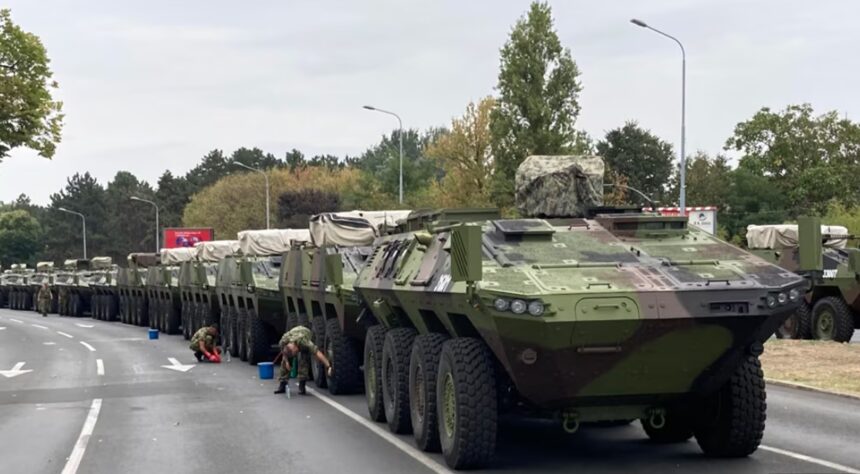
Although a partner of NATO and a candidate for membership in the European Union, Serbia has purchased supersonic air-to-ground ballistic missiles from China for its air force. According to President Aleksandar Vučić, Serbia has become the first European country equipped with CM-400AKG missiles.
“We have successfully integrated Chinese missiles into Russian fourth-generation MiG-29 aircraft. These are now among the best aircraft in Europe—perhaps even in the world. Air-to-ground missiles mean striking targets on land and have destructive power,” Vučić said on March 12.
The move triggered reactions from neighboring countries that fought Serbia during the Yugoslav wars of the 1990s. Croatia—now a NATO and EU member—described the purchase as a threat to regional stability and a sign of a growing arms race in the Balkans, while Kosovo accused Serbia of hegemonic ambitions.
These two countries, together with Albania, signed a defense and security cooperation agreement in March 2025. Vučić described it as a direct threat to Serbia’s security, claiming it was aimed solely at his country—though he provided no evidence, and Zagreb, Pristina, and Tirana have rejected such claims.
Security experts warn that such rhetoric increases fear and uncertainty in the region, raises threat perceptions, and pushes neighboring countries to strengthen their military capabilities. This dynamic can easily turn into a new arms spiral, where each move triggers a counter-response and tensions escalate further.
Redion Qirjazi, a security expert from Albania, says the Chinese missiles give Serbia new capabilities to project power and shift the regional balance. Their high precision and speed—Mach 4 to Mach 5—make them difficult to intercept.
In the Balkans, Serbia maintains tensions with Kosovo, with which it has territorial disputes, as well as with Croatia and occasionally Montenegro. Relations with Albania and North Macedonia are calmer, while ties with Republika Srpska in Bosnia and Herzegovina remain a special case.
According to Kadri Kastrati, Serbia’s arms acquisitions reflect its ambition to position itself as the most dominant military actor in the region and keep the Balkans on the edge of instability. He points to a growing competition with Croatia, especially after both countries pursued advanced fighter jet deals, including France’s Rafale aircraft.
Despite claiming military neutrality, Serbia has the highest defense spending in the Western Balkans. In 2024 alone, it spent $2.2 billion—about five times more than Albania, according to the Stockholm International Peace Research Institute.
Following the Russian invasion of Ukraine, Serbia diversified its arms sources, turning to China for drones and air defense systems while continuing purchases from Western countries such as the United States and France.
Katarina Gjokić cautions that comparisons between Serbia and Croatia should be made carefully, as Croatia operates within NATO structures, while Serbia acts outside such frameworks. She also warns that political elites often use neighbors’ military buildup to justify their own expansions.
“What is worrying is the irresponsible rhetoric of political elites, which increases tensions instead of using existing regional mechanisms—or creating new ones—for communication and problem-solving,” she said.
Qirjazi warns that such a climate of tension and mistrust can lead to misinterpretations and rapid, uncontrolled reactions—raising the risk of escalation even without a direct intention for conflict, a situation he describes as “miscalculation.”
He draws parallels with recent conflicts involving Iran, Israel, and the United States, as well as past cases like Iraq, where perceived threats led to preemptive actions and escalation.
In response to Serbia’s arms purchases, the European Union has stated that the country must make clear strategic choices on its path toward integration. Meanwhile, NATO has not commented on Serbia’s cooperation with Beijing.
In May, NATO is expected to conduct joint military exercises with Serbia at the Borovac training ground near the Kosovo border. The exercise, according to NATO’s Joint Force Command Naples, will strengthen practical cooperation and support regional stability.
For Qirjazi, this reflects Serbia’s strategy of “playing on multiple fronts”—opening the door to China while maintaining cooperation with the West to create mutual dependencies.
“This approach resembles that of former Yugoslavia under Tito, which balanced relations among major powers,” he said.
According to him, such a strategy gives Serbia more room for maneuver while placing international actors in a more complex position in the event of a conflict. Gjokić adds that Chinese weapons are often chosen because they are cheaper, though Serbia’s position in Europe brings different expectations.
Vučić did not disclose the price of the CM-400AKG missiles, which can carry up to 200 kg of explosives, but described them as “very expensive.”
A recent report by the Stockholm International Peace Research Institute shows that arms imports in Europe have surged by 210% between 2016–2020 and 2021–2025, making it the largest importing region globally.
Meanwhile, the United States has strengthened its dominance in arms exports, with Kosovo among its many clients. Kosovo defense officials emphasize that all military purchases are made exclusively from NATO allies.