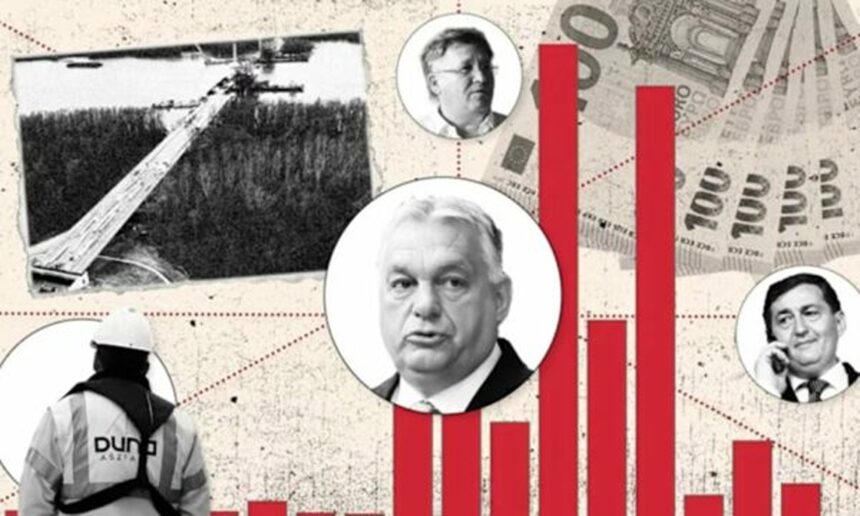
An investigation by the Financial Times sheds light on how a close circle of businessmen linked to Hungarian Prime Minister Viktor Orbán has benefited billions of euros from public contracts since he came to power in 2010.
According to the report, companies owned by 13 individuals close to Orbán’s government secured more than €28 billion from state tenders between 2010 and 2025. This marks a dramatic increase compared to the previous five-year period, when the same actors earned an average of just €608 million per year.
In total, these companies accounted for around 14% of all public procurement funds in Hungary during this period, compared to only 1% before 2010.
One of the key figures in this network is Lőrinc Mészáros, a childhood friend of Orbán, who has become the richest man in Hungary largely through state contracts. The network also includes László Szíjj, owner of Duna Aszfalt, a company that has secured contracts worth billions of euros.
Another prominent name is István Tiborcz, the prime minister’s son-in-law, who has also built considerable wealth, partly through state-related deals.
Figures such as István Garancsi and Gyula Balásy are also considered part of this economic system closely tied to political power.
“National Cooperation System” under criticism
The economic model promoted by Orbán, known as the “National Cooperation System” (NER), aims to align state and private sector interests. However, critics describe it as a form of clientelism.
Economist István János Tóth, head of the Corruption Research Center in Budapest, has labeled the system a “kleptocracy,” claiming that public funds are used to enrich elites connected to the government.
According to the report, politically connected companies are far more likely to win tenders without competition. Between 2024 and 2025, around 69% of their contracts were awarded in procedures with only a single bidder.
This phenomenon has also raised concerns within the European Union, which in 2022 suspended approximately €27 billion in funds for Hungary over concerns about corruption and irregularities in public procurement.
The Hungarian government and Orbán himself have consistently denied corruption allegations. Duna Aszfalt has stated that its success is based on experience and quality of work, emphasizing that it has won competitive tenders even against international companies.
Meanwhile, István Tiborcz has said that since 2015 he has avoided involvement in public tenders following earlier investigations by European institutions.