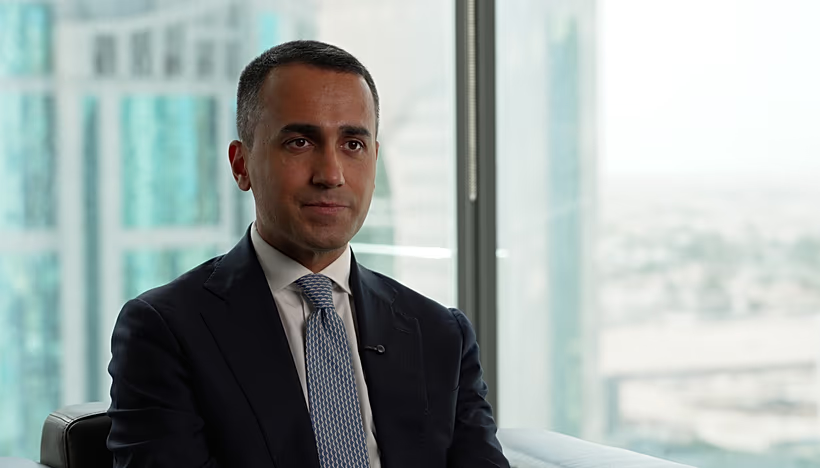
The European Union has called for a diplomatic initiative modeled on the Black Sea Grain Agreement to unblock the Strait of Hormuz, while reinforcing security cooperation with Gulf Cooperation Council (GCC) countries amid the ongoing Iran conflict. EU special envoy to the Gulf Luigi Di Maio discussed the strategy in an interview with Euronews in Doha.
“After the start of the war in Ukraine, the international community managed to negotiate a deal between Russia and Ukraine to ensure humanitarian corridors in the Black Sea,” Di Maio said. “We need to replicate this approach in the Strait of Hormuz to guarantee freedom of navigation in international waters.”
The EU’s High Representative Kaja Kallas has reportedly contacted UN Secretary-General António Guterres to launch this initiative. Di Maio stressed that the blockade of the strait has created a humanitarian crisis, affecting not only oil and gas but also fertilizers, helium, and other essential goods critical to agriculture and GCC exports.
“Europe is resilient in terms of fossil fuel quantities thanks to post-Ukraine war investments, but we are impacted by global price dynamics, and other regions are suffering more severely,” Di Maio noted.
The Black Sea Grain Initiative, initially signed in 2022 between Russia, Ukraine, Turkey, and the UN, had created a maritime corridor that allowed safe grain exports from Ukraine to global markets. The initiative ended after Russia withdrew, viewing any vessel bound for Ukraine as a potential military target, though Ukraine has since developed new export routes.
Di Maio is touring the Gulf region to strengthen the EU-GCC strategic partnership, which has gained momentum amid the Iran conflict. From the conflict’s early days, the EU expressed strong support for the Gulf countries, which have emphasized the value of international solidarity.
During the tour, Di Maio met officials in Saudi Arabia, the UAE, Oman, and Qatar, with plans to visit Kuwait and Bahrain. He stressed three key messages: solidarity with the GCC against Iranian attacks, support for GCC self-defence—including equipment provision—and a commitment to diplomacy and regional security.
He also confirmed EU support for Ukraine’s defense cooperation with Gulf countries to counter Iranian drone attacks: “The same drones hitting Ukraine are now affecting GCC soil.”
Regarding potential Iran–US peace talks, Di Maio highlighted the EU’s backing of the Islamabad mediation initiative, led by Turkey, Egypt, and Pakistan, aiming for a “structured solution” to the conflict and long-term stability in the Gulf and wider Middle East.
“The security of the Gulf and the wider Middle East is our security,” Di Maio said, promising continued EU support to GCC partners in the coming weeks and months.
The envoy also noted that the Iran war has strengthened the EU-GCC strategic partnership, opening new opportunities for security and defence collaboration. Qatari officials, including Minister of Defence Sheikh Saoud bin Abdulrahman bin Hassan Al Thani and Energy Minister Saad Sherida Al-Kaabi, held talks with Di Maio on joint defence coordination and long-term energy cooperation.