Serbia is no longer considered a democratic state, but a “moderate autocracy,” according to the latest Transformation Index by the Bertelsmann Foundation—a finding that analysts say comes as no surprise to citizens.
“This is not a surprise, but a confirmation of what citizens live every day,” said Stefan Janjić. “When the rule of law collapses, elections lose meaning and the media are brought under government control, the outcome cannot be anything else.”
The report highlights years of state capture, weakened institutions, and electoral manipulation as key reasons for classifying Serbia among moderate autocracies, alongside limited economic transformation and weak governance.
According to the index, democracy in Serbia continues to deteriorate, with significant declines in electoral conditions, rule of law, and media freedom, alongside rising political polarization. It notes that ruling parties in Serbia and Georgia have increasingly “captured” state institutions, undermining democratic and constitutional systems.
The report further states that President Aleksandar Vučić and the Serbian Progressive Party dominate the political system, effectively controlling the government, parliament, and judiciary, despite the presidency being largely ceremonial under the constitution.
It also points to intensified election manipulation, including alleged practices such as splitting local elections without justification and registering voters outside their place of residence to influence outcomes.
Janjić emphasized that the findings are not political accusations but conclusions from an international analysis. “Any attempt to downplay this only confirms the problem—because a government that refuses to acknowledge the situation shows it has no intention of changing it,” he said.
Branka Latinović, vice president of the Forum for International Relations, described the report as comprehensive and even more critical than those of the European Commission. She warned that comparisons drawn between Serbia and countries with the weakest democratic ratings are concerning.
“The way the country is governed determines its position and leads to the erosion of other democratic pillars. Without strengthening the rule of law, there can be no progress in institutions, media freedom, or elections,” she said.
Other political figures echoed similar concerns. Konstantin Samofalov linked the current trajectory to anti-European tendencies, while Gordana Čomić attributed the situation to a lack of political dialogue, warning that its absence will lead to even deeper systemic consequences.
Meanwhile, Miloš Stanković described Serbia as an “autocratic and party-controlled state,” citing concentration of power, pressure on public sector employees, and widespread media manipulation.
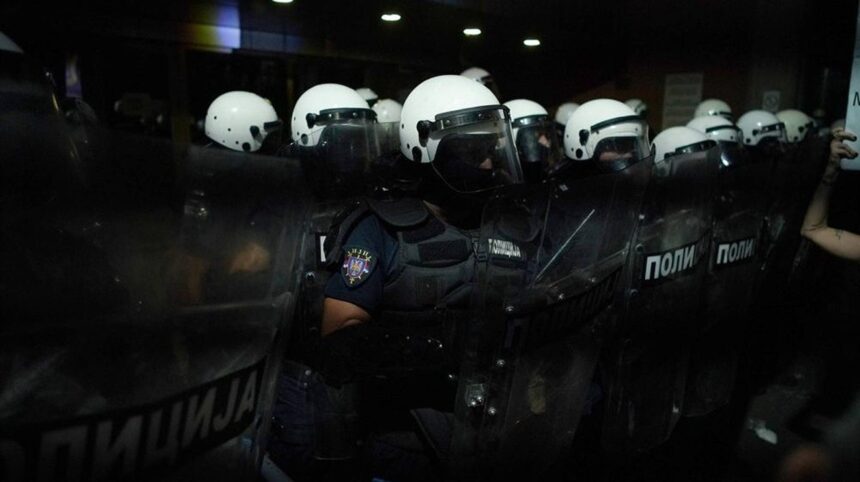
The Bertelsmann report also notes that opposition parties remain fragmented, while civil society and independent media face ongoing pressure, including smear campaigns, lawsuits, and surveillance. Mass protests in recent years, it adds, have often been dismissed by authorities as foreign-backed destabilization efforts.