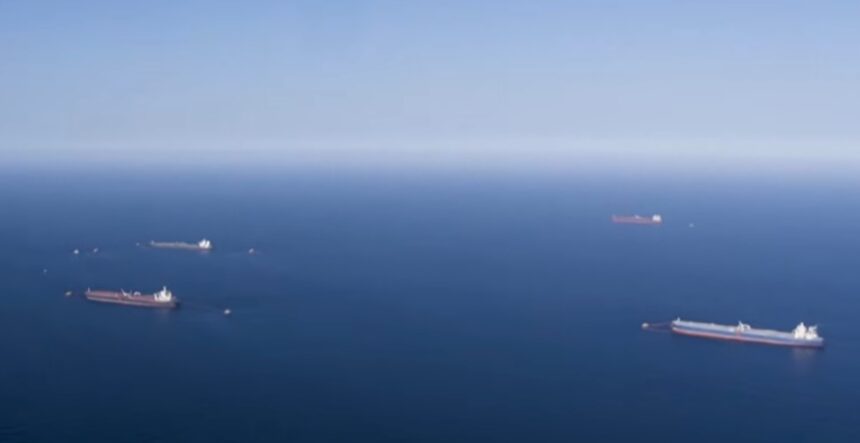
For more than 50 years, Gulf oil-producing states have promoted themselves as stable and reliable suppliers of low-cost energy. However, the third war in the region—now in its fifth week—has disrupted this image. With the Strait of Hormuz largely blocked, a significant portion of global oil supply has been unable to reach international markets, while Gulf states have reduced production and experienced declining export revenues.
In contrast, Iran appears to be following a different path. Despite U.S. and Israeli bombardments that began on February 28, Iranian tankers continue to operate across the region, and daily oil revenues have nearly doubled compared to pre-conflict levels. While the country faces heavy pressure on the battlefield, it seems to be gaining ground in the energy sector.
Estimating the exact volume of exports remains difficult, as Tehran increasingly relies on covert transportation methods. Satellite imagery has become less available from many commercial providers, while electronic interference has created an “information fog” over the Persian Gulf. According to a source cited by The Economist, Iran is currently exporting between 2.4 and 2.8 million barrels of oil and petroleum products per day, including 1.5 to 1.8 million barrels of crude oil—levels equal to or even exceeding last year’s average, but now at significantly higher prices.
Iran’s export system has adapted to withstand both military strikes and economic sanctions. A large share of revenues is now directed toward the Islamic Revolutionary Guard Corps (IRGC), the regime’s elite force, while China plays a key role in maintaining financial flows. Much of Iran’s financial reserves are held in Asian markets, beyond the reach of Israeli strikes.
Iran’s oil business operates on three main pillars: a sales network, transportation, and a parallel financial transaction system. Although exports are officially conducted through the state-owned National Iranian Oil Company (NIOC), in practice, various state and semi-state entities receive oil allocations and market them independently. Ministries, law enforcement agencies, and religious institutions all participate, alongside roughly 20 influential businessmen managing oil-for-cash networks.
Many of these actors maintain close ties with the IRGC. According to vessel-tracking firm Vortexa, the military organization is behind a significant portion of the recent export increase. The Quds Force’s international unit reportedly controls around 25% of Iran’s crude oil production, while the decentralized structure of the network makes it highly resilient to military disruption.
During the conflict, the IRGC has also strengthened its control over the shipping sector. Companies linked to the Khatam al-Anbiya complex coordinate much of the maritime logistics in cooperation with NIOC. These include firms such as Sahand, Sahara Thunder, Pasargad, Admiral, and Persian Gulf Petrochemical Company, many of which are under U.S. sanctions as front companies.
Iranian authorities have also implemented heightened security measures to protect oil tankers, whose cargoes can be worth between $150 million and $200 million. On Kharg Island—from which about 90% of crude exports originate—emergency procedures have been introduced in case of attack. Smaller terminals such as Yask, Lavan, and Sirri are also increasing capacity to potentially absorb export flows if needed.
As vessels approach the Strait of Hormuz, Iranian authorities assign them special security codes. Small IRGC boats often escort tankers through narrow coastal routes, and according to maritime sources, some ships are required to pay millions of dollars in fees for safe passage.
Despite a recent U.S. decision to ease sanctions on approximately 150 million barrels of Iranian oil already at sea, tankers continue to use concealment tactics such as falsified documentation and spoofed tracking signals. Oil is often transferred in international waters near Malaysia or Singapore before continuing to its final destination.
China remains the primary buyer, absorbing over 90% of Iranian exports. Much of the oil is processed in around 100 small independent refineries in Shandong province, often referred to as “teapot” refineries. Although officially separate from major state-owned energy firms, there are signs of indirect cooperation through joint investment schemes.
Before the war, Chinese companies purchased Iranian oil at a discount of $18 to $24 per barrel compared to Brent crude. With reduced supply from other Gulf producers, that discount has narrowed to between $7 and $12. Meanwhile, Brent prices have surged, with Iranian crude futures reaching around $104 per barrel—approximately 75% higher than before the conflict.
The financial network supporting these transactions relies on confidential accounts in smaller Chinese banks or in Hong Kong, often under the names of shell companies. Funds are transferred through multiple intermediary accounts across various countries, enabling Iran to finance imports and channel money into global markets.
Evidence suggests that companies handling oil revenues have also conducted transactions with plastic industries in India, Kazakhstan, and Turkey. This network effectively operates as an informal banking system controlled by entities linked to Iran’s Defense Ministry or the IRGC.
The widespread distribution of accounts—numbering in the thousands—helps absorb shocks from sanctions and military operations. However, the system’s complexity also makes it difficult even for Iran’s central bank to fully control and increases the risk of financial losses through intermediaries.
Despite these challenges, Iran’s energy machine continues to function and will be difficult to contain—unless there are large-scale strikes on its energy infrastructure, a move that could trigger retaliatory attacks on facilities across other Gulf states.