Donald Trump Jr.’s visit to Banja Luka on April 7 was unremarkable in itself. Private citizens travel for business; Republika Srpska, regardless of politics, is not a prohibited destination. Meetings with local officials and business figures happen routinely across the Balkans without attracting international attention.
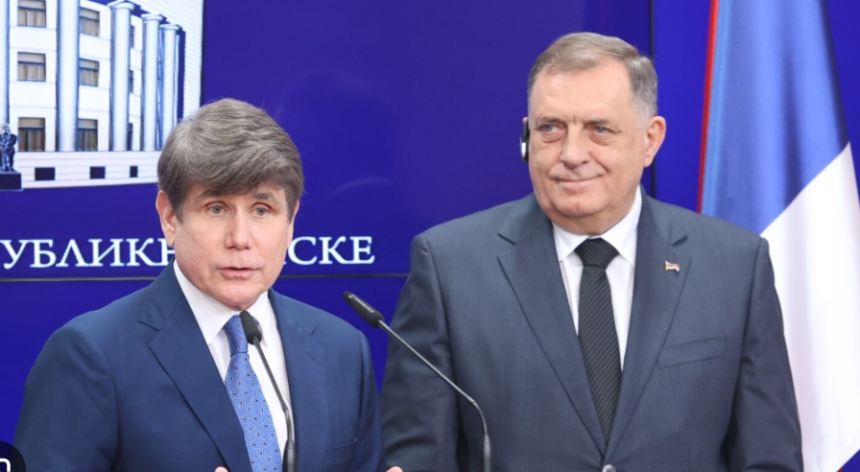
What is remarkable, however, is the X post that followed — published by Rod Blagojevich, a registered foreign agent for Republika Srpska, and distributed by RRB Strategies LLC, with the FARA disclosure buried at the end. The post claimed the visit marked a step toward a “new strategic partnership” with “Orthodox Christian Serbs in the Balkans who love America and love President Trump.” Both claims are false: they misrepresent the civilizational framing and Serbian public opinion. Yet the product is aimed squarely at American domestic audiences, while the cost is borne by relationships that matter internationally.
Civilizational framing and historical context
The phrase “Orthodox Christian Serbs” is not neutral in the Balkan context. During the 1990s wars, similar framing justified military campaigns by casting the conflict as defense of Christian Europe against Ottoman encroachment. It provided moral architecture for military operations, as documented extensively by the International Criminal Tribunal for the former Yugoslavia.
Using this language in U.S. conservative media is not rhetorical flourish — it activates a historical and political frame that Washington policymakers may not recognize. Regional governments in Ankara, Riyadh, and Amman will interpret the message differently, informed by historical and geopolitical memory. The key question for the U.S. administration is whether it is comfortable being positioned within this frame, and whether anyone in the policy apparatus was consulted beforehand.
Reality vs. narrative
Blagojevich’s claim that Serbs “love America” inverts the measurable reality. Surveys from Gallup, CRTA, and the International Republican Institute show Serbia as a regional outlier on Euro-Atlantic orientation, with low NATO favorability, high pro-Russia identification, and relatively weak support for EU accession. Republika Srpska mirrors this stance, with leadership under Milorad Dodik cultivating Russian patronage and framing EU integration as a structural threat. The constituency Blagojevich markets to U.S. audiences does not hold the values attributed to it; the claim is a fabrication.
The strategic cost
The Trump administration has invested heavily in Gulf partnerships — with Saudi Arabia, the UAE, Qatar — and relies on Turkey, Jordan, and Pakistan for critical security, energy, and diplomatic cooperation. These governments do not treat Srebrenica as a historical abstraction. The Organisation of Islamic Cooperation has formally recognized the massacre as genocide; Turkey commemorates it at the state level. Using civilizational framing invoking Orthodox Christian identity triggers institutionalized scrutiny and skepticism among these partners.
Republika Srpska offers symbolism and narrative; the governments affected offer material cooperation that the U.S. actively depends on. This is an asymmetric exposure.
How the operation works
Foreign influence operations of this type do not request policy changes directly. They shape the domestic political environment in which certain policies appear natural. By the time U.S. officials engage formally, the narrative has already influenced Republican foreign policy circles. The FARA disclosure, legally compliant but visually minimized, acknowledges that transparency would undermine the effect.
Washington is being sold a strategic alliance that does not exist, with a constituency that does not hold the values ascribed to it, by an actor whose client aligns with Russia’s regional ambitions. The cost is charged to relationships with governments that actually deliver. This is not a strategic partnership; it is a manufactured product. U.S. policymakers should read the label before buying it.