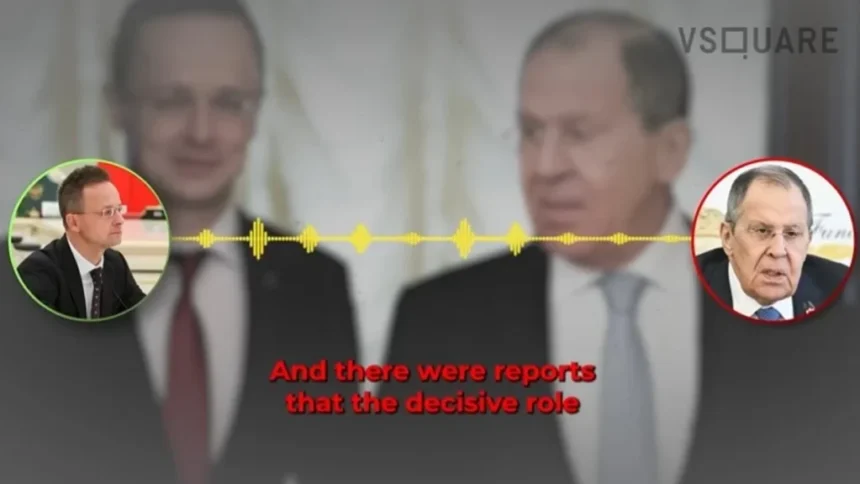
A newly reported set of leaked communications has raised concerns over alleged coordination between Hungary and Russia regarding European Union internal discussions on Ukraine’s accession process.
According to the report, a conversation dated July 2, 2024, between Russian Foreign Minister Sergey Lavrov and Hungarian Foreign Minister Péter Szijjártó discussed EU enlargement policy and Ukraine’s membership bid.
Allegations of information sharing
The leaked material suggests that Hungarian officials may have shared internal EU-related information with Russian counterparts, including sensitive formulations regarding minority rights in Ukraine. These references were reportedly used in discussions that aligned with Russia’s broader diplomatic objections to Ukraine’s EU accession process.
The report further claims that such exchanges could have been used to reinforce arguments aimed at slowing or obstructing Ukraine’s integration into the European Union.
EU reaction and concerns
The European Commission has reportedly expressed serious concern over the allegations, with Commission President Ursula von der Leyen said to be considering raising the issue at the highest level of EU leadership.
A spokesperson for the Commission described the claims as “deeply alarming,” suggesting they raise questions about whether a member state may have coordinated with Russia in ways that conflict with EU interests and security.
The EU has reportedly requested urgent clarification from the Hungarian government.
Political context in Hungary
The revelations come at a politically sensitive moment, as Hungary prepares for elections scheduled for April 12. Prime Minister Viktor Orbán is facing a challenging electoral environment, with polling reportedly showing increased competition from opposition forces.
Broader implications
If confirmed, the allegations could deepen tensions between Budapest and Brussels, particularly over Hungary’s role in EU foreign policy toward Russia and Ukraine.
The case also highlights ongoing divisions within the EU regarding enlargement policy, security coordination, and relations with Moscow.