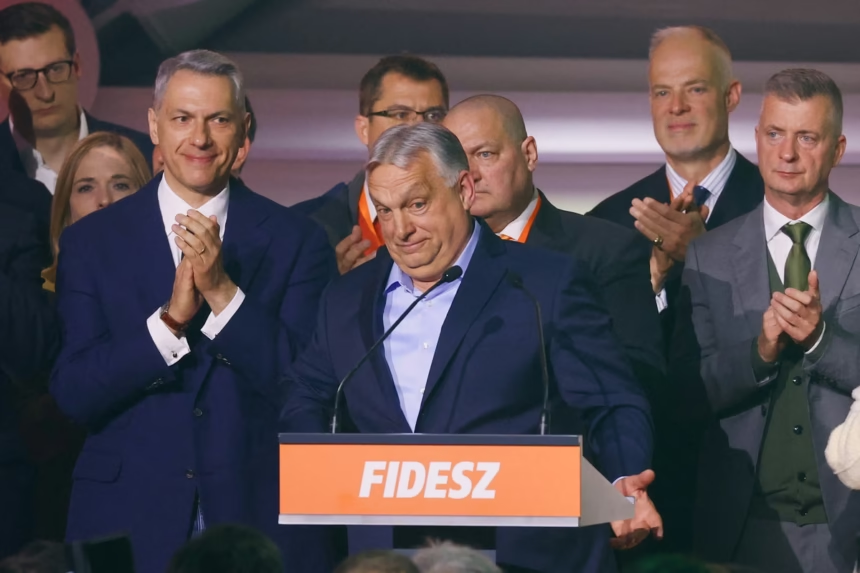
German and Austrian media have described the electoral defeat of Hungarian Prime Minister Viktor Orbán as a significant political shift in Central and Southeastern Europe, with potential consequences for his long-standing allies in the Western Balkans.
According to reporting referenced by Deutsche Welle, Frankfurter Allgemeine Zeitung (FAZ) and other European outlets, Orbán’s loss is seen as a weakening of what analysts have called a “network of illiberal allies” that included regional political leaders such as Serbian President Aleksandar Vučić, Republika Srpska leader Milorad Dodik, and North Macedonian Prime Minister Hristijan Mickoski.
The FAZ analysis argues that Orbán had spent more than a decade building a system of political, media, and financial influence across the region, supporting like-minded actors through funding, media partnerships, and strategic cooperation. His departure from power, the paper suggests, may gradually reduce Budapest’s political and financial backing for these networks.
The report highlights that Serbia was among Orbán’s closest regional partners, with cooperation spanning political messaging, media influence, and energy security narratives. It also references past claims and political episodes interpreted by analysts as coordinated messaging between Belgrade and Budapest during sensitive electoral periods.
However, European commentators caution that the dismantling of such influence structures will not happen immediately, noting that many media and political networks developed over 15 years remain in place despite changes in leadership in Hungary.
Austria’s Salzburger Nachrichten also described Orbán’s defeat as a “bad signal for Serbia,” arguing that it may weaken authoritarian-style political alliances across the region and reduce resistance to European Union conditionality and reforms.
The commentary further notes that Serbia’s EU accession process has stalled in recent years, amid domestic political tensions and ongoing protests. Some analysts quoted in European media suggest that Orbán’s political decline could indirectly impact Serbia’s domestic political dynamics, although no immediate structural changes are expected.
Despite differing interpretations, most European outlets agree that Orbán’s departure marks a shift in regional political balance and signals potential changes in the informal alliance structures that shaped Balkan politics in recent years.