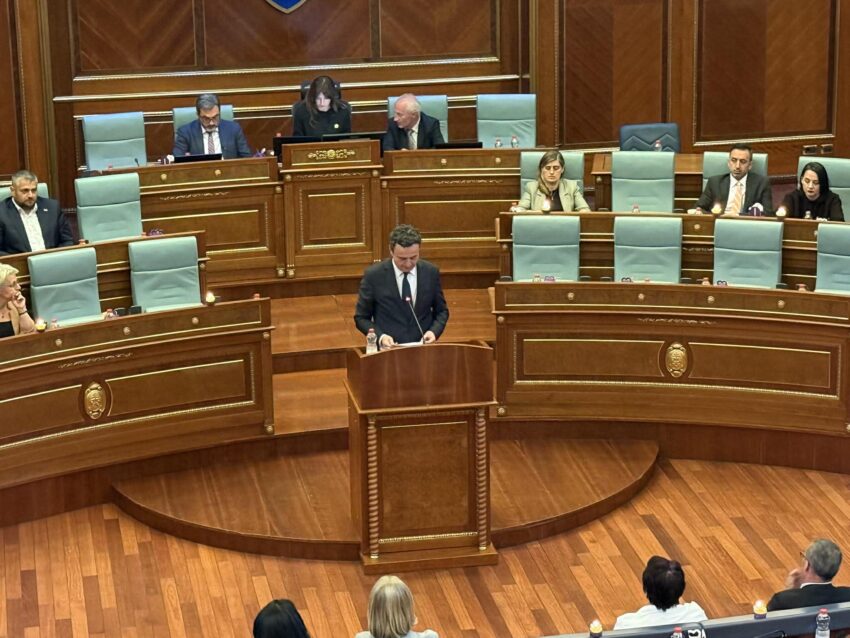
At a solemn parliamentary session marking the Memorial Day for Survivors of Sexual Violence during the war, Kosovo Prime Minister Albin Kurti stated that the number of convictions for war-related sexual violence remains low and disproportionate to the scale of crimes committed during the 1998–1999 conflict.
Kurti emphasized that while Kosovo continues to honor victims of war crimes, Serbia, according to him, still serves as a safe haven for individuals accused of war crimes and continues to deny the crimes committed during the war.
He said that silence and stigma surrounding wartime sexual violence continue to prevent thousands of survivors from seeking justice and support, adding that this issue has long-lasting intergenerational psychological consequences.
Kurti recalled that sexual violence was systematically used as a weapon of war in Kosovo during 1998–1999. He noted that after more than two decades of impunity, the first conviction for wartime sexual violence was issued in July 2021 against Zoran Vukotić for crimes committed against an Albanian woman in Vushtrri.
He further stated that although the number of trials and convictions for war crimes has increased in recent years, it remains insufficient compared to the scale of atrocities. He highlighted legislative changes in Kosovo’s Criminal Code that now allow trials in absentia for war crimes.
According to Kurti, while Kosovo is working to address wartime sexual violence and support survivors, Serbia continues to promote narratives that, in his view, distort historical facts. He referred to a recent exhibition in the Serbian parliament that, he argued, glorified units of the former Yugoslav security forces despite the conviction of senior commanders for crimes against humanity in Kosovo.
The statement was delivered during an event organized by Kosovo’s Assembly in honor of survivors of wartime sexual violence, an issue that remains central to transitional justice efforts in the country.
Kurti concluded that Kosovo’s experience in addressing wartime sexual violence is increasingly becoming an important reference for other post-conflict societies.