As the Western Balkans continues to grapple with the ghosts of its past, two of the most notorious episodes of the 1990s conflicts—the Dubrava Prison massacre in Kosovo and the Siege of Sarajevo in Bosnia—stand as stark reminders of the long and often divergent road to legal accountability.
The Dubrava Massacre: A Case of Unfinished Justice
On May 22, 1999, during the height of the Kosovo War, prisoners at the Dubrava Prison were ordered to gather in the courtyard under the pretext of being transferred to safety. “Take your belongings,” they were told.
What followed was a calculated slaughter. According to survivor testimonies and documentation by international human rights organizations, security forces opened fire from guard towers and walls using automatic weapons, snipers, and grenades. In the days following NATO bombings of the facility, up to 96 prisoners were killed by guards and police.
The event was eventually included in the 2001 indictment against former Serbian President Slobodan Milošević at the International Criminal Tribunal for the former Yugoslavia (ICTY). However, with Milošević’s death in 2006, the tribunal never reached a final verdict on the case.
Today, domestic efforts in Kosovo face significant hurdles. In 2025 and early 2026, local courts issued several acquittals for former prison guards, leaving dozens of suspects still at large or uncharged.
The Siege of Sarajevo: Convictions and New Frontiers
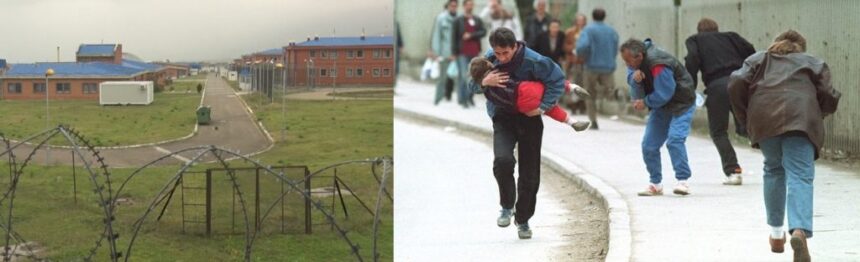
In contrast, the Siege of Sarajevo—the longest siege of a capital city in modern warfare—resulted in landmark international convictions. For nearly four years, the city was subjected to a systematic campaign of sniping and shelling aimed at terrorizing the civilian population.
The ICTY delivered concrete results: Bosnian Serb General Stanislav Galić was sentenced to life imprisonment for his role in the terror campaign, while his successor, Dragomir Milošević, received 29 years.
However, justice for Sarajevo continues to evolve. In February 2026, investigations took a global turn when prosecutors in Milan, Italy, identified an 80-year-old Italian citizen as a suspect in the “Sarajevo Safari” phenomenon. This refers to allegations that foreign “tourists” paid to shoot at civilians from the hills surrounding the city. The Prosecutor’s Office of Bosnia and Herzegovina confirmed that its war crimes department is now working with international partners to expand investigations beyond local perpetrators.
Comparative Overview: Legal Outcomes
| Event | Location | Key Legal Outcome | Status in 2026 |
| Dubrava Massacre | Kosovo | No final ICTY verdict (Milošević died). | Domestic acquittals and unresolved cases. |
| Siege of Sarajevo | Bosnia | Life imprisonment for key commanders. | New investigations into foreign “safari” shooters. |
A Common Thread of Denial
Despite the differing legal outcomes, both cases share a common history of denial. Regarding Dubrava, perpetrators attempted to shift the blame onto NATO airstrikes. In Sarajevo, propaganda frequently claimed that victims were “shelling themselves” to gain international sympathy.
As of May 2026, Sarajevo has become a symbol of what international law can achieve, whereas Dubrava remains a symbol of the “justice gap”—where indictments exist, but finality remains elusive for the victims and their families.