
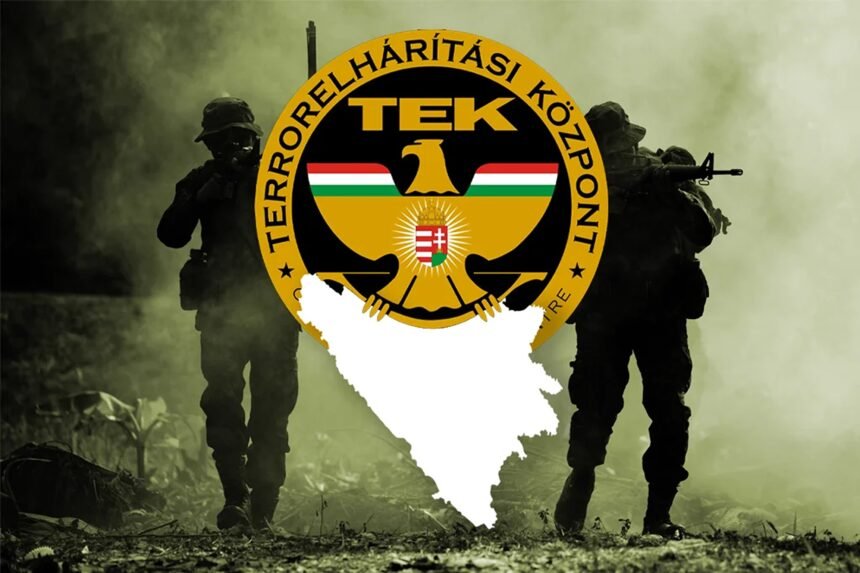
When one entity, in this case Republika Srpska, directly establishes security cooperation with a foreign special police unit, it raises a serious issue of circumventing the state.
The opening of the Hungarian anti-terrorist unit’s office in Banja Luka cannot be classified as routine international cooperation. Whoever presents it that way either does not understand the context of Bosnia and Herzegovina or is consciously ignoring it with very clear intentions. In Bosnia and Herzegovina, security issues are never merely technical matters, but deeply political ones — and among the highest-risk political issues at that.
When a foreign state establishes an operational presence in the security sector not at the state level, but at the entity level, it is not a technical matter. It is a direct encroachment on the institutional order of the country and, more importantly, it sends the message that such an order can be bypassed. At the same time, it sends a message from both the leadership of the entity and the foreign state that the institutions of Bosnia and Herzegovina can be disregarded.
Bosnia and Herzegovina is a state with a complex internal structure, but with clearly defined responsibilities: security and foreign policy cooperation with other states fall within the jurisdiction of state institutions. When one entity, in this case Republika Srpska, directly establishes security cooperation with a foreign power — and not just any foreign power, but a special police unit — it raises a serious issue of bypassing the state.
Republika Srpska does not have the mandate to conduct independent security cooperation with other states in this manner. This is not a matter of interpretation, but of the fundamental principles governing the functioning of Bosnia and Herzegovina. Bypassing state institutions is not flexibility, but the introduction of an illegal practice that, in this context, rarely remains without consequences.
This move should not be viewed in isolation. It comes at a time when the authorities of Republika Srpska have for years systematically undermined common institutions, questioned the jurisdiction of the state, and tested the limits of what is possible. In such an environment, the presence of a foreign special forces unit appears less as assistance and more as a political signal of support.
Even more problematic is the fact that this signal comes from a member state of the European Union. This sends a double message: externally, that rules are relative when political interests require it, and internally, that parallel structures are not only tolerated but encouraged. This runs directly contrary to the principles on which the European security architecture in the Western Balkans should be based.
We should not ignore the fact that Bosnia and Herzegovina already has institutions responsible for combating terrorism. If the goal of foreign partners is cooperation, then it must be built exclusively through the competent state institutions. Anything else is either distrust in the state or an attempt to bypass it and undermine its authority.
In both cases, the consequence is the same: the weakening of the already fragile system established under the Dayton Constitution of Bosnia and Herzegovina. In a region that still bears deep political and security scars, such moves do not remain without consequences. They raise tensions, deepen divisions, and create space for new crises. Because once the practice of resolving security matters outside the framework of the state is established, it becomes difficult to determine where that practice ends.
Therefore, this is not merely about the relationship between Milorad Dodik and outgoing Hungarian Prime Minister Viktor Orbán, nor about Hungary and one office, but about principle. Will Bosnia and Herzegovina remain a state with a unified security system, or become a collection of territories in which different actors establish their own arrangements with external partners? If the answer is the latter, then we are no longer speaking about reforms, but about open attempts to disintegrate Bosnia and Herzegovina as a state.
That is why responsibility lies not only with Banja Luka, but also with Budapest. Any serious European policy in the Western Balkans must be based on strengthening state institutions, not bypassing them. If Hungary wants to be a credible partner in the region, it cannot simultaneously participate in practices that undermine the very principles upon which the European Union itself is founded.
It is therefore legitimate to expect that a future Hungarian government headed by Péter Magyar would make a clear break from such policies — to put an end to arrangements that resemble political alignment disguised as security cooperation, and to take concrete steps to reverse the precedents already created in sensitive states such as Bosnia and Herzegovina.
All actors in the region should return to a principle that ought to be unquestionable: regional stability is not built through parallel channels of power, but through transparent and institutional cooperation with states, not their constituent parts. Anything else is not a contribution to security, but an irresponsible gamble with unpredictable consequences, as the not-so-distant history of this region vividly demonstrates.
(The author was a member of the Serbian Parliament)