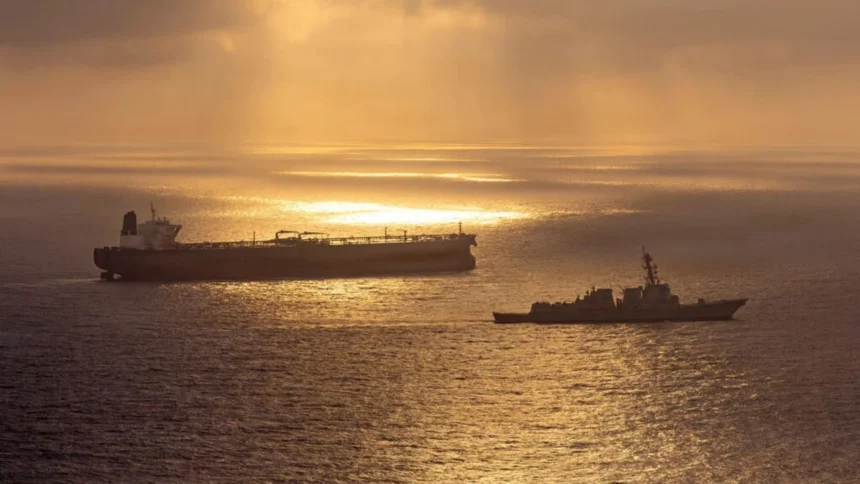
U.S. Central Command (CENTCOM) announced today that a massive naval blockade is currently preventing more than 70 oil tankers from entering or exiting Iranian ports. The stranded fleet represents a staggering capacity of over 166 million barrels of oil, valued at an estimated $13 billion.
The blockade, which President Donald Trump has characterized as a “steel wall,” is part of an aggressive economic strategy to leverage Iran’s reliance on maritime exports to bring Tehran to the negotiating table.
Kinetic Action in the Gulf of Oman
In a sharp escalation of enforcement, CENTCOM confirmed that U.S. forces disabled two Iranian-flagged tankers, the M/T Sea Star III and the M/T Sevda, earlier today.
According to official reports:
- The Strike: A U.S. Navy F/A-18 Super Hornet launched from the USS George H.W. Bush (CVN 77) intercepted the unladen vessels as they attempted to break the blockade.
- Tactical Precision: The aircraft fired precision munitions directly into the ships’ smokestacks, effectively disabling their propulsion systems without sinking the vessels or causing major environmental damage.
- Previous Incidents: This follows a similar action on May 6, when another Super Hornet from the USS Abraham Lincoln used its 20mm cannon to disable the rudder of the tanker M/T Hasna.
Strategy of “Maximum Pressure”
President Trump has prioritized this blockade as a central pillar of U.S. foreign policy in 2026. By choking off Iran’s primary revenue stream, the administration aims to cripple the Iranian economy.
“U.S. forces in the Middle East remain committed to full enforcement of the blockade,” stated Admiral Brad Cooper, CENTCOM Commander. “More than 50 vessels have already been redirected, and we will continue to ensure compliance.”
Regional Tensions and Retaliation
The situation remains highly volatile. Iranian state media (Fars News Agency) has reported direct skirmishes between Iranian armed forces and U.S. Navy vessels in the Strait of Hormuz.
The blockade comes amid a complex regional backdrop:
- Ceasefire Fragility: Despite the naval strikes, President Trump insisted today that a broader four-week-old ceasefire with Iran remains “intact,” downplaying recent exchanges as “love taps.”
- UAE Under Attack: The UAE Ministry of Defense reported today that its air defenses intercepted two ballistic missiles and three drones launched from Iran, resulting in three moderate injuries.
As the U.S. continues to enforce the blockade with an armada of 20 warships and 15,000 troops, global energy markets remain on edge over the potential for prolonged supply disruptions in the world’s most critical oil chokepoint.