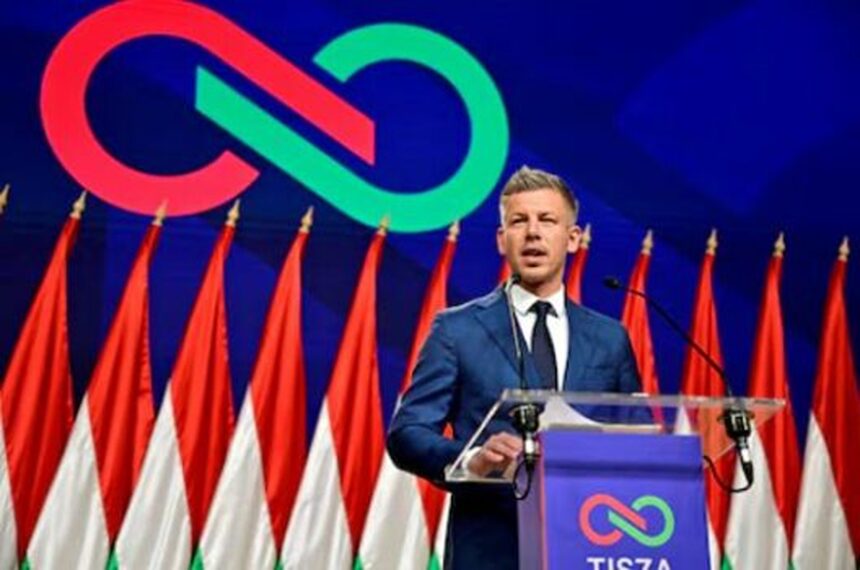
With his first official state visit to Warsaw, newly elected Hungarian Prime Minister Peter Magyar aims to repair the deeply fractured relations between Hungary and Poland. As he navigates this diplomatic reset, political analysts suggest he has much to learn from his Polish counterpart, Donald Tusk.
Following the historic April 12, 2026, parliamentary election in Hungary—which saw Magyar’s Respect and Freedom (Tisza) party sweep to victory—an overwhelming wave of enthusiasm rippled through Europe’s liberal and centrist circles.
“Welcome back to Europe,” Polish Prime Minister Donald Tusk warmly posted on social media at the time, during an official visit to South Korea where he held a congratulatory phone call with the Hungarian leader. “I think I am even happier than you are,” Tusk added.
Demonstrating the strategic weight of this alliance, Magyar embarked on his first foreign trip on May 9, 2026—just ten days after being sworn into office—heading straight to Poland. The visit fulfilled a core campaign promise to immediately reconnect with the people Magyar publicly dubbed Hungary’s “natural allies.”
Broken Ties and the Long Road to Restoring Trust
Historically, Poland and Hungary have shared an enduring cultural and geopolitical bond. However, during the consecutive reigns of Poland’s nationalist Law and Justice (PiS) party and Hungary’s Fidesz, Warsaw and Budapest operated as a synchronized, illiberal bloc that frequently paralyzed European Union decision-making.
That alliance fractured under the weight of former Hungarian Prime Minister Viktor Orbán’s staunchly pro-Russian stance, a position the Polish political establishment found intolerable following Russia’s invasion of Ukraine. Relations bottomed out in late 2023 when Tusk’s pro-European, center-left coalition assumed power in Warsaw. By October 2025, Tusk described the bilateral status quo bluntly: “Everything is clear between us: we think differently about absolutely everything.”
Tensions spiked even further when Orbán’s outgoing government granted political asylum to former Polish Justice Minister Zbigniew Ziobro and his deputy Marcin Romanowski, both of whom are wanted in Warsaw on extensive corruption charges.
With Magyar now at the helm, Budapest is eager to present itself as a predictable, pro-European partner. Marcin Bosacki, State Secretary at the Polish Ministry of Foreign Affairs, classified the itinerary as a monumental “symbolic gesture.”
“It is highly important for us that the new Hungarian government shows how much it values its friendship with Poland through such a powerful symbolic action,” Bosacki stated.
Sociologist Edit Zgut-Przybylska noted that expectations are immense on both sides: “The trust that was thoroughly demolished by the pro-Russian and aggressively anti-European policies of the previous Hungarian administration must be completely rebuilt from the ground up.”
Unlocking EU Funds and Aligning on Ukraine
Magyar’s diplomatic tour includes stops in Kraków, Warsaw, and Gdańsk. The Hungarian Prime Minister is scheduled to hold high-level talks with Donald Tusk, Polish President Karol Nawrocki, and the legendary leader of the Solidarity movement, Lech Wałęsa.
The trip serves a dual pragmatic purpose for Magyar, who campaigned on restoring Hungary’s European alignment after 16 years of Orbán’s rule and securing the release of billions in frozen EU cohesion funds.
Tusk’s counsel could prove invaluable in this area. Immediately after winning his own election, the Polish Prime Minister successfully negotiated the unfreezing of €137 billion in EU funds for Warsaw by demonstrating a concrete commitment to judicial reform.
Polish officials also expect an immediate alignment regarding aid for Ukraine. Warsaw has a direct financial stake in Hungary’s political shift; the Orbán administration had unilaterally blocked nearly 2 billion zlotys (approximately €471 million) from EU defense funds intended to reimburse Poland for military equipment it delivered to Kyiv in 2022 and 2023. Bosacki did not mince words, labeling the previous Hungarian veto “disgraceful.”
On broader European policy questions—such as stricter migration controls and realistic adjustments to EU green climate targets—Magyar and Tusk are expected to find rapid consensus. Tusk, once a textbook liberal, has notably shifted his own positions to the right in recent years to reflect changing domestic and regional security realities.
Breathing New Life into the Visegrad Four (V4)
Magyar has openly called for the resuscitation of the Visegrad Four alliance (comprising Poland, Hungary, the Czech Republic, and Slovakia), an economic and political grouping that fell into a state of paralysis due to the ideological warfare between Orbán and Tusk.
In early May, Slovak Prime Minister Robert Fico signaled a willingness to reform the alliance, posting a photograph alongside Tusk and Czech Prime Minister Andrej Babiš with the caption: “The Three Musketeers are waiting for the fourth, and the return of the V4.”
However, regional experts urge a more realistic outlook. Martin Vokalek, director of the Brussels-based think tank Europeum, warned in an interview with DW that reviving the V4 will require far more than political public relations. He anticipates a highly transactional, pragmatic form of cooperation where the four capitals coordinate strictly on overlapping regional issues, even as Poland continues to anchor its primary geopolitical strategy around its relationships with Germany and France.
Domestic Parallelisms and Missing Extradition Trophies
Despite Poland’s massive economic dominance in the region, Magyar enters the bilateral talks from a position of relative domestic strength. Unlike Tusk, who must constantly manage a fragile, highly fragmented multi-party coalition, the new Hungarian Prime Minister commands a robust, cohesive parliamentary majority back home.
Furthermore, both leaders rode to power on anti-corruption platforms. Magyar secured his mandate by promising to dismantle the entrenched oligarchic networks surrounding Fidesz. In Tusk, he sees a contemporary who made identical promises but has faced severe institutional roadblocks in executing them. The Polish daily Gazeta Wyborcza recently warned that the sluggish pace of Poland’s domestic anti-corruption cleanup has begun causing noticeable fatigue among voters—a cautionary tale for Magyar’s new administration.
However, Magyar will be unable to deliver the symbolic “inauguration gift” that Warsaw desired most: the immediate extradition of the fugitive Polish politicians. Both Zbigniew Ziobro and Marcin Romanowski fled Hungary shortly before Magyar took office, presumably aided by elements of the old regime. Ziobro has since resurfaced in the United States, releasing a statement confirming he intends to wage his political campaign against Tusk’s government from abroad.