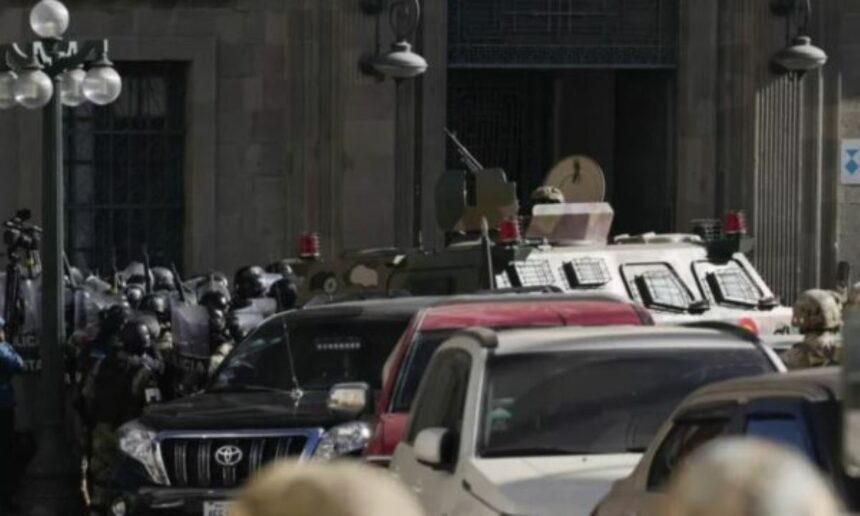
Major financial institutions in Bolivia have begun shutting down their physical branches across the administrative capital, La Paz, citing severe security threats as violent anti-government protests push the Andean nation into a deep constitutional crisis.
The economic paralysis hit the financial sector on Tuesday, forcing prominent institutions—including Banco Nacional de Bolivia, Banco de Crédito de Bolivia, Banco Económico, and the state-owned Banco Unión—to suspend all operations in the downtown core. The banks have issued emergency advisories urging citizens to rely exclusively on mobile banking and ATMs, though localized power outages and infrastructure damage have made automated services increasingly unreliable.
Dynamite Blasts Shiver the Capital
The capital has been brought to a total standstill following a multi-day march through the Andes by thousands of miners, rural farmers, indigenous groups, and public school teachers. The protests escalated violently on Monday when demonstrators, armed with dynamite sticks, Molotov cocktails, and slingshots, attempted to storm the presidential palace and main government squares, clashing with heavily armored riot police for hours.
   [THE ECONOMIC TOLL OF THE SIEGE]
   • Inflation Spike: April 2026 year-on-year inflation soared to 14%.
   • Highway Blockades: 67 major arteries choked off by 5,000+ stranded trucks.
   • Daily Financial Drain: Business syndicates report over $50,000,000 in daily losses.
   • Mass Arrests: Over 100 demonstrators detained following the looting of state offices.
The unrest represents the most severe threat yet to center-right President Rodrigo Paz, a conservative leader who assumed office less than six months ago after promising to rescue the country from its worst economic collapse in 40 years.
Tensions boiled over after Paz issued a executive decree dismantling a two-decade-old fuel subsidy to prevent the total depletion of the central bank’s US dollar reserves. The shock therapy triggered a severe fuel scarcity crisis, spiked inflation, and left thousands of transport workers and transport fleets stranded without gasoline.
The Evolution of Demands: From Agrarian Reform to Ousting the President
The nationwide uprising originally flared up over Law 1720—a highly controversial neoliberal agrarian reform enacted on April 10 that stripped small agricultural properties of their historic immunity from bank seizure, allowing rural land to be commodified and mortgaged.
“We want him to resign because he is incompetent. Bolivia is trapped in total chaos,” Ivan Alarcon, a 60-year-old farmer who marched 90 kilometers to the capital, told reporters.
Though President Paz capitulated to rural pressure and fully annulled Law 1720 on May 13, the tactical retreat failed to calm the population. The Bolivian Workers’ Central (COB) and powerful trade unions have expanded their baseline demands, now demanding blanket wage increases, labor law protections, an immediate halt to the privatization of state enterprises, and the immediate resignation of President Paz.
A Geopolitical Tug-of-War and the Shadow of Evo Morales
The administration has repeatedly blamed former left-wing President Evo Morales for orchestrating the blockades from his hideout in the tropical highlands, where he has spent the last year and a half evading an arrest warrant related to statutory sexual abuse charges. Morales has openly endorsed the civil resistance, warning on social media that the uprising will not halt until systemic fuel and food inflation are resolved.
As La Paz runs dangerously low on hospital oxygen reserves, basic foodstuffs, and medicine due to the chokehold on regional highways, neighboring Argentina has announced an extraordinary humanitarian airlift to drop supplies into the capital. Meanwhile, the US Department of State has issued an emergency travel warning, while offering explicit backing to President Paz’s deployment of 3,500 soldiers to forcefully clear the blockades.