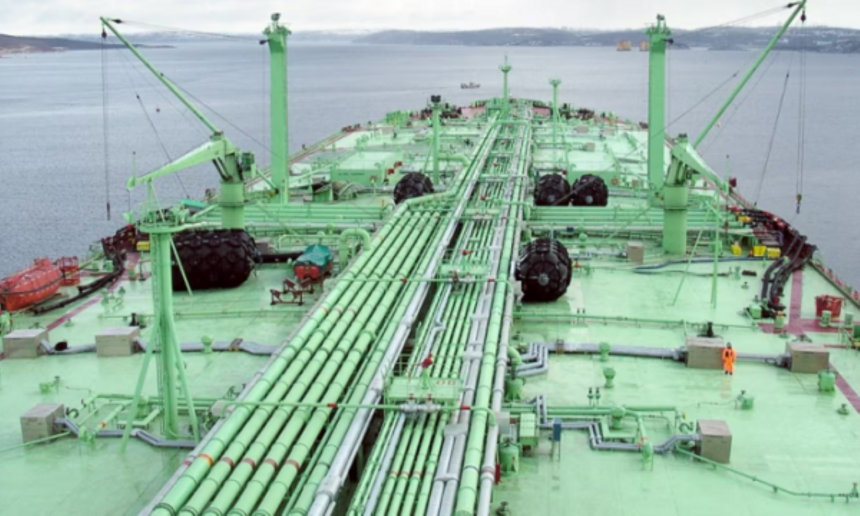
A fierce policy debate is dividing the U.S. capital over the Department of the Treasury’s decision to extend a temporary sanctions waiver on Russian oil. The specific carve-out allows vulnerable nations to purchase Russian crude shipments that were already loaded onto maritime tankers at sea, a move coming at a time when severe energy disruptions from the escalating U.S.-Israeli conventional conflict with Iran are jolting global markets.
U.S. Treasury Secretary Scott Bessent has robustly defended the measure, arguing it is micro-targeted to stabilize volatile energy sectors and blunt China’s capacity to absorb heavily discounted Russian crude. Conversely, influential Democratic critics, including Senators Jeanne Shaheen and Elizabeth Warren, warn that repetitive waivers risk eroding economic pressure on Moscow.
To unpack the strategic architecture behind this policy, Radio Free Europe sat down with Michael Parker, former investigator and section chief at the Office of Foreign Assets Control (OFAC) within the U.S. Department of the Treasury. Parker explains why calculated sanctions relief is not a sign of institutional weakness, but rather one of Washington’s most vital diplomatic bargaining chips.
The Anatomy of a General License: Managing Stranded Crude
Radio Free Europe: What does the Treasury Department’s decision to extend the Russian oil waiver for another 30 days signal about the administration’s current priorities? Is global energy stability beginning to override the mandate of maintaining maximum economic pressure on Moscow?
Michael Parker: I think what is critical to understand at a baseline level is what this specific general license issued by the Treasury actually covers. It exclusively authorizes the transaction of oil that was already loaded onto vessels and stranded at sea as of April 17. Naturally, this specific supply had been covered under a prior general license that expired roughly a day or two ago.
What this extended license does not do is permit fresh Russian oil to be loaded onto tankers moving forward. It merely addresses the exact same inventory stuck at sea since mid-April. This is a highly restrictive, narrow carve-out designed solely to wind down transactions for oil already in transit under the previous legal window. There is no broad expansion of trade here—only a brief prolongation of the timeframe in which it can be legally cleared.
The Leverage Dilemma: Do Waivers Signal Western Vulnerability?
Radio Free Europe: Critics argue that once sanctions waivers become predictable, foreign governments and global markets begin to bake them into their long-term planning. Could Moscow interpret this as a sign that the West will consistently blink and ease economic pressure whenever global energy prices spike?
Michael Parker: That is certainly a legitimate long-term policy concern, but two factors are incredibly important to keep in mind here. First is the temporal scope: we are talking about a matter of a few weeks, not a sweeping structural shift in American foreign policy.
Second is the precise nature of the relief. Because this general license is so tightly constrained to the oil at sea prior to April 17, sophisticated institutional actors and foreign governments are unlikely to read this as a broad retreat from the U.S. sanctions regime against Russia.
For instance, we have not seen any major delistings. No premier Russian state-owned enterprises or oligarchs are being removed from OFAC’s Specially Designated Nationals (SDN) List in tandem with this license. There is no generalized reprieve for Russian oil writ large. It applies strictly to this narrow, floating inventory.
Stabilizing Markets vs. Shielding Partners
Radio Free Europe: Global crude prices remain stubbornly high, hovering above $110 per barrel despite these interventions. If these narrow waivers are failing to significantly cool the broader markets, are they actually achieving their intended geopolitical goals?
Michael Parker: When analyzing U.S. economic sanctions, it is vital to remember they are instruments of national security and foreign policy—not standard commercial regulations. You have to look at the specific diplomatic intent behind why they are applied or temporarily eased.
Because this particular license extension is so mathematically limited in volume, its true objective may not have been a macro-level reduction in the global price of oil. There simply isn’t enough stranded crude on the water to single-handedly shift global benchmarks. Instead, my assessment is that this was likely a targeted diplomatic remedy to provide localized economic relief to specific, vital allied partners facing acute supply crunches.
   [THE GEOPOLITICAL COMPASS OF SANCTIONS RELIEF]
   • Dynamic Strategy:   Sanctions are designed to alter state behavior, meaning they
                         must be flexible, not permanently static.
   • Tactical Incentives: Relief acts as the "carrot" in negotiations, offering a tangible
                         reward in exchange for diplomatic concessions.
   • Coalition Upkeep:   Tailored waivers prevent economic blowback from fracturing
                         the unity of Western alliances and frontline partners.
Radio Free Europe: India appears to be one of the primary beneficiaries, continuing to import vast quantities of Russian crude. Does Washington risk sparking diplomatic friction with Ukraine and its core European allies by effectively tolerating these massive peripheral purchases?
Michael Parker: Historically, American sanctions policy has been highly sensitive to the structural energy dependencies of the European Union. At the inception of the multivariant sanctions regime following the 2022 invasion, the broader energy sector was intentionally insulated to prevent an immediate, catastrophic shock to the European economy.
This diplomatic sensitivity operates symmetrically. Easing structural friction to assist specific allies—calibrated against shifting geopolitical climates—is an operational reality that Brussels thoroughly understands. The United States’ ultimate strategic goal is to penalize the target state, not to inflict severe collateral damage on its own network of international partners.
The Strategic Divergence: Russia vs. Iran
Radio Free Europe: Simultaneously, the Treasury Department is pushing for a aggressively tighter enforcement of sanctions against Iran. How do both allies and adversaries interpret the contrast between easing restrictions on Russian oil while demanding absolute compliance regarding Teheran?
Michael Parker: Iran represents an entirely different strategic matrix. Following the collapse of the 2015 Joint Comprehensive Plan of Action (JCPOA), the United States has maintained a highly consistent, escalating trajectory of maximum-pressure enforcement against Tehran.
Rusia, by contrast, was fundamentally integrated into the bedrock of the global financial, banking, and energy architectures prior to 2022. Because of this systemic integration, a complete, instantaneous economic decoupling would trigger a global depression. Therefore, I do not see these concurrent approaches as contradictory or hypocritical. Both policy tracks are executing a consistent, calculated strategy: Iran faces a sustained clampdown, while the Russian sanctions regime utilizes tailored authorizations to adapt dynamically to real-time geopolitical shifts.
   [COMPARING REGULATORY STANCES: RUSSIAN VS. IRANIAN OIL]

   RUSSIA (Dynamic/Targeted Waivers)         IRAN (Uncompromising Clampdown)
   ┌────────────────────────────────┐        ┌────────────────────────────────┐
   │• Interconnected Global Asset   │        │• Isolated Financial Footprint  │
   │• Calibrated General Licenses   │        │• Absolute Enforcement Push     │
   │• Aimed at Regional Stability   │        │• Targeted Counter-Proxy Strategy│
   └────────────────────────────────┘        └────────────────────────────────┘
Sanctions are “Carrots,” Not Static Punishment
Radio Free Europe: Iranian state media has frequently spun these temporary Western oil waivers as proof of broader, back-channel diplomatic desperation. In your operational experience at OFAC, how much genuine leverage do these sanctions modifications generate at the negotiating table?
Michael Parker: In the grander theater of international diplomacy, sanctions relief is the essential “carrot” that pairs with the “shick.” The exact amount of leverage generated depends entirely on the overarching foreign policy priorities and what a administration is attempting to extract from an adversary.
The word you used—leverage—is the absolute crux of the entire discipline. Sanctions generate economic leverage that can be systematically tightened or loosened depending on the tone, progress, and flow of diplomatic negotiations.
Ultimately, U.S. sanctions are legally designed to change behavior. In virtually every high-level designation announcement issued against a foreign entity, OFAC explicitly states that the primary purpose of the sanction is behavioral modification, not permanent punishment. They are meant to be dynamic, not static monuments.
When a waiver is granted or a restriction is reinforced, it serves a deliberate purpose. Loosening the economic vise in a controlled manner is a text-book deployment of this leverage, providing a highly attractive, multi-billion-dollar bargaining chip that can be traded for sweeping security concessions.
Breaking the Cycle: The Path to Reversibility
Radio Free Europe: Some energy analysts argue that once Washington justifies these waivers on the grounds of global economic stability, it inadvertently establishes a dangerous precedent for infinite extensions. Is the U.S. government now trapped in an irreversible cycle of its own making?
Michael Parker: It is a valid risk for policymakers to monitor, but I do not believe Washington has locked itself into a permanent corner. The architecture of these general licenses provides a built-in exit strategy.
The fact that this current extension only runs until mid-June and is strictly confined to oil already on the water proves it is a temporary tactical patch, not a permanent structural shift. The beauty of this mechanism is its absolute reversibility. To snap the full weight of the sanctions back into place, the administration does not need to pass new legislation or draft complex executive orders. It simply has to do nothing, and let the temporary general license expire.
OFAC has allowed hundreds of licenses to quietly expire over the decades due to shifts in geopolitical conditions. This latest extension is a tightly controlled diplomatic pause, leaving Washington firmly in the driver’s seat.