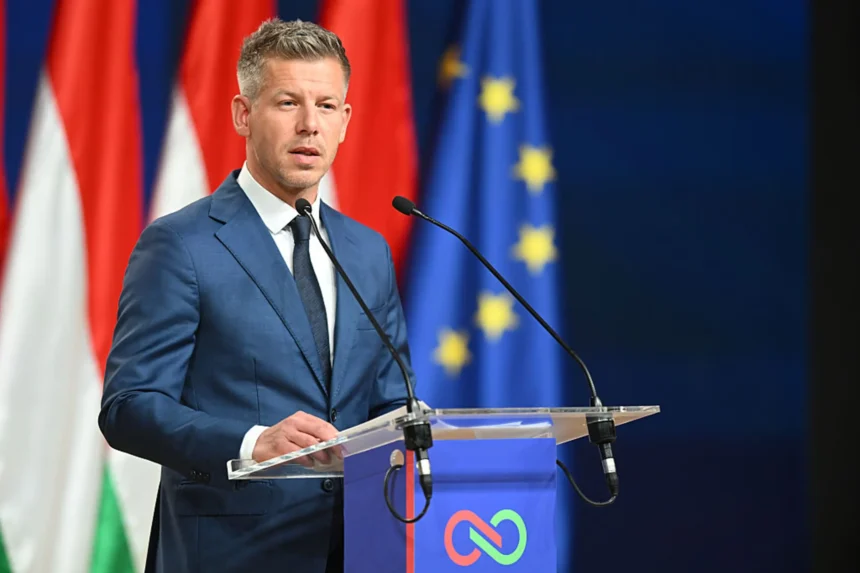
In a major international development revealing the sweeping geopolitical aftershocks of Hungary’s recent transformation, newly inaugurated Hungarian Prime Minister Péter Magyar has confirmed that an indicted former Polish deputy justice minister, wanted by Warsaw on multi-million-euro corruption charges, is believed to have fled Hungary via Serbia.
The revelation was made by Prime Minister Magyar during an interview with the prominent Polish broadcaster TVN24 in Warsaw. Magyar is currently undertaking a high-profile, two-day official visit to Poland—marking his very first foreign trip since his center-right Tisza Party unseated the long-ruling, far-right autocrat Viktor Orbán in the country’s recent historic elections.
Tearing Down the Safe Haven for Fugitive Factions
The geopolitical incident stems from a controversial decision by the former Orbán administration, which had granted formal political asylum to former Polish Justice Minister Zbigniew Ziobro and his right-hand deputy, Marcin Romanowski. Polish state prosecutors have filed extensive indictments against both men, charging them with the systematic embezzlement of public funds from a state pool earmarked for crime victims, allegedly using the capital to aggressively finance espionage networks targeting their political opponents.
Following the landslide victory of Magyar’s Tisza Party—which campaigned on a fierce anti-corruption platform and vowed that international fugitives would no longer find a safe haven under Budapest’s protection—the legal immunity shielding the high-profile Polish defectors shattered.
   [THE FUGITIVE TRACKING TIMELINE - MAY 2026]
   • Zbigniew Ziobro:      Fled the Schengen Zone approx. 24 hours prior to Magyar's inauguration.
                           Currently located in the United States under a controversially fast-tracked visa.
   • Marcin Romanowski:    Subject to an active European Arrest Warrant (EAW). Fled Budapest.
                           Traced moving south; strongly suspected of entering Serbia.
“From what I have understood, Ziobro managed to exit the Schengen Area roughly a day prior to my formal inauguration,” Prime Minister Magyar stated. “Furthermore, I just finished speaking with my intelligence colleagues… and there are strong indications that Mr. Romanowski has also fled our jurisdiction by crossing through Serbia. However, this information has not been completely finalized or confirmed yet.”
The Ministry of Foreign Affairs in Belgrade has remained tightly sealed regarding the matter, refusing to issue any official comment on whether Romanowski has successfully transited through or requested safe harbor within Serbian territory.
A Symbolic Polish-Hungarian Reset: Looking to the Future
Magyar’s Warsaw pilgrimage serves as a powerful symbol of Central Europe’s shifting political sands, mirroring the 2023 electoral triumph of Polish Prime Minister Donald Tusk, who successfully dismantled eight years of national-conservative rule in Poland.
   [THE BUDAPEST–WARSAW GEOPOLITICAL RESET]
   • Rule-of-Law Alignment:  Magyar seeks Tusk's backing to unlock billions in frozen EU funds.
   • Energy Independence:   Hungary pledges to completely end reliance on Russian energy by 2035.
   • The Baltic Alternative: Warsaw plans to supply Budapest with American LNG via Gdansk by 2028.
Later today, Prime Minister Magyar will hold strategic plenaries with Prime Minister Tusk and Polish President Karol Nawrocki. The bilateral leaders will then travel north to the historic Baltic port city of Gdansk for a milestone meeting with former President and Nobel Peace Prize laureate Lech Wałęsa.
The summit is expected to conclude with a landmark energy solidarity agreement. To accelerate Hungary’s newly announced goal of achieving absolute energy independence from the Kremlin by 2035, Warsaw is preparing to grant Budapest strategic access to American Liquefied Natural Gas (LNG) through Poland’s cutting-edge maritime terminal in Gdansk, currently slated to hit full operating scale by 2028.