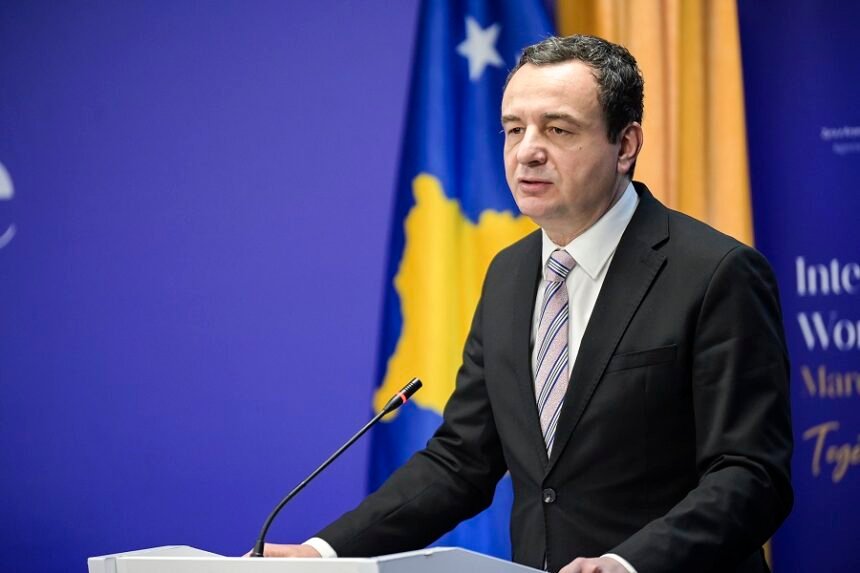
Acting Prime Minister Albin Kurti has shed new light on the executive branch’s highly anticipated strategic move to establish a national Gendarmerie force, confirming that the high-readiness internal security concept has been under intense logistical planning for a significant period.
Speaking directly to the press corps on Wednesday following a government briefing, Kurti emphasized that the new specialized militarized force is designed to systematically fill a vital operational vacuum within Kosovo’s current domestic defense apparatus.
The Tactical Threshold: “More Than Police, Less Than Army”
Kurti outlined the structural doctrine behind the initiative, describing the Gendarmerie as a highly adaptive instrument capable of deploying across high-threat internal security environments that exceed standard civil policing capabilities but do not yet trigger full conventional military engagement from the Kosovo Security Force (KSF).
   [KOSOVO'S EVOLVING SECURITY ARCHITECTURE]
   ┌────────────────────────────────┐
   │ 1. Kosovo Police (KP)          │ -> Civil Policing, Standard Law Enforcement
   ├────────────────────────────────┤
   │ 2. NEW GENDARMERIE AGENT       │ -> Border Control, Counter-Terror, Critical Infrastructure
   ├────────────────────────────────┤
   │ 3. Kosovo Security Force (KSF) │ -> Territorial Defense, Conventional Warfare (NATO Track)
   └────────────────────────────────┘
“Regarding the official foundational document, the specialized working group, and the granular details concerning the Gendarmerie, we will provide an official update very soon,” Kurti informed journalists. “We have been planning this for a long time, because a tejet crucial aspect of Kosovo’s national security involves an operational zone that sits squarely between being ‘more than the police and less than the army.’ This stretches from elite border security and combating asymmetric terrorism to completely sealing all remaining smuggling routes and executing tactical control over our state’s critical infrastructure.”
A Specialized Agency Within the Ministry of Internal Affairs
The Prime Minister’s update closely follows a landmark announcement made on Tuesday, May 19, by Acting Minister of Internal Affairs Xhelal Sveçla, who confirmed that the legal and administrative machinery required to establish the force has officially been set into motion.
Sveçla detailed that the Gendarmerie will be structured as a specialized, autonomous agency operating under the direct jurisdiction of the Ministry of Internal Affairs. This organizational model is mirroring European frameworks like France’s Gendarmerie Nationale or Italy’s Carabinieri, blending strict military discipline and advanced hardware with domestic law enforcement authority.
   [THE NEW GENDARMERIE'S CORE MISSION PROFILE]
   • Dynamic Border Enforcement: Preventing illegal cross-border incursions.
   • Counter-Terror Operations: Tactical response against organized armed groups.
   • Smuggling Interdiction:    Completely choking off black-market supply networks.
   • Asset Protection:          Securing energy grids, water reserves, and state nodes.
“The Gendarmerie represents a monumental milestone in the consolidation of our national security architecture,” Sveçla stated during his initial policy rollout. “It carries a razor-sharp mission to guarantee a robust, unwavering state presence dedicated to preserving our borders, national integrity, and territorial sovereignty.”
The sudden legislative push to field an elite, border-focused tactical force lands at a highly sensitive geopolitical moment. With extraordinary parliamentary elections looming on June 7, and Western allies continuously sounding alarms over Belgrade-backed political intimidation in minority hubs like Graçanica, Prishtina is moving rapidly to lock down its sovereign borders and cement its domestic authority.