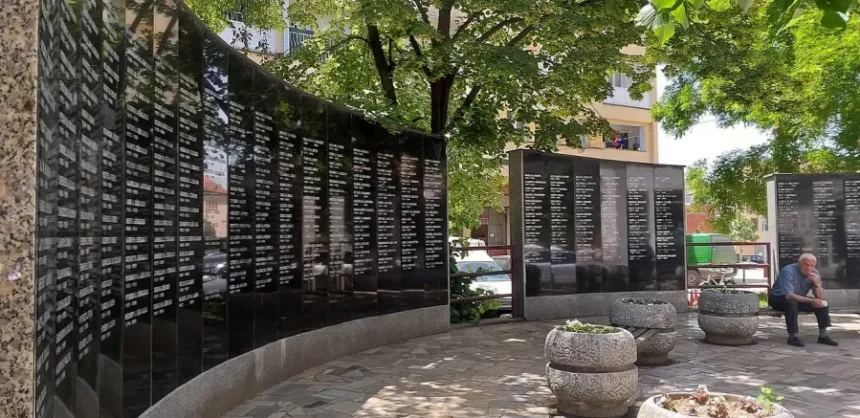
Today marks exactly 27 years since the Vushtrri massacre, one of the most brutal urban atrocities committed by the regime of Slobodan Milošević and Arkan’s paramilitary units during the 1999 Kosovo War.
On May 22, 1999, the civilian population of Vushtrri became the target of a systemic campaign of terror. Serb police and military forces forcibly expelled families from their homes, driving them toward a central assembly point known locally as “Te varrezat” (The Graveyard). Amid mass extortion and looting, the captive population was systematically broken up into three distinct groups: women and children under the age of 15, elderly citizens, and young-to-middle-aged men.
While approximately 1,000 men were driven to a local sports hall to face systemic torture before being sent to the Smrekonica prison or deported toward Albania, a far more tragic fate awaited those trapped on what is known today as “22 Maji” Street.
   [THE VUSHTRRI MASSACRE ARCHITECTURE: MAY 22, 1999]
   • Total Systematic Expulsion: Entire urban population forced out to "Te varrezat".
   • Mass Extortion:            Forced surrender of money, gold, and valuables.
   • The Executions:            68 civilians isolated at the Kahriman Pasoma house.
   • Method of Execution:       Severe torture followed by point-blank shots to the head.
   • The Cover-Up:              Bodies loaded into trucks and hidden in mass graves in Batajnica, Serbia.
The Slaughters at the Kahriman Pasoma House
The absolute horror of that day culminated inside the residential property of Kahriman Pasoma. A group of 68 ethnic Albanian civilians—including teenagers, women, and the elderly—were separated from the larger columns and detained inside the house.
After suffering horrific physical abuse at the hands of their captors, all 68 victims were systematically executed. Forensic examinations later revealed that the vast majority were killed via point-blank execution shots to the forehead. Among the casualties were young teenagers aged 15, women, and elderly citizens up to 62 years old, showcasing the indiscriminate nature of the assault.
The Logistics of Concealment
Following the slaughter, the Serbian military apparatus attempted to meticulously erase all traces of the war crime. The bodies of the 68 victims were loaded into specialized military trucks and transported across the border into Serbia proper, where they were hidden in clandestine mass graves inside a police training center in Batajnica, a suburb of Belgrade.
                  [THE ANATOMY OF A WAR CRIME COVER-UP]
                                    │
       Executions inside the Pasoma Estate (Vushtrri, Kosovo)
                                    │
                                    ▼
       Bodies loaded into Belgrade-bound cargo trucks
                                    │
                                    ▼
       Secret burial at SAJ Police Training Base (Batajnica, Serbia)
                                    │
                                    ▼
       Post-war liberation reveals catastrophic forensic traces in home
When local survivors and international investigators finally entered the Pasoma residence following the withdrawal of occupying forces in June 1999, the bodies had already been cleared, but the architecture of the crime remained vivid. Investigative teams documented extensive, high-velocity blood spatters covering the walls, floors, and domestic structures—marking the site as one of the most harrowing monuments to the policy of ethnic cleansing in Kosovo.