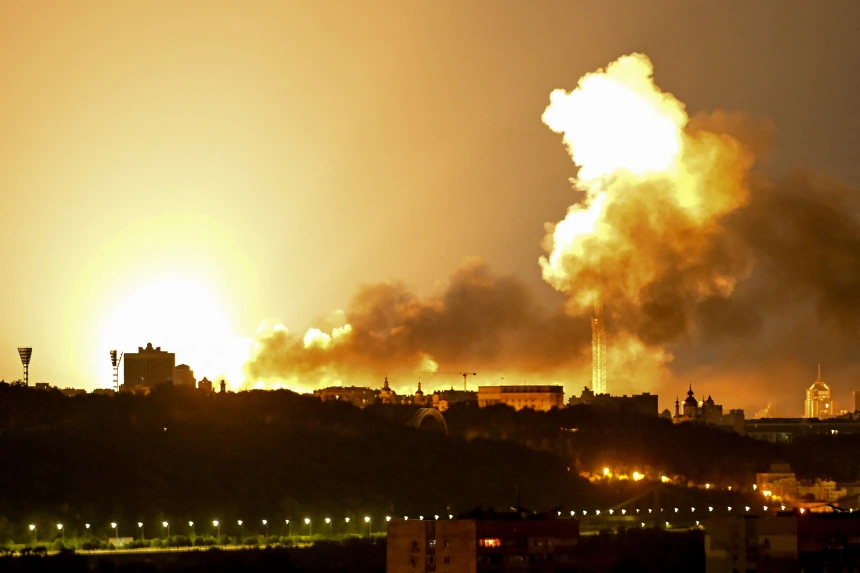
Russian forces executed an unprecedented, massive coordinated aerial bombardment across major Ukrainian urban hubs on Tuesday, June 2, 2026. The devastating strikes—primarily targeting the capital city of Kyiv, the southeastern city of Dnipro, and the eastern metropolis of Kharkiv—have left at least 18 civilians dead and well over 100 others wounded, according to local emergency authorities.
The relentless multi-wave assault vindicated days of intelligence warnings from President Volodymyr Zelenskyy, who had alerted citizens that Moscow was stockpiling precision munitions for a sweeping strategic offensive.
Severe Civilian Casualties and Destructive Infrastructure Strikes
The Carnage in Dnipro and the “Double-Tap” Tactic
The southeastern industrial city of Dnipro bore the brunt of the fatalities during the bombardment. Local officials confirmed that 12 individuals lost their lives, including two young children, while 36 others sustained severe injuries.
Regional Governor Oleksandr Hanzha released harrowing field footage displaying the systematic destruction of entire residential blocks, charred vehicles, and a completely obliterated children’s playground.
The emergency services suffered a direct blow when a rescue worker—identified as Fire and Rescue Squad Deputy Chief Major Anton Yarmolenko—was killed on duty. Major Yarmolenko fell victim to Russia’s controversial “double-tap” strike tactic, where an initial precision missile impacts a civilian target, followed minutes later by a secondary strike specifically engineered to kill first responders rushing to pull survivors from the rubble.
Kyiv Shaken by Ballistic Barrages
In the capital city of Kyiv, Mayor Vitali Klitschko announced that at least six civilians were killed and 66 others were wounded, including multiple children.
A high-velocity missile tore directly through a 24-story residential complex, inducing a partial structural collapse of the upper floors and prompting specialized search-and-rescue teams to deploy heavy machinery to locate survivors trapped underneath concrete slabs.
- Falling Debris and Firestorms: In the Obolon and Podilskyi districts, falling rocket hulls ignited vast fires in open public spaces and civilian parking zones, with one major blaze erupting directly adjacent to a local kindergarten.
- Mass Displacement and Grid Blackouts: Tens of thousands of residents fled to underground bomb shelters and deep metro stations as air-raid sirens wailed uninterrupted throughout the morning. The energy operator DTEK reported that the bombardment knocked out local sub-stations, plunging roughly 140,000 capital residents into immediate electricity blackouts.
Air Defense Penetration: The Breakdown of Munitions
The Ukrainian Air Force Command released an exhaustive breakdown of the incoming threat vector, revealing an extraordinary saturation strategy designed to drain local air defense stockpiles.
[The Air Attack Discrepancy: June 2, 2026]
   ├── Incoming Attack UAVs: 656 Launched ──> 602 Neutralized/Downed 🛡️
   └── Incoming Missiles:     73 Launched ──>  40 Neutralized/Downed 🛡️
                                                    │
                                                    ▼
                                     [33 Ballistic & 3 Cruise Missiles
                                      Breached Air Defense Grid]
In total, Russia deployed a staggering 729 pieces of aerial ordnance overnight, which included:
- 656 Attack UAVs: A mixture of Shahed loitering munitions, Gerbera and Italmas drones, and cheap decoy drones engineered to absorb defensive anti-aircraft fire.
- 73 Sophisticated Missiles: This high-tier payload included 27 Kh-101 cruise missiles, 5 sea-launched Kalibr cruise missiles, 33 Iskander-M ballistic missiles, and 8 highly dangerous 3M22 Zircon hypersonic anti-ship missiles.
While Ukrainian electronic warfare and mobile air units successfully intercepted 602 drones and 40 missiles, the defense grid was overwhelmed by heavy ballistic trajectories. Over 30 ballistic and cruise missiles successfully breached defenses, impacting 38 distinct geographic coordinates across the country.
Geopolitical Rhetoric and Retaliatory Drone Sabotage
In a formal briefing, the Ministry of Defense of the Russian Federation confirmed the execution of a “massive high-precision strike,” though it claimed the operation exclusively targeted Ukraine’s underlying military-industrial complex and domestic defense manufacturing facilities. Both combatants continue to formally deny the deliberate targeting of civilian non-combatants.
The massive offensive prompted immediate diplomatic responses. President Volodymyr Zelenskyy utilized the tragedy to issue an urgent plea to international allies, specifically calling on the United States to expedite shipments of Patriot air defense interceptors. Zelenskyy warned that Ukraine’s stock of anti-ballistic defenses has reached a critical bottleneck, leaving metropolitan centers exposed to uninterceptable high-speed ballistic fire.
Simultaneously, Ukrainian intelligence hit back using long-range asymmetric sabotage. Russian regional governors reported a series of retaliatory Ukrainian drone swarms targeting infrastructure behind enemy lines. The operations triggered a large-scale structural fire at the Ilsky oil refinery located in the Krasnodar region, alongside deep drone strikes targeting naval installations and energy hubs in occupied Crimea and the border territory of Kursk.