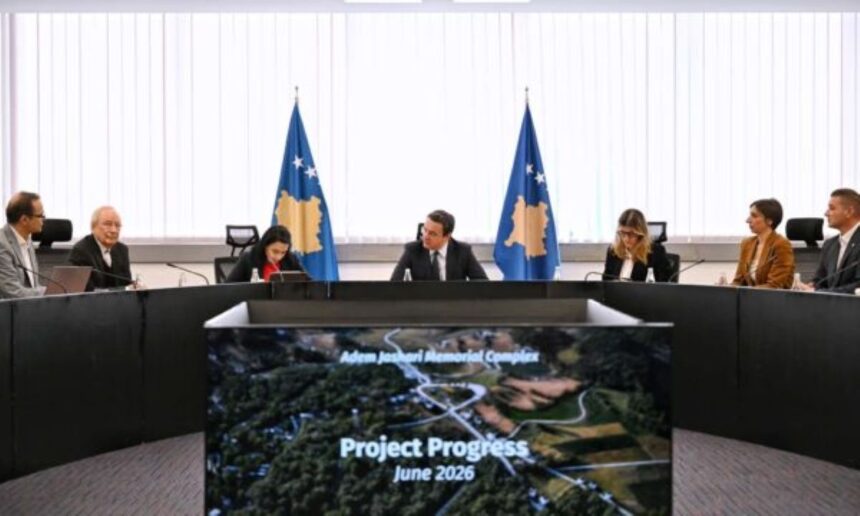
Caretaker Prime Minister Albin Kurti joined cultural authorities to present the foundational progress of the multi-million-euro Master Plan for the “Adem Jashari” Memorial Complex. Billed as Kosovo’s most significant historical memory project, field operations to stabilize the iconic resistance towers are slated to begin this year.
The Government of Kosovo has unveiled the structural progress of the long-awaited Master Plan for the “Adem Jashari” Memorial Complex in Prekaz, marking a definitive shift toward active preservation of the state’s most revered historical site.
Attending the formal ministerial presentation, Caretaker Prime Minister Albin Kurti hailed the newly compiled architectural and historical blueprints as “documents drawn up at the highest professional level.”
Kurti framed the complex not as a standard infrastructure development, but as the emotional anchor of modern Kosovan statehood and an essential pillar of national identity.
“The resistance and ultimate sacrifice of the Jashari family transformed Prekaz into the absolute symbol of defending the homeland and devotion to liberty,” Kurti stated. “They proved that freedom is not merely a political ideal, but a supreme value for which everything is sacrificed.”
Transitioning from Blueprints to Battlefield Conservation
The treatment of the Prekaz complex has faced scrutiny in recent years due to the compounding weather degradation of the bullet-riddled structures where KLA commander Adem Jashari and over 50 of his family members were killed by Serbian forces in 1998.
The caretaker prime minister emphasized that the state is moving past institutional paralysis:
- Beyond Architecture: The executive framework treats the complex not merely as a spatial planning or museum project, but as a binding institutional obligation to systematically document and transmit Kosovo’s liberation heritage.
- The 2026 Mandate: Technical conservation blueprints for the historic Kullas (Resistance Towers) are legally scheduled for final sign-off by the end of this year.
┌────────────────────────────────────────────────────────────────────────┐
│             Prekaz Master Plan: Operational Timeline 2026              │
├───────────────────────────────────────┬────────────────────────────────┤
│            PHASE I: DESIGN            │        PHASE II: FIELD         │
├───────────────────────────────────────┼────────────────────────────────┤
│ Execution of high-level architectural │ Completion of structural       │
│ master plans and historical audits.   │ engineering reviews for Towers.│
├───────────────────────────────────────┼────────────────────────────────┤
│       PHASE III: PROCUREMENT          │       PHASE IV: EXECUTION      │
├───────────────────────────────────────┼────────────────────────────────┤
│ Ministry of Culture & Tourism launches│ Heavy physical stabilization   │
│ international tender procedures.      │ and active on-site conservation│
└───────────────────────────────────────┴────────────────────────────────┘
Launch of International Procurement Tenders
The completion of the structural design phase will formally clear the path for the newly reorganized Ministry of Culture and Tourism to initiate large-scale procurement procedures.
By locking in the technical specifications, the administration intends to transition directly from theoretical planning into concrete, heavy physical stabilization interventions on the ground. Government engineering experts warn that the emergency reinforcements are vital to protect the crumbling masonry from another winter cycle.
The presentation concluded with a joint assurance from the project’s multidisciplinary steering committee that all incoming interventions will strictly adhere to international heritage protection conventions, ensuring the raw, wartime authenticity of the site remains completely unaltered.