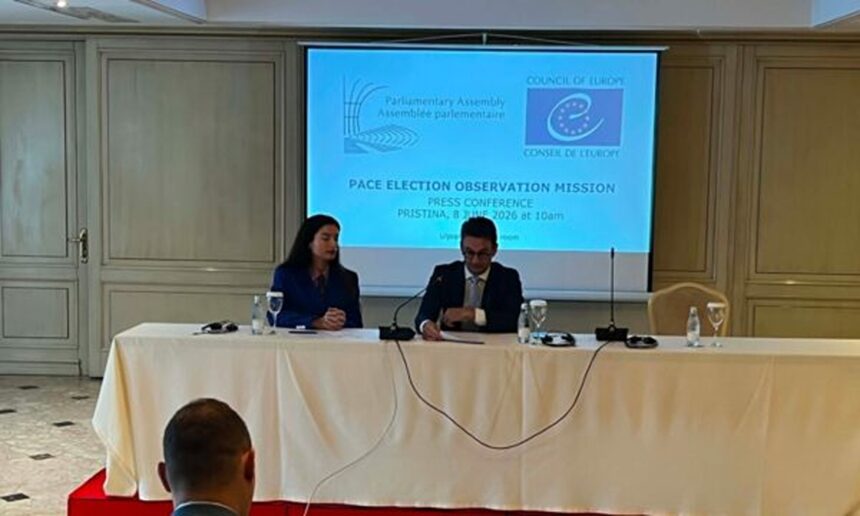
The head of the delegation of the Parliamentary Assembly of the Council of Europe (PACE), Iulian Bulai, has stated that the early parliamentary elections held on 7 June in Kosovo were conducted in an orderly manner without major incidents, but warned that the significant drop in voter turnout should be seen as a “wake-up call” for the political class.
Following the election observation mission, Bulai said in a press conference that Kosovo has held elections for the third time in 16 months due to political parties’ failure to reach agreements on forming institutions and electing a president.
“For the third time in 16 months, voters in Kosovo were called to the polls after political parties failed to reach agreements and elect a president, which resulted in the dissolution of the Assembly. Our delegation welcomes the orderly and peaceful conduct of the early elections held on 7 June 2026, which took place without major incidents,” he said.
Bulai emphasized that the elections were held in an atmosphere of voter fatigue and frustration, noting that the campaign was characterized by a lack of substantive debates and a shift toward digital communication.
“These elections took place against a backdrop of frustration and voter fatigue. The traditional campaign was subdued, marked by a lack of substantive debates. There was a shift toward digital campaigning. In this context, we commend citizens for participating, but the significant drop in turnout must be a wake-up call,” he said.
He added that in polling stations visited by the delegation, the process was conducted professionally and calmly, although some language-related issues were observed in certain municipalities.
“Election officials showed competence and the atmosphere was calm and orderly. However, language difficulties and insufficient representation in some cases created minor friction. Equal ethnic representation in election commissions should be improved,” Bulai stated.
According to him, there were also improvements in election management, but challenges remain regarding access to polling stations and inclusion of communities.
Bulai praised the technical organization of the elections and the work of the Central Election Commission (CEC) in certifying political entities and candidates.
“Despite tight deadlines, the elections were technically well organized and inclusive,” he said.
He added that changes in CEC rules created difficulties for registering civil society observers, stressing the importance of transparency in vote counting.
Bulai also noted diaspora participation, saying that recent changes in identification document rules caused confusion.
He said the delegation received reports of alleged misuse of state resources during the campaign, as well as external interference in the electoral process.
“Reports were made of alleged abuse of administrative resources and external influence, including interference from Serbia to influence the vote of Kosovo Serbs,” he said.
Bulai also raised concerns about disinformation and the use of artificial intelligence during the campaign, warning of risks to electoral integrity.
In conclusion, he called on political parties to engage in constructive dialogue to form institutions and elect a president, warning of the risk of further public disappointment.