“Serbia is a large kitchen from which we supply all of Europe,” is the message of the founder of the Chinese company “Minth,” which produces automotive spare parts.
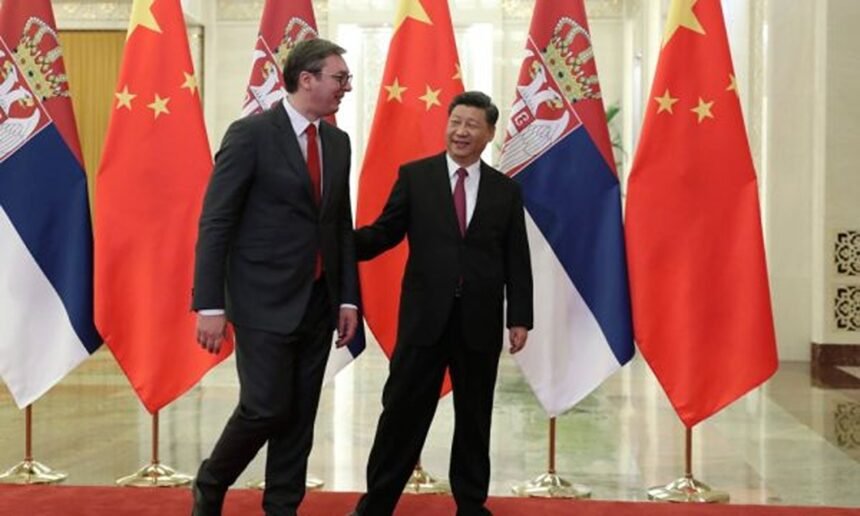
It is one of several companies with which Serbian President Aleksandar Vučić signed new agreements during his visit to China at the end of May.
The announcements come at a time when European Union (EU) countries are considering new measures to further protect their markets and jobs due to the rapid growth of Chinese investments and imports.
One proposed solution is a law commonly referred to as “Made in Europe,” which would restrict China’s access to EU markets in certain sectors.
Beijing has described the Brussels measures as discriminatory and warned of possible reciprocal action.
While for authorities in Belgrade Chinese investments mean new jobs and economic growth, the Serbian Chamber of Commerce estimates that the new EU measures could also affect Serbia’s economy.
What is the European Union proposing?
At the beginning of March, the European Commission proposed new measures to stimulate industry in EU member states, which the European Parliament is expected to vote on soon.
Formulated under the Industrial Accelerator Act – “Made in Europe,” the measures aim to strengthen European production, ensure clean technology, and increase employment for EU citizens.
According to the draft law, the measures will affect imports of steel, cement, aluminum, and the automotive industry, with the possibility of expanding the list.
Foreign investments controlling more than 40% of global production capacity in sectors such as electric vehicles, batteries, or solar energy will be targeted.
The law also aims to prevent unfair competition, as Chinese producers—supported by state subsidies—enter the European market at significantly lower prices than their competitors.
EU commissioners met on May 29 to discuss the proposals and stated that “the current state of trade and investment relations with China is not sustainable.”
Brussels also said that talks with China will continue and that the EU remains one of the most open markets in the world.
China is the EU’s third-largest trading partner, after the United States and the United Kingdom, but the trade balance is heavily in China’s favor.
Why could Serbia feel the impact of EU measures?
Billions of euros in Chinese investments have entered Serbia over more than a decade.
Beyond infrastructure projects and resource extraction, China is also investing in factories that export more easily to the EU via Serbia.
Serbia has a Stabilization and Association Agreement with the EU, allowing duty-free exports of most industrial and agricultural products.
Chinese products manufactured in Serbia can carry the “Made in Serbia” label and more easily enter the EU market.
“It is all a screwdriver industry,” says economic journalist Miša Brkić, referring to assembly plants using Chinese-made components.
New EU rules could change this situation, as Brkić believes Europe will protect itself regardless.
What else does China export to Europe via Serbia?
Several Chinese companies operate in Serbia producing automotive parts for the European market.
Among them is the Minth factory, with facilities in Šabac and Loznica.
At the end of May, during an official Serbian delegation visit to China led by President Aleksandar Vučić, Minth founder Chin Ronghua said Serbia is the hub from which their products enter the entire European market.
According to Ronghua, Serbia is a “large kitchen” for plants supplying EU countries.
How is Serbia’s trade with China?
As with the EU, Serbia also runs a trade deficit with China.
Imports from China are many times higher than exports to China.
The Serbia–China Free Trade Agreement, implemented in July 2024, did not significantly improve the figures.
Brussels has expressed concern about the agreement, stating that Serbia, as an EU candidate country, is expected to align its trade policy with the Union.
Possible consequences
Serbian President Aleksandar Vučić recently announced that additional Chinese investments worth €945 million are coming to Serbia.
Experts warn that Serbia could face consequences if the EU tightens trade rules against China further.
According to analysts, Serbia’s dependence on both China and the EU could create economic tensions in the future.
Is there a solution to China’s market expansion?
Experts say both Europe and Serbia will struggle to reduce economic dependence on China.
The EU is attempting to strengthen its industrial base and limit subsidized Chinese competition.
In Serbia, experts suggest increasing the involvement of local companies in supply chains and improving transparency in agreements with China.
However, most major Chinese investments are negotiated at the state level and often involve Chinese state companies and loans.