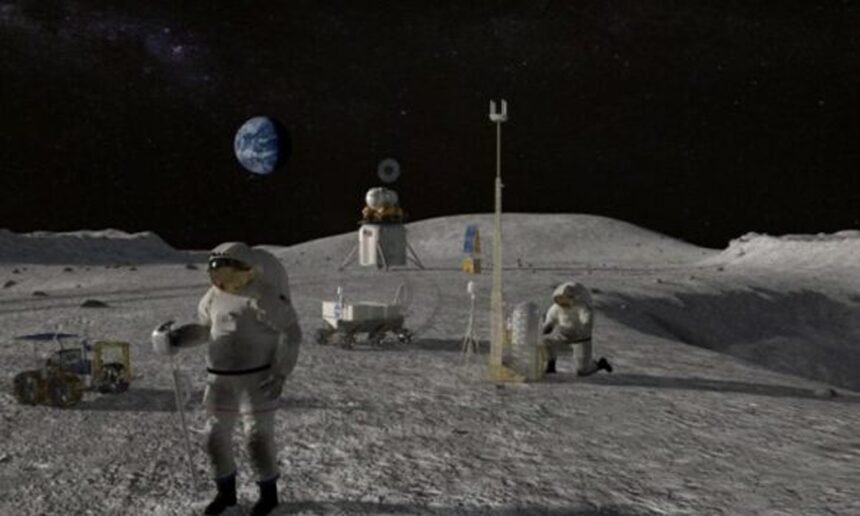
NASA has begun ordering landing vehicles, exploration rovers, and drones for a large-scale lunar base, just two months after the historic Artemis II mission orbited the Moon, according to AP.
The U.S. space agency unveiled the first phase of its lunar base plan by awarding contracts worth hundreds of millions of dollars to four American companies.
Jeff Bezos’ company, Blue Origin, will provide two landing vehicles to transport lunar rovers to the Moon’s surface near the south pole. These vehicles will be built by Astrolab and Lunar Outpost. Meanwhile, Firefly Aerospace, which successfully completed a Moon landing last year, will deliver the first drones to Earth’s natural satellite.
According to the plan, this equipment is expected to reach the Moon before the first astronauts of the Artemis program land there, which is scheduled no earlier than 2028. During the Artemis II mission in April, four astronauts flew around the Moon, traveling farther into space than Apollo-era crews in the late 1960s and early 1970s.
For the Artemis III mission, planned for next year, another crew will practice docking procedures in Earth orbit between NASA’s Orion capsule and lunar landers being developed by Blue Origin and SpaceX, owned by Elon Musk.
NASA aims to launch Artemis III in mid-2027, while the landing of two astronauts on the Moon could take place as early as 2028.
The second phase of the project, spanning 2029 to the early 2030s, envisions building permanent infrastructure, including a power network. In the third phase, during the 2030s, the base is expected to support long-term astronaut stays in permanent habitats.
“Then we will be able to say: ‘We are here to stay, and we are not leaving,’” said Carlos Garcia-Galan, head of NASA’s lunar base program. He envisions a base stretching across hundreds of square miles, with boundaries monitored by drones called “MoonFall” placed at the edges of the territory.
NASA Administrator Jared Isaacman said these territorial markers are intended to respect the equipment and assets of other nations that may be operating nearby. According to him, the goal of the lunar base is to foster a lunar economy, support scientific research, and lay the groundwork for future missions to Mars.
“For those who have been patiently waiting, the big return is very close, and we will not slow down. In fact, we are just getting started,” Isaacman said.