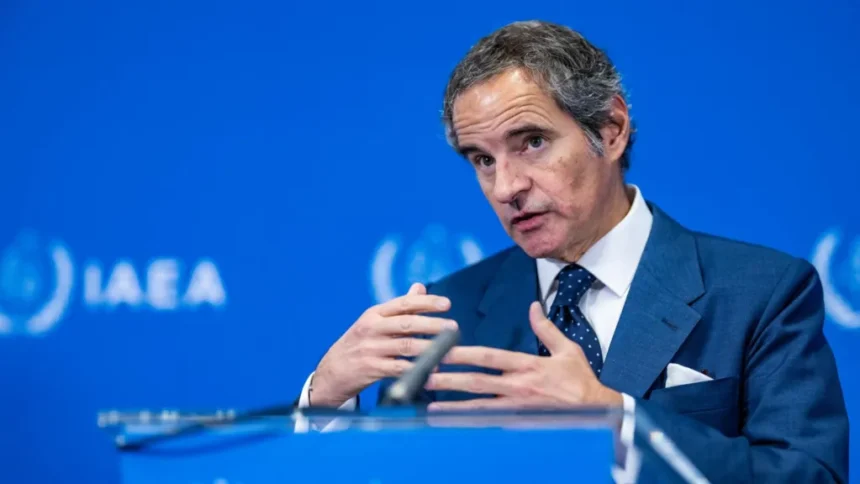
Rafael Grossi, the head of the global nuclear watchdog agency, confirmed today that nuclear inspections will resume in Iran following the framework of the preliminary peace agreement brokered last week between Washington and Tehran.
Speaking to reporters during a diplomatic visit to Japan, the Director General of the International Atomic Energy Agency (IAEA) struck an optimistic but urgent tone regarding the verification of Iran’s controversial nuclear inventory.
Verifying the Enriched Uranium Dilution
Grossi emphasized that the newly signed accord explicitly positions the IAEA as the primary guarantor overseeing the denuclearization process.
- Logistical Blueprints: The IAEA chief noted that teams are moving rapidly to iron out operational modalities, including specific dates, access procedures, and facilities to be inspected.
- The Uranium Mandate: Grossi stated that the agreement “clearly and unequivocally” dictates that the dilution of Iran’s highly enriched uranium stockpile must be executed entirely under direct IAEA surveillance.
Key Milestones of the U.S.-Iran Preliminary Peace Accord (June 2026):
========================================================================
IAEA Mandate      --> Oversee the immediate dilution of highly enriched uranium.
Maritime Relief   --> Iran restores free passage in the Strait of Hormuz;
                      U.S. lifts its naval blockade on Iranian ports.
Economic Impact   --> Brent crude drops below $75/barrel for the first time since
                      the U.S.-Israel-Iran war began.
Evacuation Scheme --> UN initiates safe-passage corridors to evacuate thousands
                      of war-stranded sailors.
========================================================================
Teheran Signals Strict Conditions Amid U.S. Regional Diplomacy
Despite Grossi’s assurances, internal political friction remains. Iran’s Deputy Foreign Minister threw a wrench into the immediate timeline, stating that actual physical access to the country’s war-damaged nuclear facilities and sensitive materials will strictly be handled only within the framework of a finalized, comprehensive treaty with the United States.
Concurrently, U.S. Secretary of State Marco Rubio is spearheading a high-stakes diplomatic tour of Gulf nations to solidify regional backing for the fragile truce. Rubio met with UAE President Mohamed bin Zayed Al Nahyan in Abu Dhabi today, with subsequent stops scheduled for Kuwait and Bahrain.
Oil Slumps and Naval Blockades Ease
The geopolitical detente has sent shockwaves through global markets. On Wednesday, the price of Brent crude oil tumbled below $75 per barrel for the first time since the outbreak of the devastating U.S.-Israeli war against Iran.
The market correction reflects immediate relief over the dual-deescalation clauses of the preliminary pact:
The Maritime Equation: Under the agreed terms, Iran has committed to safeguarding the Strait of Hormuz for international shipping, while the United States has begun lifting its crushing naval blockade on Iranian ports. The United Nations confirmed that the first wave of commercial ships has safely traversed the vital choke point under a specialized humanitarian scheme designed to evacuate thousands of foreign mariners stranded by the conflict.