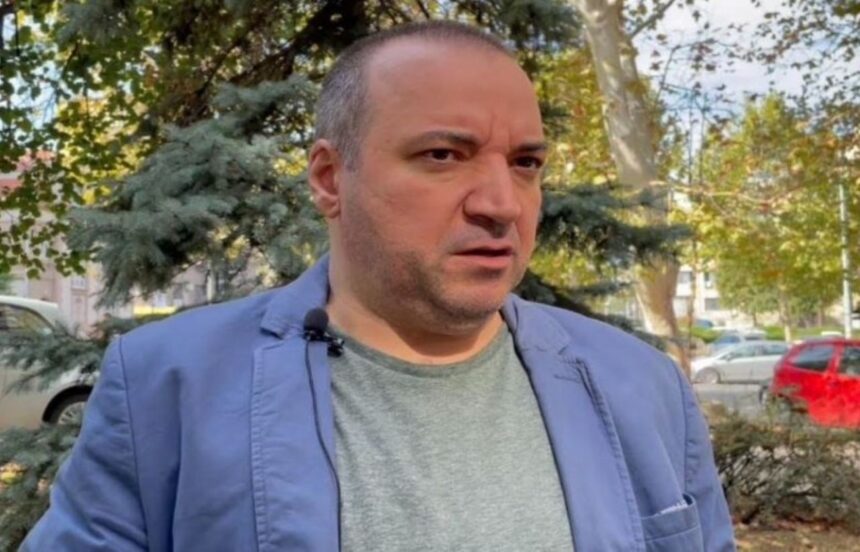
In a revealing interview with Radio Kosovo 2, Belgrade-based historian Dragan Popović warned that official Belgrade has systematically repurposed the narrative of the 1990s Yugoslav wars, transforming the Srebrenica genocide from a historical fact into a highly weaponized political instrument designed to consolidate authoritarian power.
Popović argues that by strictly monopolizing the public sphere, the regime of President Aleksandar Vučić actively manufactures national anxiety to shield itself from domestic criticism and justify a centralized, heavy-handed style of governance.
Manufacturing Crisis for Political Cohesion
According to Popović, state-aligned media outlets and public institutions are synchronized to push a singular historical policy. Within this framework, Srebrenica is acknowledged as a crime, but it is deliberately diluted as “just one of many” wartime atrocities. More importantly, any international commemoration or judicial reminder of the genocide is framed as a hostile, external conspiracy against the Serbian people.
                    ┌── External Pressure: International remembrance is framed as an anti-Serb plot.
THE SURVIVAL LOOP   ┼── Manufactured Fear: Citizens feel perpetually targeted by foreign forces.
                    └── Authoritarian Necessity: Dissent is silenced in the name of "national unity."
The historian emphasizes that this constant manufacturing of an external threat serves a very specific domestic purpose:
“When a society is convinced that the entire state is under immense external pressure, it becomes incredibly easy to justify the need for political unity around a single ruler. The message sent to citizens is clear: abandon internal debates, democratic dialogue, and political conflicts, and gather under a single flag and the strong hand of an authoritarian leader. Aleksandar Vučić has perfected this principle to a very high level.”
— Dragan Popović, Historian
By identifying the current ruling elite with the state itself, any political opposition or internal critique is successfully re-branded as a direct betrayal of national interests.
Weaponizing the Past Across the Western Balkans
Popović extended his critique to the broader region, noting that wartime atrocities, which should serve as the baseline for post-conflict reconciliation and justice, are instead exploited by regional political elites to maintain neighboring states as permanent adversaries.
| Strategic Misuse | Operational Consequence |
| Monopolization of Media | Erases objective, court-established historical facts from mainstream view. |
| Production of Hatred | Relies on the exploitation of trauma to maintain a high-stress political environment. |
| Impunity for Violence | Extends protection to extremist groups to actively silence independent voices. |
“The Truth Will Not Disappear”
Despite the overwhelming state apparatus and the shrinking space for civil dissent—highlighted just days ago by the violent assault on author Vladimir Arsenijević—Popović remains optimistic about the resilience of independent historical memory in Serbia.
He asserts that a committed segment of civil society, alongside incoming generations, will inevitably break through the state-sanctioned historical revisionism.
“New generations are coming who will inevitably ask what happened and how such a crime was possible in Europe at the end of the 20th century,” Popović concluded. “There will always be people who ask questions. And the moment you start asking questions and thinking critically about the past, you are much closer to finding the answers.”