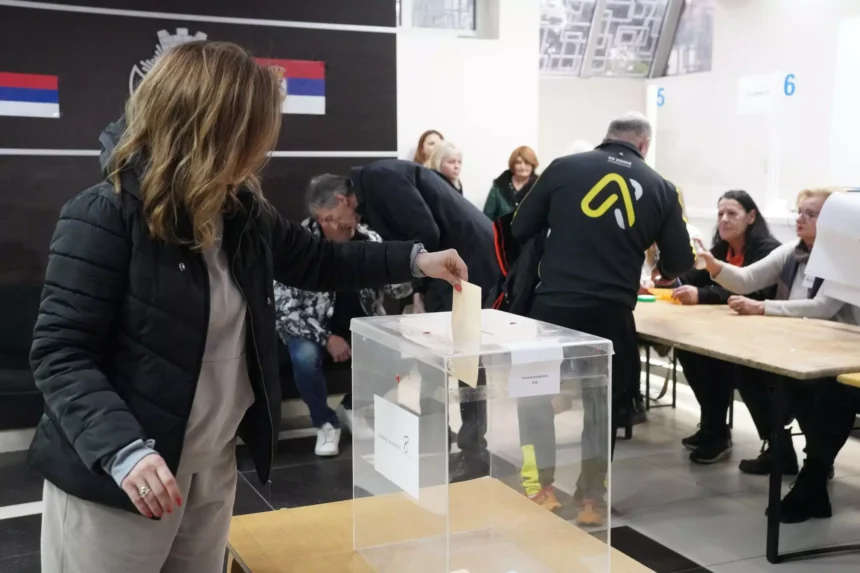
A newly formed parliamentary group in Serbia is seeking to expand the number of election monitors available to support the country’s student movement, as political parties and activists debate whether the nearly 15,000 people currently being trained will be enough to ensure effective oversight of future elections.
The parliamentary group, “MPs With Students – For Election Control,” currently includes 16 lawmakers. It was formed with the support of the Democratic Party (DS) and other independent MPs with the aim of increasing representation in Serbia’s election boards and making additional positions available to a future student-backed electoral list or movement.
Under Serbia’s electoral system, parties participating in elections can appoint members to the expanded composition of polling boards, while parliamentary groups are entitled to representation in the permanent composition of election boards based on their number of MPs.
DS official Zoran Alimpić said the creation of the new parliamentary group could significantly increase the number of positions available for election monitoring.
According to him, around 50,000 positions are available within the permanent composition of election boards nationwide, with each MP effectively accounting for roughly 200 members.
“The only purpose of this parliamentary group is to secure the largest possible number of election board members who will be made available to the student list, or to the movement of students and citizens already undergoing training,” Alimpić said.
Nearly 15,000 monitors currently in training
Students participating in Serbia’s protest and blockade movement have announced that nearly 15,000 people are currently undergoing training to monitor elections.
Students from the Faculty of Electrical Engineering in Belgrade have said that approximately 16,546 trained monitors would be needed to cover the entire country.
The student movement has also said its representatives would be present in permanent election-board structures through supporting political parties, as well as through election-observation missions. Additional volunteers are expected to operate outside polling stations in various support roles.
However, political and election experts differ sharply over whether 15,000 to 16,000 monitors would be sufficient.
Alimpić has previously argued that as many as 60,000 people could be needed to provide effective protection against potential electoral fraud.
The Free Citizens Movement (PSG) has meanwhile estimated that at least 31,000 election monitors would be required to protect the integrity of the vote.
Branimir Kuzmanović, president of the DS city committee and a veteran of numerous election campaigns, said approximately 16,000 trained and verified monitors would represent an absolute minimum.
He argued that three coordinated people per polling station would be preferable, bringing the required number to around 24,000.
According to Kuzmanović, three people would allow two monitors to remain present while a third could take breaks or perform other duties, including accompanying mobile voting teams when necessary.
One MP could secure around 200 election-board positions
DS leader Srđan Milivojević said the party’s MPs, together with eight independent lawmakers, formed the parliamentary group because each MP provides access to approximately 200 positions in election boards across Serbia.
Before the new group was established, DS could reportedly count on around 1,392 election monitors. With the addition of eight more MPs, the party expects the number of available positions to roughly double.
Milivojević stressed that joining the parliamentary group does not automatically mean joining DS, securing a place on a future student electoral list or receiving any other political privilege.
Instead, he described participation as an act of responsibility aimed at protecting what he called a potential victory by a student-backed list and preventing electoral fraud.
He said the group would continue calling on other MPs to join before the expected dissolution of parliament.
Milivojević also said the parliamentary group is currently the second largest in Serbia’s National Assembly, behind the ruling Serbian Progressive Party (SNS), while emphasizing that it does not constitute a formal political coalition.
The differing estimates — ranging from around 16,000 to as many as 60,000 people — underline the scale of the organizational challenge facing Serbia’s opposition and student movement as they prepare for possible elections.