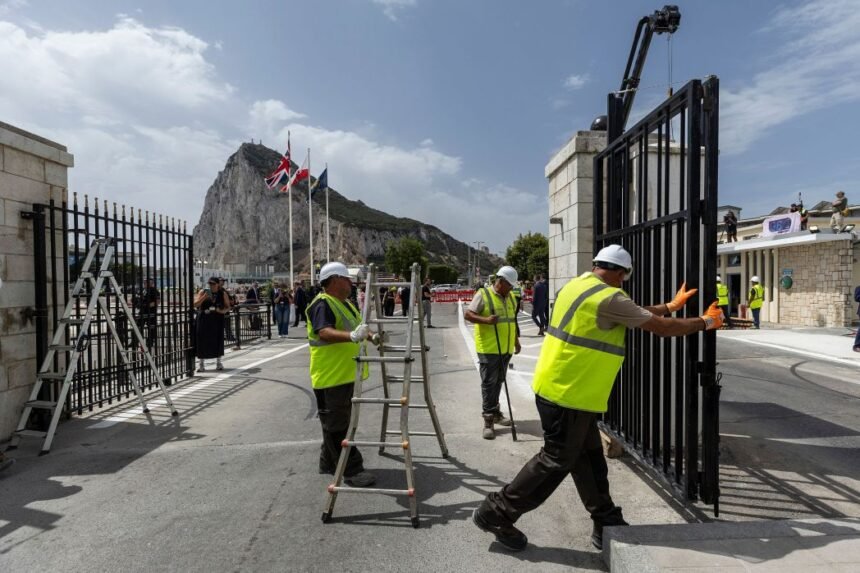
Communities on both sides of the Spanish-Gibraltarian border are celebrating a momentous shift in European geopolitics. Following the signing of a landmark post-Brexit treaty, workers have begun dismantling Western Europe’s last physical border fence—bringing an end to over a century of strict division and persistent border delays.
The historic agreement, finalized in Brussels on Tuesday, took effect at midnight. The deal concludes more than four years of intensive, often-stalled negotiations between the United Kingdom, Spain, Gibraltar, and the European Union following Britain’s formal exit from the bloc.
Breaking Down the Brussels Agreement
The newly enacted treaty completely restructures how the British Overseas Territory interacts with its European neighbor, focusing heavily on mutual economic survival and regional fluidity:
- Schengen Zone Integration: To eliminate physical border and customs checks at the land crossing, Gibraltar effectively joins the Schengen passport-free zone.
- Spanish Oversight: Spain will assume the sovereign responsibility of managing Schengen-standard security checks at both Gibraltar’s international airport and seaport.
- The End of the Fence: The physical border fence—originally erected by British authorities in 1908 to control livestock and movement—is being permanently removed.
A Lifeline for the Local Economy
The geopolitical resolution is, above all, a massive relief for the local workforce. Gibraltar is home to approximately 40,000 residents but relies heavily on a daily influx of labor to keep its economy afloat.
                    [ The Daily Cross-Border Flow ]
                                   |
         +-------------------------+-------------------------+
         |                                                   |
         v                                                   v
 [ The Spanish Workforce ]                           [ Regional Economic Impact ]
 • Over **15,000 Spanish citizens**                  • Crucial financial driver for Andalucia's
   cross into Gibraltar every single day.              underdeveloped **Campo de Gibraltar** region.
 • Heavy peak-hour queues are now eliminated.       • Ensures long-term prosperity for 300,000 locals.
“Three Centuries of Division” Resolved
Spanish Foreign Minister José Manuel Albares hailed the treaty as a triumph of modern diplomacy, noting that the agreement resolves historical friction dating back to the 1713 Treaty of Utrecht, which originally ceded the “Rock” to Great Britain.
“We have just ended a long period of disagreement and opened the door to a new era of coexistence for two populations that lived apart and are now uniting, three centuries later. This is an agreement for the future, representing a major step forward in stability and prosperity.”
— José Manuel Albares, Minister of Foreign Affairs of Spain
Under the previous post-Brexit status quo, temporary transitional measures kept the border open, but travelers frequently faced multi-hour bottleneck queues during periods of political tension between London and Madrid. With the fence now coming down, both sides are looking forward to uninterrupted economic and social integration.