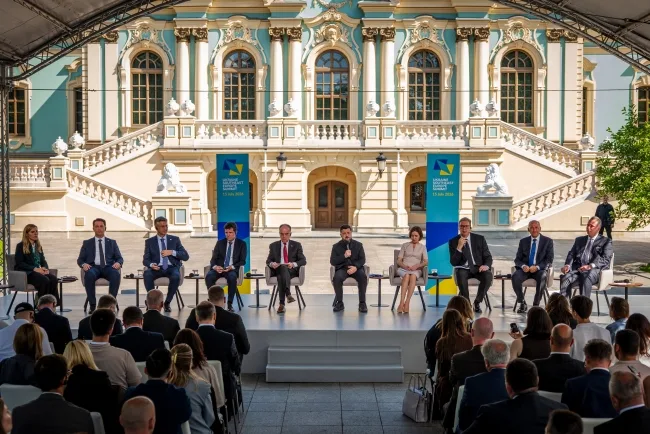
Serbian President Aleksandar Vučić has confirmed that he was the only participant at the fifth Ukraine–Southeast Europe Summit in Kyiv who refused to sign the joint declaration.
The document outlined continued military, financial, and security support for Ukraine, alongside tightening sanctions on Moscow and targeting Russia’s “shadow fleet.”
While Ukrainian President Volodymyr Zelenskyy and representatives from all other regional participants—Albania, Greece, Moldova, Romania, Croatia, Slovenia, North Macedonia, Montenegro, and Bulgaria—signed the joint declaration, Serbia chose to stand alone.
What the Rejected Declaration Demanded
The joint declaration put forward by Southeast European leaders and Ukraine contained a series of sharp political and economic demands directly aimed at the Kremlin:
- War Classification: It explicitly accused Russia of an “illegal, unprovoked, and unjustified aggression,” demanding the immediate, unconditional withdrawal of its military forces from all Ukrainian territory.
- War Crimes: It labeled Russian attacks on civilians and critical infrastructure as war crimes, expressing support for the establishment of a Special Tribunal for the Crime of Aggression.
- Economic Pressure: It called for a further tightening of sanctions, the suppression of Russia’s “shadow fleet” of oil tankers, and measures against third countries assisting Moscow.
Belgrade’s Five Positions and the Sovereignty Balance
Despite refusing to sign the document due to its provisions on military aid and sanctions, Vučić presented five specific positions for Serbia based on strict adherence to the UN Charter.
“I am the only one who did not sign the declaration… I discussed all key issues with President Zelenskyy, and we expressed mutual gratitude for respecting the territorial integrity of our respective countries.”
— Aleksandar Vučić, President of Serbia
Bilateral Diplomacy: Regional Logistics and the “Đerdap 3” Project
On the sidelines of the summit, Vučić engaged in several high-profile bilateral meetings, keeping the focus heavily on economic development over geopolitical alignment:
1. Dialogue with Ursula von der Leyen and Janez Janša
Vučić met with the European Commission President and the Slovenian Prime Minister to discuss European integration and infrastructural connectivity. He requested EU funds for a proposed Belgrade–Trieste railway extension, which would eventually stretch through Romania and Moldova to Ukraine.
The Serbian president reiterated that economic growth remains Belgrade’s priority over the opening of EU accession clusters:
“We will keep working on integration, but our lives do not depend on opening clusters. We have already surpassed all countries in the region that were once ahead of us in terms of economy and living standards.”
2. Joint Energy Venture: “Đerdap 3” with Romania
Following a meeting with Romanian President Nicușor Dan, Vučić announced that both countries would sign a memorandum of understanding for the Đerdap 3 (Iron Gates III) pumped-storage hydropower plant. Supported by the United States, this massive investment is designed to provide long-term energy security for Serbia as electricity demands rise.