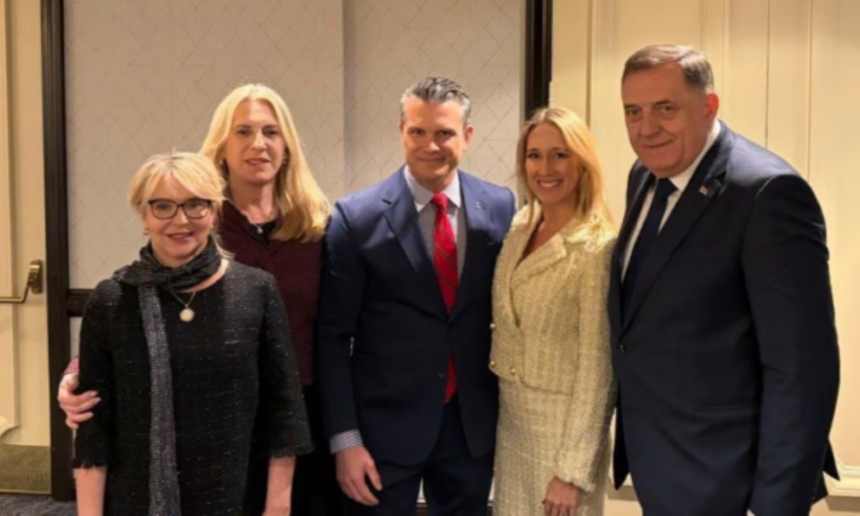
Republika Srpska has spent millions of dollars on lobbying efforts in Washington aimed at promoting its independence from Bosnia and Herzegovina, according to data from the U.S. Department of Justice analyzed by Radio Free Europe/Radio Liberty (RFE/RL).
The entity has allocated approximately $4 million from its budget to hire lobbying firms in the United States, with its latest contract signed with Israeli-Canadian consulting firm Dickens & Madson. The agreement forms part of a broader lobbying campaign that has been underway for more than a decade.
Since 2015, Republika Srpska has spent at least $8.3 million on lobbying and legal representation in the United States.
The lobbying campaign has focused on several objectives, including securing the removal of U.S. sanctions against former Republika Srpska President Milorad Dodik, challenging the legitimacy of the Office of the High Representative (OHR) in Bosnia and Herzegovina, and promoting greater autonomy for the Serb-majority entity.
The United States lifted sanctions against Dodik and several of his associates in 2025, while then-High Representative Christian Schmidt resigned in May 2026.
In addition to lobbying contracts, Republika Srpska allocated 54.9 million convertible marks (approximately €28 million) in its revised 2025 budget for lobbying-related activities. The funding was approved by the entity’s National Assembly, where Dodik’s Alliance of Independent Social Democrats (SNSD) holds a governing majority.
By comparison, Bosnia and Herzegovina’s state institutions have hired a lobbying firm only once since the end of the 1992–1995 war. In 2025, the country’s Foreign Ministry briefly retained a Washington-based firm to advocate for Bosnia and Herzegovina’s territorial integrity.
Independence Remains a Declared Goal
The most significant lobbying agreement was signed on September 6, 2025, with Dickens & Madson, valued at $4 million. The contract explicitly states that “the independence of Republika Srpska from Bosnia and Herzegovina is our ultimate objective.”
Dickens & Madson founder Ari Ben-Menashe, a businessman who describes himself as a former Israeli military intelligence officer, declined to discuss the company’s activities, citing confidentiality obligations under its contract.
Neither the Government of Republika Srpska nor Bosnia and Herzegovina’s Ministry of Foreign Affairs responded to RFE/RL’s requests for comment.
Under Bosnia and Herzegovina’s Constitution, neither Republika Srpska nor the Federation of Bosnia and Herzegovina has the legal authority to secede from the state or organize a referendum on independence. Despite this, Republika Srpska’s leadership has repeatedly raised the possibility in recent years.
During the 30th anniversary of the Dayton Peace Agreement in November 2025, the United States reaffirmed its support for Bosnia and Herzegovina’s sovereignty and territorial integrity, emphasizing its commitment to preserving peace and stability across the Western Balkans.
Extensive Network of Republican-Linked Lobbyists
Over the past decade, Republika Srpska has retained 15 U.S.-based lobbying firms and legal consultancies, including its own representative office in Washington, which is registered under the U.S. Foreign Agents Registration Act (FARA).
According to public FARA filings, all of the contracted firms have ties to Republican political circles in Washington.
Among them is Zell & Associates International Advocates, founded by Israeli-American attorney Marc Zell, who chairs the Republican Party’s branch in Israel and is considered politically close to Israeli Prime Minister Benjamin Netanyahu.
Republika Srpska also hired RRB Strategies, led by former Illinois Governor Rod Blagojevich. Blagojevich, whose parents were Serbian immigrants, has frequently visited Banja Luka and has publicly highlighted his ties to Serbia. His prison sentence for corruption was commuted by U.S. President Donald Trump in 2020 before he received a full presidential pardon in 2025.
Another firm, CRB Global, simultaneously represents both the Government of Serbia and Republika Srpska’s Ministry for European Integration and International Cooperation. According to FARA disclosures, Serbia pays the firm $10,000 per month, while Republika Srpska pays $100,000 monthly.
Legal Disputes Over the Lobbying Campaign
The lobbying campaign has also triggered legal challenges within Bosnia and Herzegovina.
In February 2026, eleven lawmakers from the Federation of Bosnia and Herzegovina filed criminal charges against Mladen Filipović, who signed the Dickens & Madson contract on behalf of Republika Srpska. Filipović heads Republika Srpska’s Representative Office in Austria, through which the lobbying agreement was financed.
The lawmakers argued that financing a campaign advocating independence constitutes an attack on Bosnia and Herzegovina’s constitutional order and territorial integrity.
However, the Prosecutor’s Office of Bosnia and Herzegovina dismissed the complaint, stating that the criminal offense requires the use or threat of force aimed at altering the country’s constitutional order or territorial borders.
Bosnian lawmaker Denis Zvizdić criticized the decision, arguing that public funds contributed by taxpayers across Bosnia and Herzegovina are being used to finance activities that undermine the constitutional framework of the state.
The issue is now pending before the Constitutional Court of Bosnia and Herzegovina, where Zvizdić has requested a ruling prohibiting the use of public funds for lobbying efforts that contradict the country’s Constitution.
A previous Constitutional Court decision from 2008 ruled that Republika Srpska is legally permitted to hire lobbying firms abroad to promote its own interests as an entity, provided it does not exercise the exclusive foreign policy competencies reserved for Bosnia and Herzegovina’s central institutions.
Political Objectives Beyond Sanctions
While individual contracts differ, most share similar strategic objectives.
These include advocating for the removal of sanctions against Dodik and his associates, promoting Republika Srpska’s interpretation of the Dayton Peace Agreement, seeking greater decentralization of Bosnia and Herzegovina, and questioning the authority of the Office of the High Representative.
Some agreements also include organizing meetings between Republika Srpska officials and U.S. policymakers, providing political consulting, conducting media and social media campaigns, and facilitating contacts with the White House, Congress, and the U.S. State Department.
Republika Srpska officials, including Dodik, have made several visits to the United States in recent years. On April 7, Donald Trump Jr., the eldest son of U.S. President Donald Trump, visited Banja Luka.
Current lobbying contracts do not specify deadlines for achieving their political goals, instead committing lobbying firms to continue promoting Republika Srpska’s interests before U.S. institutions on an ongoing basis.
Meanwhile, Bosnia and Herzegovina’s central institutions currently have no active paid lobbying contracts registered under FARA.
Political analyst Jasmin Mujanović told RFE/RL that Republika Srpska’s more centralized political structure allows it to organize and finance international lobbying campaigns more efficiently than Bosnia and Herzegovina’s fragmented state institutions.
Although Bosnia and Herzegovina’s Foreign Ministry briefly partnered with Continental Strategy through the Bosnian-American Alliance in 2025 without financial compensation, that arrangement ended after five months. Republika Srpska subsequently signed its own one-year, $420,000 contract with Continental Strategy in January 2026 for lobbying and strategic consulting related to political, economic, and security issues involving the United States.