A book praising the rule of Russian President Vladimir Putin and endorsing Russia’s annexation of Crimea has been distributed to schools in Serbia and Republika Srpska, the Bosnian Serb entity, through the Russkiy Mir (Russian World) Foundation, an organization sanctioned by the European Union.
In July, the foundation announced that, with the support of Russia’s Ministry of Foreign Affairs, it had donated educational equipment and teaching materials to 60 educational institutions in Serbia, Republika Srpska, and Tunisia. The materials, including books and laptops, were delivered to schools where the Russian language is taught.
According to the foundation, the donation included dozens of schools in Serbia and 27 schools in Republika Srpska. Due to copyright restrictions, Radio Free Europe/Radio Liberty (RFE/RL) was unable to review all of the books included in the donation.
The relevant ministries in Serbia and Bosnia and Herzegovina did not respond to RFE/RL’s questions regarding whether they considered the content of the donated books problematic. The Russkiy Mir Foundation also declined to comment.
The foundation is financed by the Russian government and was established in 2007 by decree of President Vladimir Putin.
Alexander Meienberger, a researcher and author of a book on the activities of the Russkiy Mir Foundation, told RFE/RL that he was not surprised by the content of the book.
“The Russkiy Mir Foundation presents itself as an organization dedicated to promoting the Russian language and culture, but its work has always had an ideological component,” he said.
Following Russia’s full-scale invasion of Ukraine in 2022, the foundation was placed under European Union sanctions.
Despite this, authorities in Serbia and Republika Srpska continued to deepen cooperation with Russia even after the invasion. Serbia, although an EU candidate country, has refused to join Western sanctions against Moscow.
Ideological Content
At the beginning of July, Isidora Sekulić Primary School in Šajkaš, near Novi Sad, announced on Facebook that it had received a donation from the Russkiy Mir Foundation.
According to the school, the donation included books and laptops intended to improve Russian language teaching.
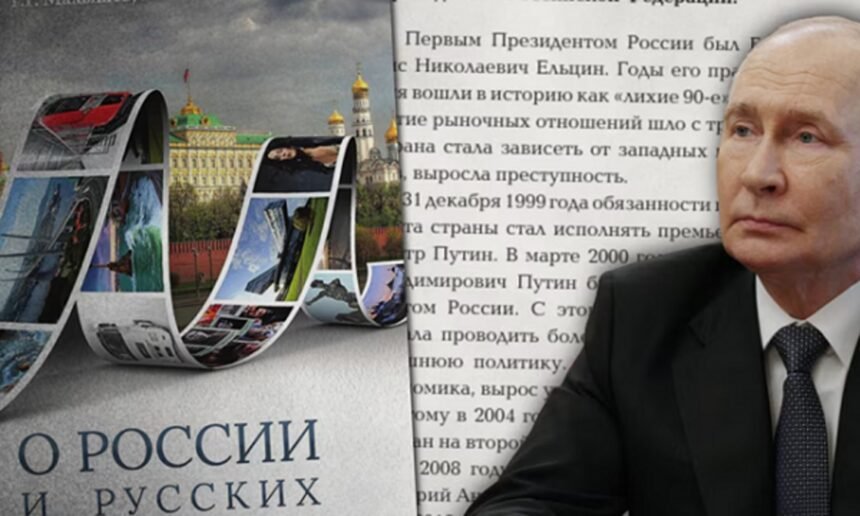
However, one of the donated books, “About Russia and Russians,” contains chapters with clear ideological content praising Vladimir Putin’s leadership and supporting Russia’s annexation of Crimea.
The school stated that it had maintained successful cooperation with the Russkiy Mir Foundation for several years. The foundation itself confirmed that it had delivered educational materials to 16 schools in Serbia.
The donation ceremony was covered by the public broadcaster Radio Television of Vojvodina, where books on the Russian language, culture, and history were displayed.
Among them was “About Russia and Russians,” a textbook for learners of Russian as a foreign language covering Russia’s geography, history, and culture.
The same book also appeared in photographs from the donation ceremony held for schools in Republika Srpska.
After reviewing the publication, RFE/RL found that several chapters reflect interpretations of modern history consistent with official Kremlin narratives.
The edition examined by RFE/RL was published in 2015, seven years before Russia launched its full-scale invasion of Ukraine.
In the chapter dedicated to modern Russia, the book claims that after Vladimir Putin came to power in 1999, Russia “began pursuing a more independent foreign policy.”
It also states that Russia’s economy “strengthened significantly” and that “the standard of living of Russian citizens improved,” suggesting these achievements secured Putin another presidential term.
Putin has effectively remained in power for nearly 27 years, alternating between the offices of president and prime minister to bypass constitutional term limits.
One chapter, titled “The Return of the Republic of Crimea to Russia,” claims that in March 2014 the people of Crimea held a referendum and decided to leave Ukraine and join Russia.
The book fails to mention that Russia’s annexation of Crimea has not been recognized by the vast majority of countries and that the international community considers Crimea to be internationally recognized Ukrainian territory.
Russia occupied and annexed Crimea in 2014, an event widely regarded as the beginning of the war against Ukraine, which escalated into a full-scale invasion in February 2022.
Responses from Schools and Institutions
The Russkiy Mir Foundation also donated books to the Eighth Belgrade Gymnasium.
School officials wrote on Instagram that the donation represented “an important step toward improving teaching conditions and the development of our students.”
However, neither this school nor Isidora Sekulić Primary School responded to RFE/RL’s official inquiries regarding the donation.
Unofficial sources at Isidora Sekulić Primary School told RFE/RL that the books were only donations and were not used in the teaching process.
According to those sources, teachers had not yet reviewed the books.
RFE/RL also contacted Serbia’s Institute for the Improvement of Education, the body responsible for providing expert evaluations during the approval process for school textbooks.
The Institute stated that it is not responsible for approving donated books and does not maintain records of publications schools receive as gifts.
It also confirmed that “About Russia and Russians” had never been submitted for official evaluation under Serbia’s Law on Textbooks.
Nevertheless, the Institute emphasized that a book being present in a school library does not automatically grant it the status of an approved textbook.
“Additional literature and teaching manuals may be selected and used by educators in accordance with their professional judgment and the specific needs of instruction,” the Institute said.
The same educational materials were also distributed to schools in Republika Srpska during a ceremony attended by representatives of the Republika Srpska Pedagogical Institute and the entity’s Ministry of Education and Culture.
The event took place at the National and University Library of Republika Srpska, which has hosted a Russian Cultural Center established by the Russkiy Mir Foundation since 2012.
The center contains around 1,000 books and multimedia materials and, according to the library, aims to promote the Russian language.
The library noted that the Russkiy Mir Foundation currently operates 48 cultural centers across 33 countries.
Neither the library nor the Ministry of Education and Culture responded to RFE/RL’s requests for comment regarding the donation.
Expanding Russia’s Soft Power
Alexander Meienberger, author of The Russkiy Mir Foundation: Ideology, Goals and Networks, has researched the foundation’s activities in Austria and Germany prior to Russia’s full-scale invasion of Ukraine.
According to him, the foundation established Russian cultural centers, Russian language classrooms, and funded educational programs abroad.
“The foundation’s activities were never limited to language promotion. The goal was to build long-term networks of people sympathetic to Russia and create a positive image of Russian culture and the Russian state,” he said.
Meienberger argues that after 2022, the Balkans, Africa, and Asia became increasingly important for Russia’s cultural outreach, as many Western countries cut ties with Russian state institutions.
He believes this reflects Moscow’s efforts to preserve and expand its soft power in regions where it still has political partners and influence.
According to the foundation’s official website, its recent activities include initiatives promoting the Russian language across Africa, Latin America, and Asia.
“Although the foundation does not usually function as a direct propaganda outlet, its educational and cultural activities contribute to spreading interpretations of history and international politics that can be used to justify Russia’s foreign policy, including narratives regarding Ukraine and Crimea,” Meienberger said.
Sanctions and Propaganda
Because of these activities, the European Union sanctioned the Russkiy Mir Foundation in 2022.
The EU stated that Russia uses the organization to advance its political interests throughout the former Soviet space.
Earlier, in 2016, the European Parliament described the foundation as an instrument of Kremlin propaganda.
According to a European Parliament resolution, Russia uses the foundation, together with other institutions and media outlets, to challenge democratic values, fuel divisions within Europe, strengthen domestic support for Kremlin policies, and spread disinformation.
The ideological aspect of the foundation’s work became even more pronounced after 2022.
Its official website regularly publishes reports highlighting what it calls the most important developments of Russia’s “special military operation”—the Kremlin’s term for the invasion of Ukraine—primarily focusing on Russian military successes.
The site also features statements by Russian officials promoting the “denazification” and “demilitarization” of Ukraine, terminology widely used by the Kremlin to justify the war.
In 2024, the foundation organized a seminar titled “Denazification in Culture: Practical Aspects” for managers and employees of cultural institutions in the occupied Ukrainian regions of Donetsk, Luhansk, Zaporizhzhia, and Kherson, territories that Russia claims to have annexed.
The foundation also promotes the concept of the “Russian World”, describing it as a global community consisting not only of Russian citizens but also of everyone who speaks, learns, or teaches the Russian language, as well as those who are “genuinely interested in Russia and concerned about its future.”
The concept occupies a central place in the Kremlin’s foreign policy doctrine, aiming to promote the Russian language, culture, and religion worldwide.
Critics argue that it serves as a vehicle for expanding Moscow’s political and ideological influence beyond Russia’s borders.