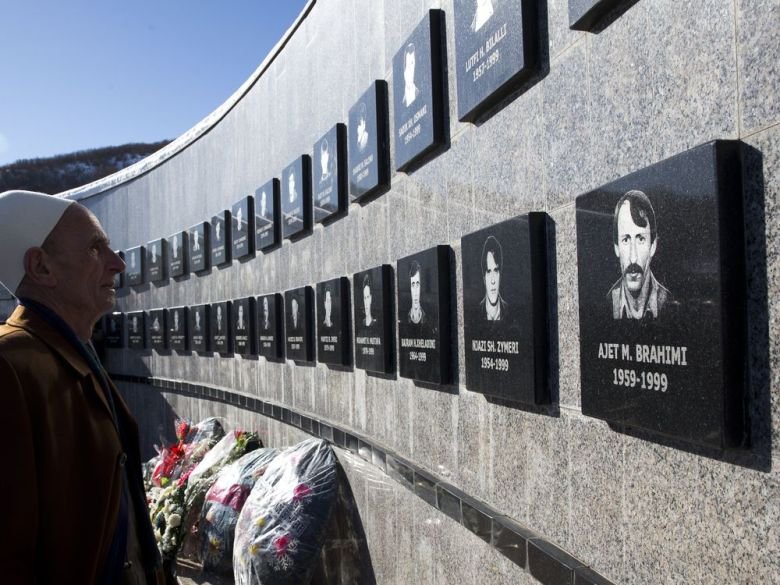
As Kosovo prepares to open a long-awaited war crimes trial over the 1999 Reçak massacre, survivor Ramë Shabani says true justice cannot be achieved unless those accused are brought before the court.
Shabani, 60, who survived the massacre in the village of Reçak in the municipality of Shtime, said he learned through media reports that proceedings against 21 defendants accused of war crimes would begin on Friday. He added that Kosovo’s institutions had neither informed him about the trial nor invited him to testify.
“I was not informed by any institution about the court proceedings, and I have not received an invitation to appear as a witness,” Shabani told Radio Free Europe/Radio Liberty.
The trial will be conducted in absentia, as none of the 21 defendants are in the custody of Kosovo’s judicial authorities.
Recalling the events of January 15, 1999, Shabani described how Serbian police and military forces launched an assault on Reçak early in the morning. He and his family initially sought refuge in a neighbor’s basement before Serbian forces stormed the house.
“They shelled the house, forced us outside, beat us, and took everything we had in our pockets. Then they brought us to the site of the massacre,” he said.
According to Shabani, the detained civilians were taken to a location known as Kodra e Bebushit, where Serbian forces began executing Albanian civilians.
“They insulted us in Serbian, and I managed to escape down a slope. Seven or eight others behind me were killed,” he recalled.
After Serbian forces withdrew, Shabani returned to the scene and discovered that his brother, Bajrush Shabani, had been killed alongside 11 relatives and more than 30 other villagers. In total, 45 Kosovo Albanian civilians were murdered during the Reçak massacre.
The killings triggered widespread international condemnation and significantly increased pressure on the Serbian regime, contributing to the diplomatic efforts at the Rambouillet peace talks. Following the collapse of those negotiations, NATO launched its 78-day air campaign against the Federal Republic of Yugoslavia, ultimately leading to the withdrawal of Serbian military and police forces from Kosovo.
Despite the historic significance of the upcoming proceedings, Shabani remains skeptical that a trial conducted without the accused present can deliver meaningful justice.
“I want a fair verdict, but this cannot bring justice. Those 21 people whose names have been identified will never come to Kosovo, and our authorities will never be able to arrest them. Without them sitting in the courtroom, justice cannot truly be served,” he said.
He nevertheless described the proceedings as an important symbolic acknowledgment by Kosovo’s institutions.
“For me, it is at least recognition that what happened in Reçak is being acknowledged and that our institutions are trying to do something, even if it cannot fully deliver justice,” he added.
The Special Prosecutor’s Office of Kosovo filed the indictment in December 2025 against 21 former members of the Yugoslav Army’s 243rd Mechanized Brigade of the Third Army—known as the Priština Corps—and Serbia’s Ministry of Internal Affairs. They are charged with war crimes against the civilian population, including murder, inhumane treatment, forced displacement, ethnic cleansing, and the destruction of civilian property during operations in Reçak.
According to the indictment, Serbian forces surrounded the village from several directions, shelled residential areas, searched homes, separated men from women and children, expelled civilians, and executed detained Albanian men.
Separately, Kosovo authorities arrested five ethnic Serbian suspects in June as part of the “Reçak II” investigation into the massacre. Prosecutors allege the suspects were members of Serbian special police units involved in the January 1999 operation, while a sixth suspect remains at large.
For Shabani, however, the passage of time has already denied many families the justice they sought.
“Most of the victims’ parents have already died. They never lived to see justice. They died with their eyes still waiting for it,” he said.