
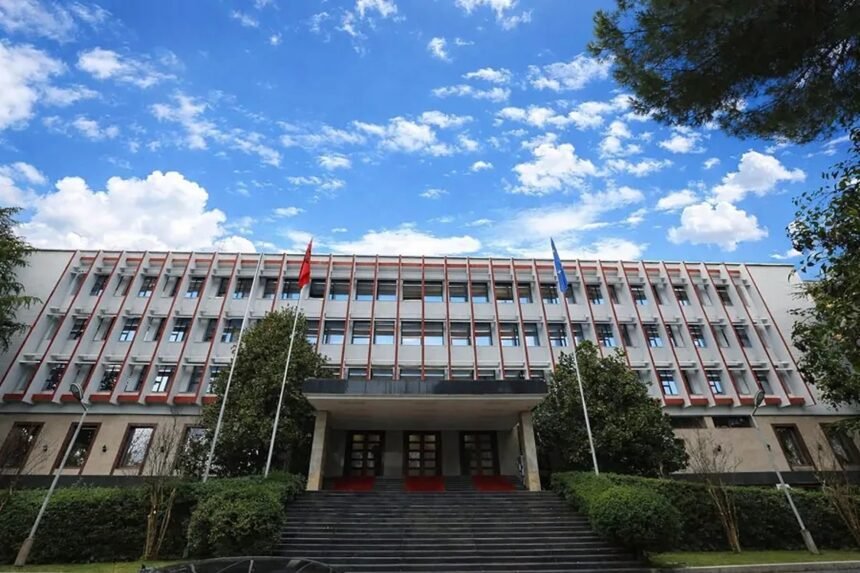
Albania’s Ministry for Europe and Foreign Affairs has stated that any attempt to draw parallels between Kosovo and other international situations is “wrong, opportunistic, and deeply misleading,” while reaffirming its support for Kosovo’s independence and sovereignty.
The reaction from Albanian diplomacy comes in the context of Ukrainian President Volodymyr Zelenskyy’s visit to Serbia, which Tirana officially described as significant.
“There should be no misunderstanding on this point: any attempt to draw a parallel or establish an equation between Kosovo and any other international situation is wrong, opportunistic, and deeply misleading,” the statement said.
The ministry emphasized that, alongside its strong support for Ukraine’s sovereignty, independence, territorial integrity, and European future, Albania remains equally committed to Kosovo and its Euro-Atlantic perspective.
According to Albanian diplomacy, the issue of Kosovo rests on its own historical, political, and legal foundations, also recalling the advisory opinion of the International Court of Justice regarding Kosovo’s declaration of independence.
“At the request of the United Nations General Assembly, the International Court of Justice was unequivocal: Kosovo’s declaration of independence did not violate international law,” the statement emphasized.
The statement draws a clear distinction between the case of Kosovo and Russia’s aggression against Ukraine, which it describes as a serious violation of the United Nations Charter and international law.
Tirana has emphasized that a peaceful, stable, and European Western Balkans requires recognition of the reality and irreversibility of Kosovo’s independence.
“Kosovo’s independence has contributed to regional stability and is part of a future in which borders are not changed through force, and peoples and communities can determine their future in peace and security,” the statement continued.
Albania reiterated its position that Kosovo and Serbia belong to a common European future, while the normalization of relations between them should ultimately lead to mutual recognition.
According to the ministry, such a development would not weaken Serbia, but would help close one of the most painful chapters in the region’s recent history and pave the way for reconciliation, good neighborly relations, and lasting peace.
Regarding Zelenskyy’s visit to Serbia, Albanian diplomacy assessed that the visit primarily advances Ukraine’s interests, but that any step that moves Belgrade away from Russian influence and closer to Europe is positive.
“Every engagement is also an opportunity to advance a fundamental understanding: the Western Balkans must move forward, not backward,” the statement concluded.
A day earlier, Ukrainian President Volodymyr Zelenskyy said that Ukraine would not recognize Kosovo’s independence.
Zelenskyy made the statement during his visit to Serbia and meetings with Serbian President Aleksandar Vučić.
“Our position on the non-recognition of Kosovo remains unchanged. We are grateful to Serbia for respecting Ukraine’s territorial integrity, including, of course, Crimea. Serbia’s position is not changing, including at the United Nations,” Zelenskyy said in Belgrade.
It should be recalled that Kosovo has supported Ukraine since the beginning of the war between Ukraine and Russia.