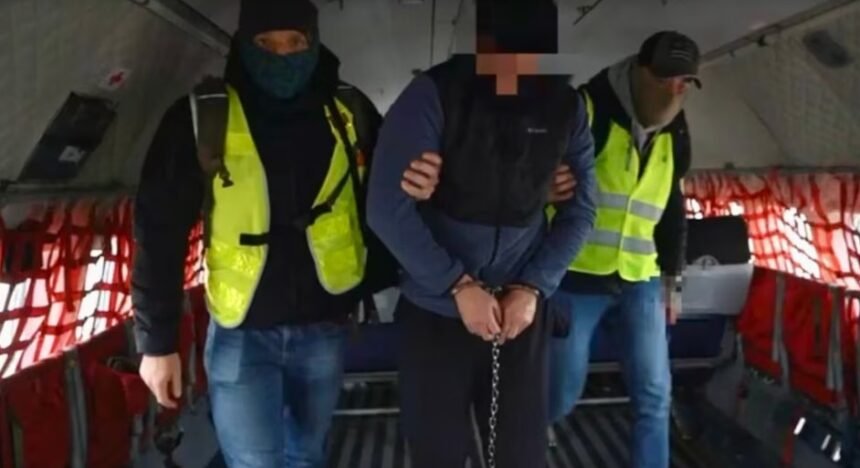
A Russian national arrested in Bosnia and Herzegovina has emerged as a key figure in a wider European investigation into suspected sabotage operations allegedly linked to Russian military intelligence, as prosecutors in Poland examine a network accused of sending incendiary devices through international logistics routes.
Aleksandr Bezrukavyi, who was extradited from Bosnia and Herzegovina to Poland in February 2025, has recently begun giving evidence before a court in Warsaw. Polish prosecutors accuse him of participating in a network that prepared test shipments to the United States and Canada as part of an operation they say was designed to assess delivery routes and logistics systems before potentially sending incendiary or explosive materials.
The investigation has drawn renewed attention following a separate security incident at Leipzig/Halle Airport in Germany in early August 2026, where a drone carrying an unidentified explosive device was discovered near a runway.
The latest incident has not been officially linked to the 2024 sabotage cases. However, Leipzig/Halle was also the site of one of the most serious incidents examined by European investigators: a shipment containing a concealed incendiary device caught fire at a DHL cargo facility in July 2024 shortly before it was due to be loaded onto an aircraft bound for the United Kingdom.
Five defendants on trial in Warsaw
Polish prosecutors filed charges in January 2026 against five people — Russian national Aleksandr Bezrukavyi and Ukrainian nationals Vyacheslav Chabanenko, Vladislav B., Vladislav D. and Serhiy Y. — over their alleged involvement in the shipment operation.
According to the indictment, which Radio Free Europe obtained from the Warsaw court, Bezrukavyi was part of a group responsible for preparing test shipments to the United States and Canada.
The shipments were allegedly intended to determine transportation routes, delivery times and the reliability of logistics networks before the network moved to more dangerous operations.
Prosecutors say the alleged network deliberately divided responsibilities among its members so that individual participants had limited knowledge of the broader operation.
According to the indictment, four shipments were sent from Lithuania in July 2024, with two destined for the United Kingdom and two for Poland.
The packages reportedly contained massage cushions, cosmetics and other consumer goods concealing incendiary mechanisms and flammable chemical substances.
One shipment caught fire on July 20, 2024, at a DHL cargo facility at Leipzig/Halle Airport in Germany shortly before it was scheduled to be loaded onto a flight to the United Kingdom.
Another caught fire two days later at a DHL facility in Birmingham, while a third caused a fire in a truck trailer in Poland.
The defendants face sentences ranging from several years in prison to life imprisonment, depending on the charges and the roles prosecutors allege they played.
Investigation spans several European countries
The investigation has involved authorities in Germany, Lithuania, Poland, the Netherlands and the United Kingdom.
According to Eurojust, European investigators identified 22 suspects in Lithuania and Poland who are allegedly connected to operations carried out on behalf of Russian military intelligence.
Investigators say some suspects were recruited through online platforms, with tasks divided among numerous individuals and payments frequently made in cryptocurrency.
The suspects include citizens of Russia, Ukraine, Lithuania, Latvia and Estonia. Investigators have said that many were recruited from difficult social or economic circumstances.
How Bezrukavyi ended up in Bosnia
Bezrukavyi was arrested in November 2024 in Bosanska Krupa, northwestern Bosnia and Herzegovina, after being found with forged Spanish documents.
Initial reports suggested that he could have been connected to Russian groups allegedly training Moldovan citizens to provoke unrest in Bosnia and Serbia. Those allegations were later determined to be unfounded.
According to later reporting, Bezrukavyi had entered Bosnia and Herzegovina in February 2024, apparently from Turkey. He subsequently crossed illegally into Croatia and traveled through several European Union countries before returning to Bosnia.
Bosnian intelligence authorities located him in Bosanska Krupa on November 15, 2024, one day after he had allegedly entered the country illegally from Croatia. He was arrested that evening in a rented apartment together with local police.
Authorities also found an expired Russian passport in his possession.
Bezrukavyi remained in custody at the state prison in Istočno Sarajevo while Bosnia and Herzegovina considered competing extradition requests.
Poland had issued an Interpol arrest warrant for him, while Russia also sought his extradition over separate allegations involving illegal possession of weapons and narcotics and suspected theft.
During proceedings before the Court of Bosnia and Herzegovina, Bezrukavyi denied involvement in the crimes alleged by Polish authorities. He reportedly sought extradition to Russia through an expedited procedure, but the Bosnian authorities ultimately approved his transfer to Poland.
Russia’s request for extradition and the involvement of the Russian Embassy in Bosnia and Herzegovina became part of the proceedings. His lawyer argued that Bezrukavyi would not receive a fair trial in Poland.
Poland sent an aircraft to Bosnia and Herzegovina to take him into custody and transfer him to Poland on February 13, 2025.
Prosecutors allege a carefully organized network
Although the Polish indictment was filed in January, Bezrukavyi only recently began presenting his defense before the Warsaw court.
He denies knowing the purpose of the shipments described in the indictment.
During the proceedings, he also discussed communications with an individual operating the Telegram account “VWarrior,” which prosecutors say appeared repeatedly in the investigation as a channel through which members of the network received instructions.
According to the Polish prosecution, the network operated according to predetermined roles.
Some participants allegedly transported and stored materials, while others collected, packaged and delivered shipments or provided logistical assistance.
Prosecutors allege that one defendant traveled from Warsaw to Kaunas, Lithuania, in mid-July 2024 and collected bags containing massage cushions, cosmetics and other items.
The indictment alleges that incendiary devices designed to start fires were concealed inside massage cushions, while packages containing cosmetic products allegedly contained a mixture of chemicals capable of causing combustion.
The shipments were subsequently transported to Vilnius, where prosecutors say they were activated, repackaged and sent onward to Poland and the United Kingdom.
According to the indictment, two packages were destined for Warsaw, one for London and one for Birmingham.
The consequences followed within days.
On July 20, 2024, one shipment caught fire at the DHL cargo center at Leipzig/Halle Airport shortly before it was due to be loaded onto a flight to the United Kingdom.
Another caused a fire at a DHL facility in Birmingham, while a third triggered a fire inside a truck trailer in Poland.
In a separate trial in Lithuania, a DHL representative testified in early August that the Leipzig shipment narrowly avoided causing a fire aboard an aircraft because of a delay.
According to his testimony, the incendiary device activated only minutes after the scheduled departure time. The container that caught fire in Leipzig reportedly contained as many as 140 shipments.
Bezrukavyi allegedly prepared the next phase
Unlike several of the other defendants, Bezrukavyi is not accused of directly sending the packages that caught fire in Germany, Britain and Poland.
Instead, prosecutors allege that his role was to prepare the next stage of the operation by testing shipment routes to the United States and Canada.
According to the indictment, he obtained two pairs of shoes and six T-shirts and handed them to one of the Ukrainian defendants with instructions to send them to addresses in the United States and Canada.
On August 1, 2024, prosecutors allege, the defendant sent two packages by courier to the United States and Canada on Bezrukavyi’s instructions.
The purpose, according to the prosecution, was to test the security and reliability of the delivery channel, including transportation routes, delivery times and the time required for packages to reach the specified addresses.
Prosecutors allege that the information obtained through those test shipments could later have been used to send packages containing explosive and incendiary materials by air.
Bezrukavyi’s defense rejects the allegations. His lawyer did not respond to a request for comment from Radio Free Europe.
Another defendant, Ukrainian national Vyacheslav Chabanenko, has also claimed that he did not know the packages he transported contained incendiary devices.
Chabanenko reportedly told the court that he acted on instructions from people with whom he communicated through Telegram and was unaware of the contents of the packages.
He also claimed that Bezrukavyi did not know what the items used in the test shipments to the United States and Canada contained, according to Novaya Gazeta.
Polish prosecutors reject those claims and maintain that the defendants were members of an organized network involved in a broader sabotage operation targeting European logistics and aviation infrastructure.
Leipzig again at the center of security concerns
The investigation into the 2024 shipments has gained additional attention because Leipzig/Halle Airport was again at the center of serious security incidents in August 2026.
German authorities reported two significant incidents that temporarily disrupted and diverted flights.
Leipzig police said an unidentified flying object was observed near the airport late on August 4, prompting several aircraft, including a passenger plane, to be diverted to other airports.
A drone carrying what authorities described as a suspicious object was subsequently discovered near one of the airport’s two main runways.
The Dresden Public Prosecutor’s Office and the Saxony State Criminal Police Office, which are leading the investigation, said the drone was carrying an unidentified explosive device.
German authorities have not established any connection between the latest Leipzig incident and the 2024 shipment investigation.
Nevertheless, Interior Minister Alexander Dobrindt has warned that Germany faces continuing hybrid threats from abroad, including espionage, sabotage and other covert operations.
Following the Leipzig incidents, German media reported that the government was considering further measures to strengthen the country’s defenses against drones.
Poland, Lithuania, Latvia and Estonia have also taken steps to strengthen protection of critical infrastructure amid growing concerns over potential hybrid operations and sabotage.
Security services in the region have additionally warned about the possibility of so-called false-flag operations, in which drone attacks could be carried out in a way intended to make Ukraine appear responsible.
The investigation into Bezrukavyi and the wider European network therefore remains significant not only because of the 2024 DHL incidents, but also because of growing concern across Europe that covert sabotage operations could increasingly target civilian logistics, aviation and other critical infrastructure.