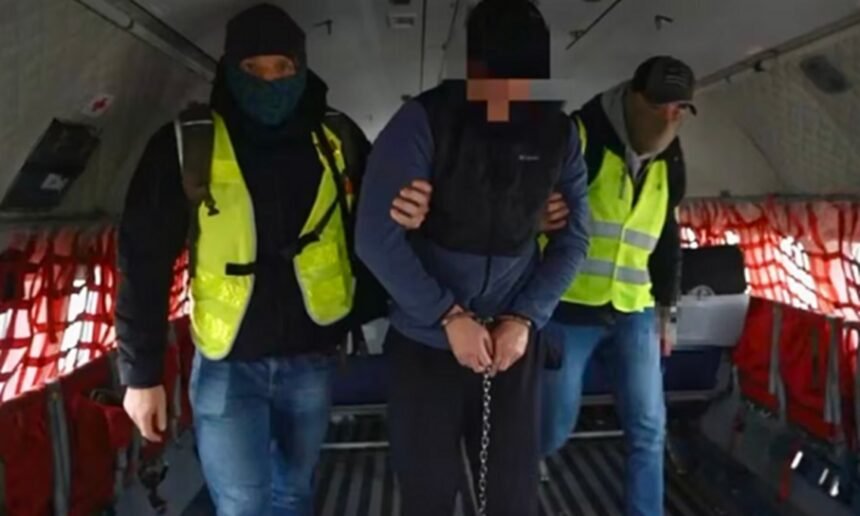
A year and a half after being extradited from Bosnia and Herzegovina, Russian national Aleksandar Bezrukavji has begun testifying before a court in Warsaw about his alleged role in a case involving shipments containing incendiary devices, which Polish prosecutors link to activity carried out on behalf of Russian intelligence.
One of the incidents included in the wider investigation was the fire that broke out in July 2024 at the DHL cargo facility at Leipzig/Halle Airport in Germany, when a shipment containing a concealed incendiary device caught fire shortly before it was due to be loaded onto a plane bound for the United Kingdom.
According to the indictment, Bezrukavji was part of a network of individuals and is accused of preparing test shipments to the United States and Canada.
The case has drawn renewed attention after German authorities launched an investigation in early August 2026 into a new security incident at the same airport, where a drone carrying an explosive device was found near the runway.
While details of the new incident in Leipzig remain unclear, separate proceedings are underway in courts in Poland and Lithuania against individuals whom investigators link to suspected sabotage operations carried out during the summer of 2024.
Five Defendants Before a Warsaw Court
In early January 2026, Polish prosecutors indicted five people: Russian national Aleksandar Bezrukavji and Ukrainian nationals Vjacheslav Chabanenko, Vladislav B., Vladislav D. and Serhiy Y., over their alleged roles in an operation involving the shipment of packages containing incendiary devices.
According to the indictment, obtained anonymously by Radio Free Europe from the Warsaw court, Bezrukavji was part of the group and had the specific task of preparing test shipments to the United States and Canada.
The shipments were intended to test routes, transportation times and the functioning of the logistics chain.
Five hearings have been held so far, while Bezrukavji has remained in pre-trial detention since his extradition. His detention has been extended until November 11, 2026.
According to prosecutors, the tasks were divided in such a way that some members of the group were not fully aware of the entire operation.
Prosecutors allege that one of the defendants organized the shipment of four packages from Lithuania in July 2024, two of which were destined for the United Kingdom and two for Poland.
The packages contained massage pillows, cosmetic products and sex toys, inside which incendiary mechanisms and flammable chemical substances had allegedly been concealed.
One shipment caught fire on July 20, 2024, at the DHL cargo facility at Leipzig/Halle Airport in Germany, shortly before it was due to be loaded onto a plane bound for the United Kingdom.
A second caught fire two days later at a DHL warehouse in Birmingham, while a third caused a fire in the trailer of a truck in Poland.
The defendants face sentences ranging from several years in prison to life imprisonment, depending on the roles prosecutors attribute to them in the alleged operation.
Joint Investigation Involving Several European Countries
According to Eurojust data, the investigation involving Germany, Lithuania, Poland, the Netherlands and the United Kingdom identified a total of 22 suspects in Lithuania and Poland who allegedly acted in the interests of Russian military intelligence.
The joint European investigation found that suspects were recruited through online platforms, tasks were divided among several individuals, and payments were often made in cryptocurrency.
European investigators say the suspects included nationals of Russia, Ukraine, Lithuania, Latvia and Estonia, many of whom were living in difficult social or economic circumstances.
How Did Bezrukavji End Up in Bosnia and Herzegovina?
In November 2024, a Russian national carrying forged Spanish documents was arrested in the city of Bosanska Krupa, in northwestern Bosnia and Herzegovina.
These were the first media reports about Aleksandar Bezrukavji.
Initial information released by local police suggested that he might have been linked to Russian groups training Moldovan nationals to provoke unrest in Bosnia and Herzegovina and Serbia, after information about such activities had emerged earlier. However, this later proved to be inaccurate.
Bezrukavji first entered Bosnia and Herzegovina in February 2024, reportedly most likely from Turkey. He later illegally crossed into Croatia and, over several months, visited several EU countries, apparently using new documents, which he was later found carrying in Bosanska Krupa.
Bosnia and Herzegovina’s Intelligence-Security Agency located him on November 15 in Bosanska Krupa, one day after he had illegally entered from Croatia. He was arrested in cooperation with local police that evening at a private accommodation he had rented.
He was also found in possession of an invalid and expired Russian passport.
Until his extradition to Poland, which had issued an international arrest warrant through INTERPOL, he was held at the State Prison in East Sarajevo.
During several hearings before the Court of Bosnia and Herzegovina in late 2024 and early 2025, he denied any connection to the activities of which he was accused by Poland.
While the decision by the Bosnian court and Ministry of Justice on his extradition to Poland was pending, Russia also requested his extradition, accusing him of alleged criminal offenses involving illegal possession of weapons and narcotics, as well as suspected theft.
During a hearing, he said he wanted to be extradited to Russia through an expedited procedure, but this did not happen.
During the extradition proceedings in Bosnia and Herzegovina, the Russian Embassy in the country also became involved, while his lawyer argued that if extradited to Poland, he would not receive a fair trial there.
Poland sent a plane to collect him, and on February 13, 2025, he was deported from Bosnia and Herzegovina to Poland.
Details From the Trials in Poland and Lithuania
Although the Polish indictment was filed in early January, Bezrukavji has only begun presenting his defense before the Warsaw court in recent weeks. He denies knowing what the shipments mentioned in the indictment were intended for.
During questioning, he also spoke about communications with the person behind the “VWarrior” account on Telegram, which is mentioned several times in the indictment as a channel through which some defendants received instructions regarding tasks connected to the shipments.
Polish prosecutors allege that the network operated according to predetermined roles.
While some members were responsible for transporting and storing materials, others received, packaged and shipped the packages or provided logistical support.
According to the indictment, one of the defendants traveled from Warsaw to the Lithuanian city of Kaunas in mid-July 2024, where he collected bags containing massage pillows, cosmetic products and other items from a vehicle.
Prosecutors allege that incendiary devices had been hidden inside the massage pillows, while the cosmetic packaging contained a mixture of nitromethane, nitrocellulose and titanium oxide.
The shipments were then transported to Vilnius, where they were activated, repackaged and sent toward Poland and the United Kingdom. According to the indictment, two shipments were destined for Warsaw, one for London and one for Birmingham.
The consequences occurred several days later. One shipment caught fire on July 20, 2024, at the DHL cargo facility at Leipzig/Halle Airport in Germany, shortly before it was due to be loaded onto a plane that was scheduled to continue to the United Kingdom.
A second caught fire at the DHL warehouse in Birmingham, while a third caused a fire in the trailer of a truck in Poland.
In a separate trial taking place in Lithuania, a DHL representative testified in early August that the aircraft in Leipzig escaped a fire during flight only because its departure had been delayed.
According to his testimony, the incendiary device activated only a few minutes after the scheduled departure time. Up to 140 shipments were inside the container that caught fire in Leipzig, the witness said.
Unlike the other defendants, Bezrukavji is not accused of sending the packages that caught fire in Germany, the United Kingdom and Poland.
Prosecutors allege that his role was to prepare the next phase of the operation, which involved test shipments to the United States and Canada.
According to the indictment, he purchased two pairs of shoes and six short-sleeved shirts, which he handed over to one of the Ukrainian defendants, instructing him to send them to addresses in the United States and Canada.
On August 1, 2024, the other defendant, allegedly acting on Bezrukavji’s instructions, sent two packages by courier to the United States and Canada. The purpose was to test the secure transfer channel, including the courier service’s delivery time and route, as well as the time required for the packages to reach the designated addresses.
The information obtained would later be used to send packages containing explosive and incendiary materials by air, constituting a terrorist act intended to endanger a large number of people, according to the indictment.
Radio Free Europe attempted to contact the Russian defendant’s defense lawyer but received no response.
According to reports from the trial, one of the defendants, Ukrainian national Vjacheslav Chabanenko, claimed that he did not know the items he collected and transported contained incendiary devices.
During questioning, he said he acted according to instructions from people with whom he communicated through Telegram and did not know what was inside the packages.
Chabanenko also claimed that Bezrukavji did not know what was inside the items used for the test shipments to the United States and Canada, Novaya Gazeta reported.
Polish prosecutors reject these claims, saying the defendants acted as part of a pre-organized network whose purpose was to carry out sabotage against logistics and aviation infrastructure.
Leipzig Again, Two Years Later?
While trials continue in Lithuania and Poland over the earlier cases, Leipzig Airport has once again become the focus of attention following “two very serious incidents” that temporarily suspended and diverted flights.
Leipzig police said that on August 4, an “unidentified flying object” was spotted near the airport, leading to several aircraft, including a passenger plane, being diverted to other airports.
A drone carrying a “suspicious object” was also discovered near one of the two main runways.
The Dresden Public Prosecutor’s Office and the Saxony State Criminal Police Office, which are leading the investigation, said the drone found on the runway was carrying an “unknown explosive device.”
Although German authorities have so far not linked the latest incident to the 2024 package case, German Interior Minister Alexander Dobrindt said Germany is targeted every day by hybrid attacks from abroad, including espionage, sabotage and other covert operations.
Following the incidents in Leipzig, German media reported that the government is considering further strengthening its drone-defense systems.
Similar measures have also been taken by Poland, Lithuania, Latvia and Estonia, particularly concerning energy and other critical infrastructure, amid fears of potential hybrid operations and sabotage.
The security services of these countries have warned about the possibility of so-called “false flag” attacks, in which drone attacks could be carried out in a way that makes Ukraine appear responsible, Reuters reported in an analysis following the incident at Leipzig Airport.