A Serbian-language portal has published an unsubstantiated claim that Washington has allegedly offered Serbia territorial gains in exchange for NATO membership and a break with Russia, China and Turkey — a scenario that would involve the fragmentation of Montenegro and North Macedonia.
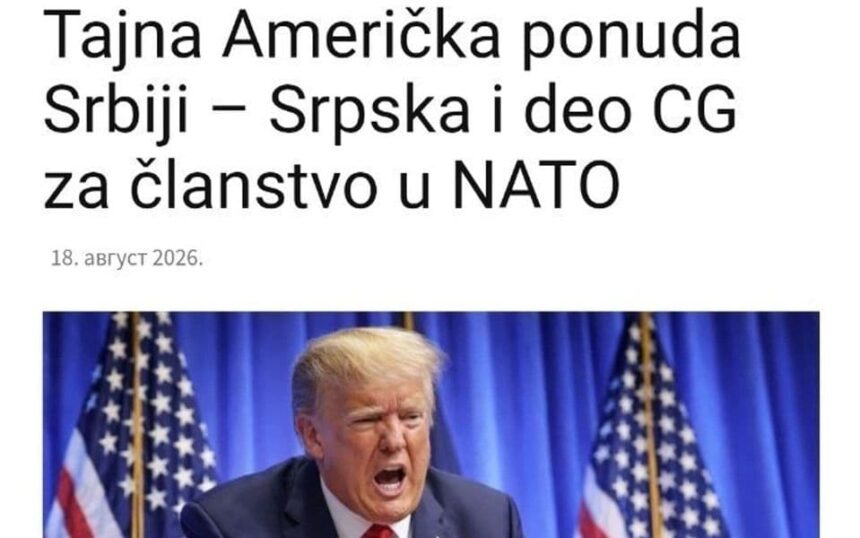
The claim was published by Vidovdan on August 18 under the headline “Secret American Offer to Serbia – Republika Srpska and Part of Montenegro for NATO Membership.” The article provides no documentary evidence, diplomatic source or named U.S. official to support the alleged proposal.
According to the scenario presented by the portal, Serbia would receive Republika Srpska and “most of Montenegro” in exchange for joining NATO and abandoning its strategic ties with Russia, China and Turkey. The remaining parts of Montenegro would allegedly be divided between Croatia and Albania, with the Bay of Kotor linked to Croatia and the Bar and southern areas incorporated into an imagined Albanian territory.
The article also claims that Bosnia and Herzegovina would lose Republika Srpska, while Croatia would receive parts of Bosnia and Herzegovina. North Macedonia, meanwhile, would allegedly be divided into Serbian, Albanian and Bulgarian zones.
Vidovdan presents the alleged territorial changes as part of a broader U.S. strategy for “stabilizing” the Balkans and integrating the region into Euro-Atlantic structures, describing the supposed territorial concessions to Serbia as a major opportunity.
However, the article itself ultimately acknowledges that no official in Washington, Brussels or Belgrade has publicly advocated such a territorial map. It nevertheless proceeds to speculate about alleged “deep state” structures supposedly preparing a redrawing of Balkan borders.
No U.S. government document, diplomatic communication, intelligence assessment or other verifiable evidence is provided to substantiate the claims. The article also offers no source for its assertion that a European war with Russia is allegedly being planned before 2030.
The proposed scenario is also at odds with the publicly stated principles of NATO, which emphasize respect for the sovereignty, political independence and territorial integrity of states.
Montenegro and North Macedonia are already NATO members, having joined the alliance in 2017 and 2020 respectively. NATO has also repeatedly affirmed its support for the sovereignty and territorial integrity of Bosnia and Herzegovina.
The publication comes amid continued political and media debates over Serbia’s foreign policy, its relations with Russia and the West, and competing narratives about the future of the Western Balkans.
The alleged “American offer” should therefore be treated as speculation rather than a documented diplomatic proposal. No evidence presented in the article demonstrates that Washington has proposed dismantling or partitioning Montenegro or North Macedonia, or transferring their territory to neighboring states.
The promotion of hypothetical maps involving the disappearance or partition of internationally recognized countries is particularly sensitive in the Balkans, a region whose recent history includes wars, ethnic displacement and competing territorial projects. Such claims can contribute to nationalist narratives even when they are not supported by verifiable evidence.
Vidovdan describes its mission as supporting ideas and projects consistent with what it calls the Serbian tradition and national interest. In this case, the article uses an alleged Western initiative to advance a territorial vision involving the expansion of Serbia and the fragmentation of neighboring states.