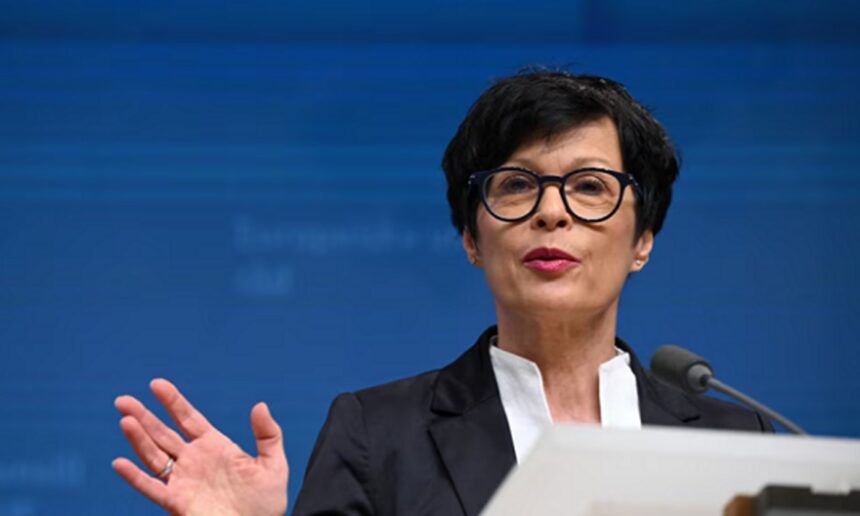
European Commissioner for Enlargement Marta Kos has canceled her planned visit to Serbia, citing the glorification surrounding the death and return of convicted war criminal Ratko Mladić.
In a statement posted on X, Kos said Mladić’s return to Belgrade and the public honours surrounding his death were incompatible with the values underpinning Serbia’s path toward European Union membership.
“Ratko Mladić was convicted of genocide, crimes against humanity and war crimes,” Kos wrote. “The glorification accompanying his death is incompatible with the values on which the EU path is built.”
She stressed that European integration requires countries seeking membership to confront their past, pursue genuine reconciliation and respect the victims of war crimes.
“The values underpinning our common future are not negotiable,” Kos said, adding that, in this context, she had decided not to proceed with her planned visit to Serbia “for the time being.”
The decision represents one of the clearest signals yet from Brussels that the treatment of Mladić is not being viewed as a purely domestic or family matter.
Mladić, the former commander of the Bosnian Serb Army, died in The Hague on August 27 while serving a life sentence. He had been convicted of genocide, crimes against humanity and war crimes committed during the 1992–1995 Bosnian war.
His remains were returned to Belgrade on September 3 aboard a Serbian government aircraft. Serbian Justice Minister Nenad Vujić accompanied members of Mladić’s family, while the coffin was received in Belgrade with Serbian military personnel and covered with the Serbian flag.
The Serbian government’s involvement, combined with plans for public commemorations and a funeral in Belgrade, has triggered growing concern among European officials.
Kos had already warned that Serbia’s handling of Mladić’s death and funeral would be an important test of the country’s European trajectory. The European Commission has likewise stressed that the glorification of convicted war criminals is incompatible with fundamental European values.
Kos was expected to meet Serbian government officials, opposition representatives, civil society and other stakeholders during her planned visit next week. The meetings scheduled for September 10 have now been canceled, according to Serbian media.
The message from Brussels is therefore becoming increasingly difficult to misunderstand:
EU integration is not only about reforms on paper. It is also about how a country confronts the crimes of its past, treats their victims and responds to those convicted of the most serious international crimes.
For Serbia, the controversy surrounding Mladić is no longer confined to Belgrade.
It has reached the heart of its European accession process.