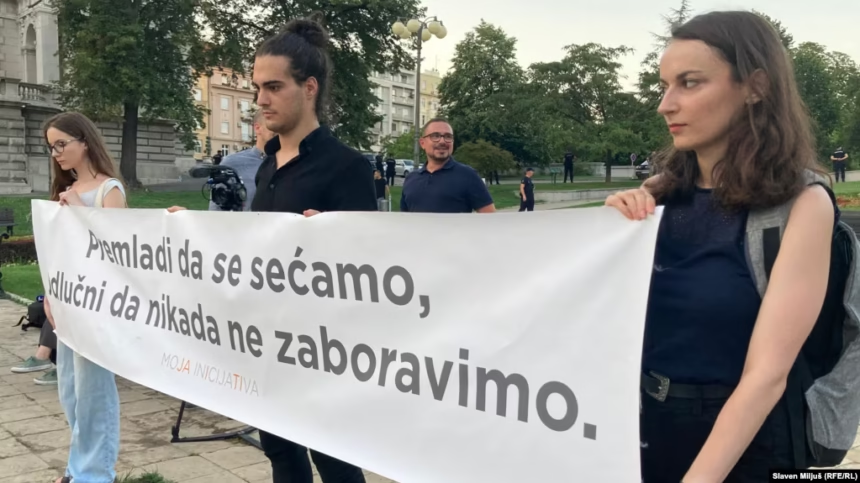
The Youth Initiative for Human Rights in Serbia has condemned what it described as the misuse of state resources to transport the body of former Bosnian Serb military commander Ratko Mladić and organize an announced state commemoration for the convicted war criminal.
In a statement, the organization argued that Mladić lost his military rank and associated rights in the Serbian Armed Forces following his final conviction for genocide and other crimes, meaning that he was no longer entitled to state or military honors.
“By honoring a war criminal, the Government of Serbia and the Ministry of Defense violated the Law on the Army,” the organization said.
The Youth Initiative also accused Serbian authorities of creating an atmosphere over the previous week in which the denial of war crimes, particularly the Srebrenica genocide, was being promoted in public discourse.
According to the organization, Mladić’s coffin was covered with the flags of Serbia and Republika Srpska and was carried from an aircraft by six members of the Serbian Armed Forces in military uniforms.
The organization also criticized the announced state commemoration at the House of the Serbian Army in Belgrade, saying the event would represent another example of state institutions honoring a convicted war criminal.
The group further condemned the police and military personnel who saluted during the transport convoy carrying Mladić’s body, describing the gesture as an insult to the victims of his crimes as well as to Serbian prosecutors and police officers who had previously arrested him and brought him before international justice.
Criticism of Serbian officials
The Youth Initiative accused Defense Minister Bratislav Vujić and President Aleksandar Vučić of acting as public defenders of Mladić in recent days.
The organization particularly criticized statements questioning the medical treatment provided to Mladić by the International Residual Mechanism for Criminal Tribunals, calling the remarks deeply immoral and arguing that Serbian citizens would ultimately be ashamed of such conduct by government officials.
Mladić died on August 27 while receiving hospital treatment at the UN detention facility in The Hague. He is scheduled to be buried on September 7 at Topčider Cemetery in Belgrade.
The International Criminal Tribunal for the former Yugoslavia sentenced Mladić to life imprisonment in 2021. His conviction included genocide committed against approximately 8,000 Bosniak men and boys in Srebrenica in July 1995, as well as persecution and forcible transfer of Bosniak and Croat civilians, the terror campaign against civilians during the siege of Sarajevo and the taking of UN peacekeepers hostage.
The controversy surrounding his death and burial has reignited a broader debate in Serbia and across the region over the glorification of convicted war criminals, the legacy of the Bosnian war and Serbia’s approach to confronting the crimes of the 1990s.