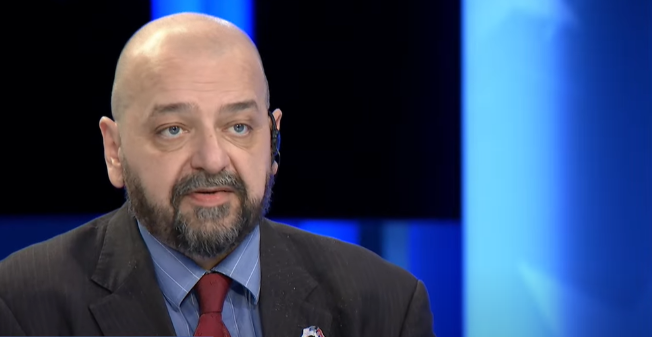
Serbia’s next parliamentary elections risk becoming a contest between two competing forms of populism rather than a genuine debate over the country’s future, former Serbian politician and Vučić ally Dragan Šormaz argues.
In an analysis published by The GeoPost, Šormaz says the emerging political camps may differ in their approach and rhetoric, but neither has so far demonstrated the willingness to make Serbia’s European future the central question of the election campaign.
Instead, he argues, voters are likely to hear familiar arguments about Kosovo, national betrayal, sanctions against Russia, sovereignty, foreign influence and lithium, while fundamental questions about Serbia’s institutions, economy, demographics and long-term geopolitical direction remain secondary.
According to Šormaz, the central question of the elections should be whether Serbia intends to become a member of the European Union.
He argues that EU membership is not simply a question of flags, ideology or attitudes toward Brussels, but one that would determine Serbia’s economic, political, security and institutional direction.
“It is the question of the market in which we will sell our goods, the system in which our economy will operate, the standards according to which our citizens will live and the alliances that will determine our position in the world,” Šormaz writes.
Two populist camps, one nationalist framework
Šormaz argues that the political confrontation is likely to develop between supporters of Aleksandar Vučić’s ruling system and opposition forces, including political and student movements that have emerged as major challengers to the government.
While the confrontation is genuine, he says, much of the political language remains rooted in nationalism, populism and geopolitical ambiguity.
The ruling camp is expected to accuse its opponents of betraying Serbia, while parts of the opposition accuse the government of compromising national interests for relations with the EU and Western investors.
According to Šormaz, both sides risk competing over who can present the stronger nationalist message rather than offering fundamentally different visions for Serbia’s future.
He is particularly critical of political groups that describe themselves as pro-European while simultaneously portraying the EU as an enemy, a colonial power or an actor primarily interested in Serbia’s lithium resources.
Criticism of Brussels is legitimate, he acknowledges, arguing that EU policy toward Serbia has often been inconsistent, bureaucratic and overly focused on stability.
But he distinguishes between criticizing specific European policies and systematically presenting the EU as a hostile power seeking to turn Serbia into a colony.
“When for years you tell citizens that Brussels remains silent about autocracy because of lithium… you cannot then expect citizens on election day to believe that you are the leaders of a European Serbia,” Šormaz argues.
Serbia’s geopolitical “gray zone”
Šormaz also warns against what he sees as Serbia’s continued attempt to balance between competing geopolitical centers without making a clear strategic choice.
Serbia is a relatively small country in geographic, demographic and economic terms, he argues, and therefore cannot afford a foreign policy based on myths of geopolitical grandeur.
He identifies several principles that he believes should guide the country.
First, strategic foreign policy should take precedence over short-term domestic political calculations.
Second, economic interests should be considered alongside foreign policy rather than being subordinated to geopolitical narratives. Serbia conducts most of its trade and maintains extensive economic ties with the EU while simultaneously allowing anti-EU rhetoric to dominate parts of its political discourse.
Third, strategic objectives should not contradict one another.
Šormaz argues that Serbia cannot realistically pursue EU membership while simultaneously building domestic politics around anti-EU sentiment, embrace European values while relativizing authoritarian models elsewhere, or seek integration into European economic and security structures while politically signaling loyalty to Vladimir Putin’s Russia.
Responsibility also lies with the opposition
Šormaz places much of the responsibility for the current political landscape on the opposition as well as the government.
He argues that after years of Vučić’s rule, the European idea has been pushed toward the margins of Serbia’s political debate. But rather than offering a clear alternative, parts of the opposition have adopted similar nationalist language.
The government accuses opponents of treason, while some opposition forces accuse the government of effectively selling Serbia’s interests to the EU over lithium.
The result, Šormaz argues, is a political space dominated by competing forms of nationalism rather than a coherent European alternative.
He says Serbia needs a political force willing to tell voters that the country cannot remain indefinitely in a geopolitical gray zone.
There is, he argues, no sustainable future in imitating Russian politics or seeking refuge in an authoritarian model associated with China, while simultaneously expecting to benefit from European markets, investment and standards.
The cost of postponing the decision
The greatest danger, according to Šormaz, is that Serbian voters may once again be offered the illusion of choice without being presented with genuinely different visions for the country’s future.
Political campaigns can offer different candidates, slogans and coalitions, he argues, while leaving the most important strategic question unanswered.
Meanwhile, Serbia’s underlying problems will remain: demographic decline, youth emigration, weak institutions and the need for sustainable economic development.
“Serbia today risks becoming a country that formally has elections but has no real choice for its future,” Šormaz writes.
He warns that if the country spends another decade avoiding a fundamental strategic decision, it may eventually lose the ability to make that choice on its own terms.
For Šormaz, the central issue is therefore not which political camp can produce the most convincing nationalist message, but whether Serbia is prepared to define a clear European future.
“If Serbia is not European, it will hardly have any serious future,” he concludes.
The views expressed in the article are those of Dragan Šormaz and reflect his political analysis of Serbia’s upcoming elections.