Serbia is deepening its cooperation with China in artificial intelligence, prompting warnings from the United States and the European Union over the technological and political choices being made in Belgrade.
In a response to Radio Free Europe, the U.S. State Department stressed that Serbia’s future economic prospects will depend on political decisions and the choice of partners it makes today.
“The United States encourages Serbia to develop its full potential and ensure its national security by choosing reliable sources and suppliers of AI equipment and technology, as well as trusted partners such as the United States,” the State Department said.
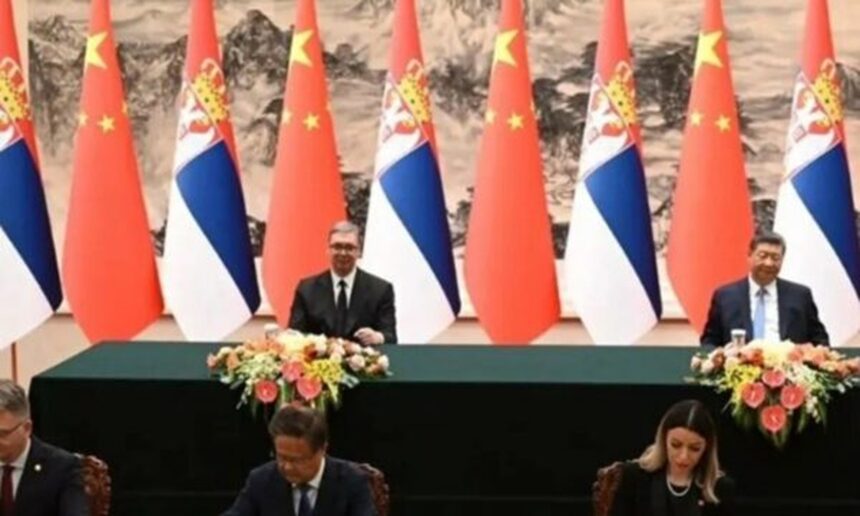
The warning comes after Serbian President Aleksandar Vučić and Chinese President Xi Jinping attended the signing of a memorandum on AI cooperation during Vučić’s visit to Beijing in May.
The agreement was signed on behalf of Serbia by Mihajlo Jovanović, director of the Office for IT and e-Government, while the Chinese side was represented by the National Development and Reform Commission.
Two months later, in July, Serbia joined an agreement establishing the World Artificial Intelligence Cooperation Organization (WAICO), founded in Shanghai.
Alongside Serbia, the other European countries involved are Russia and Belarus, while Iran later joined the organization. The Serbian government had approved the decision to join a month earlier, making Serbia one of the founding members.
Through WAICO, Serbia is expected to gain access to open-source AI models, while Chinese technology could provide a cheaper alternative to solutions developed by Western companies. Programs have also been discussed that could allow Serbian experts to receive training in China through scholarship schemes.
US: Choose Trusted Partners
The U.S. State Department emphasized that Washington remains at the forefront of AI development and presented American technology as a standard for systems developed responsibly and transparently, without ideological interference from governments.
“When countries adopt U.S. AI systems, they are not simply buying infrastructure as consumers — they are opening innovative opportunities for their economies and citizens,” the department said.
Washington has for years viewed China’s rapid development of AI as a national security issue, particularly because of its potential applications in military modernization and surveillance capabilities.
EU Reminds Serbia of Its Commitments
The European Commission has also raised concerns over the growing technological cooperation between Belgrade and Beijing.
Brussels reminded Serbia that, as an EU candidate country, it has committed to aligning its legislation with European Union rules, including regulations governing artificial intelligence.
“As part of the accession process, Serbia has committed to aligning its legislation with these rules,” a European Commission spokesperson told Radio Free Europe.
According to the EU Institute for Security Studies, deeper cooperation with Chinese technology ecosystems could make it more difficult for Serbia to eventually align with EU requirements.
The institute argues that the concern is not limited to individual technologies but also involves Belgrade’s broader strategic orientation.
“For the EU, the main concern is that Serbia is gradually integrating into technological and governance ecosystems that may differ from European ones,” experts at the institute said in their analysis.
Huawei and the Risk of Technological Dependence
Serbia’s technological cooperation with China is not new. It intensified in 2019, when Serbia’s Office for IT and e-Government signed a memorandum with Chinese technology giant Huawei to establish a national platform for AI development.
In 2021, Serbia established its Institute for Artificial Intelligence, while development of the country’s national AI platform continued at the State Data Center in Kragujevac, relying on infrastructure and technologies linked to Huawei.
European experts have warned that this could create long-term technological dependence on China, particularly if the same ecosystem becomes embedded across infrastructure, hardware, cloud services, computing capacity, software, AI models and technical expertise.
According to the experts, connecting these different technological layers can make any future transition to another ecosystem considerably more expensive and politically difficult.
The institute has also pointed to Huawei’s Safe City surveillance system, which is already used in Serbia, raising concerns about data security and the potential for mass surveillance.
Experts warn that combining AI with sensitive data, surveillance infrastructure and dependence on foreign technology providers could increase risks related to cybersecurity and espionage.
Meanwhile, at the end of August, a factory producing humanoid robots was opened in Šabac, Serbia, with the robots intended for export to the EU market.
Serbia has been an official candidate for European Union membership since 2012, but its growing technological alignment with China is increasingly raising questions in Brussels and Washington over how compatible its strategic choices are with its stated European path.