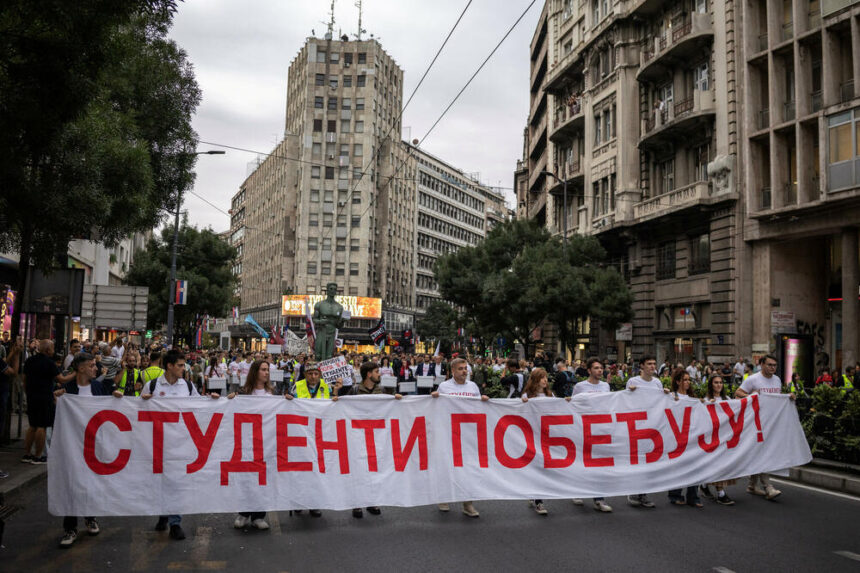
Serbian students and representatives of their electoral list have unveiled an 11-point program they say is designed to help rebuild the country, with proposals ranging from a major overhaul of the police and judiciary to free school textbooks, media reform and more affordable housing.
The program was presented at campaign stands across Vojvodina on Tuesday. According to Nova.rs, the proposals are organized into three broad areas, with the stated goal of stopping what the students describe as systemic theft, recovering misappropriated public funds and redirecting resources toward education and the economy.
“Serbia or the Mafia”
The first section focuses on institutions, corruption and accountability.
The students propose freeing courts and prosecutors from political pressure and establishing a specialized prosecutorial police unit tasked with independently investigating corruption and arresting those responsible without political interference.
They also call for a comprehensive review of the Interior Ministry’s work and the removal of officials and officers allegedly connected to organized crime. The program specifically proposes dismissing police officers who violated service laws during confrontations with protesting students and citizens.
A second proposal calls for legislation on tracing and confiscating illegally acquired assets, alongside a process of vetting public officials. The students want the Tax Administration strengthened to investigate officials’ wealth and recover what they describe as stolen public money.
They also propose reviewing the conduct of public officials and establishing accountability for individuals who abused their positions, engaged in corruption or violated human rights, the Constitution or the law.
Another key demand is full transparency in public procurement and an audit of state projects. The students propose making public all contracts and tenders, strengthening the State Audit Institution and reviewing infrastructure projects they say have been overpriced, delayed or conducted without sufficient transparency.
The program also calls for media reform, including the depoliticization of the Regulatory Authority for Electronic Media (REM), restoring what the students describe as the independence of Serbia’s public broadcaster RTS, and reviewing the responsibility of journalists and management at state and private television stations over alleged discrimination and hate speech.
“Knowledge Is Power”
The second section focuses on education, public-sector employment and economic development.
The students propose ending political appointments in the public sector and replacing party-based recruitment with competitive procedures based on professional qualifications.
They also want public companies to be led by proven experts rather than political appointees and propose stricter financial oversight of their operations.
Education is another central priority. The program calls for modern curricula, critical thinking and practical skills adapted to the 21st century.
It proposes free textbooks for all primary and secondary school students regardless of where they live, as well as more affordable educational trips and extracurricular activities.
The students also want to develop what they call a knowledge-based economy by connecting universities, research institutes and professional associations with businesses.
Their proposals include stronger grants and subsidies for startups, innovation, domestic entrepreneurs and farmers, with the stated aim of moving Serbia away from a low-cost labor model toward a higher-value economy.
“Serbia Grows With Us”
The final section addresses employment, food security, housing and healthcare.
One proposal would amend Serbia’s Labor Law to reduce the maximum period of fixed-term employment from 24 months to 12 months, after which workers would receive open-ended contracts. The students say the measure would reduce prolonged job insecurity and pressure on employees.
They also propose eliminating what they describe as monopolistic practices by importers and interest groups that distort the relationship between production and retail prices.
Agricultural land and water, they say, should receive greater protection as national resources essential to the country’s food security.
The program further proposes affordable housing for young couples and workers in professions facing shortages, including teachers and healthcare workers. Measures would include subsidized rent and purchase schemes as well as tax incentives for young families and key public-sector professionals.
On healthcare, the students call for stronger state control over medicine prices and a substantial reduction in the cost of essential medicines.
They also propose reopening and modernizing rural clinics and health centers and hiring young doctors and medical technicians to ensure basic healthcare is available throughout Serbia, including in rural areas.
The 11-point platform comes amid a broader political mobilization by Serbia’s student movement, which has increasingly sought to translate its demands for institutional accountability and political change into a concrete policy agenda.